
Since 1954, the Bilderberg Meetings have operated through a sophisticated system of concentric circles—from a powerful Steering Committee to rotating participants—creating one of the world’s most influential informal networks. Understanding this structure reveals how global elites coordinate policy discussions beyond public scrutiny.

TL;DR
- The Bilderberg Group operates through a three-tier structure: inner Steering Committee, regular participants, and occasional invitees
- Founded in 1954 at Hotel de Bilderberg in the Netherlands with approximately 50 delegates from 11 countries
- Victor Halberstadt has chaired the 30-40 member Steering Committee since 2019, selecting all topics and attendees
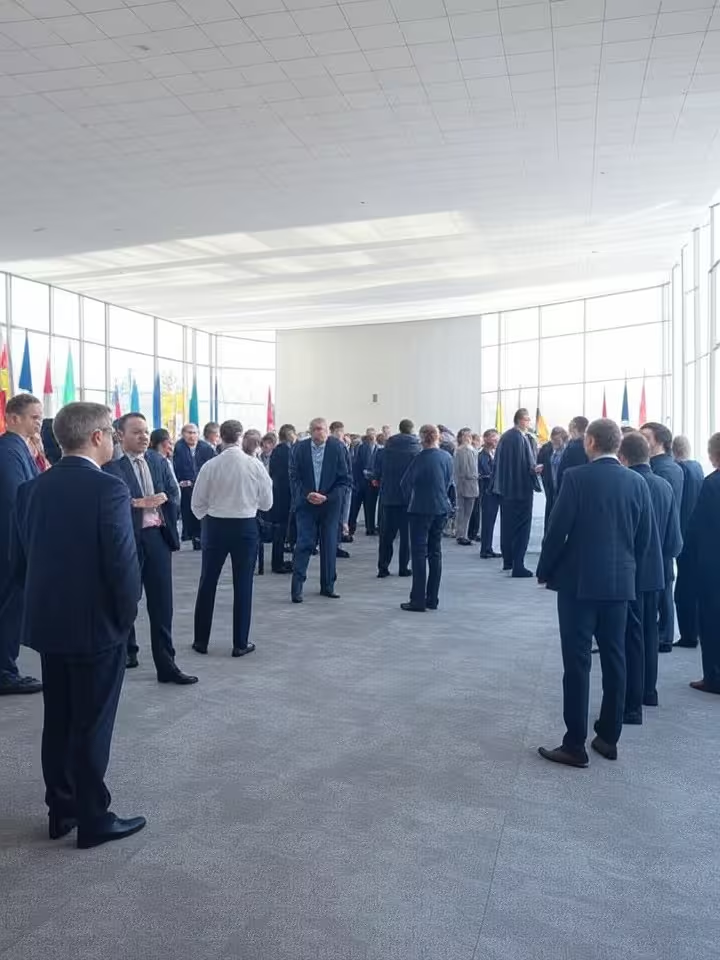
- Annual meetings host around 130 participants from politics, business, media, and academia under strict confidentiality rules
- The Chatham House Rule allows ideas to circulate without attribution, encouraging candid discussions
- Official website publishes participant lists since 2000, balancing transparency with operational secrecy
- No formal membership exists—all attendance is by Steering Committee invitation only
Introduction: Why Bilderberg’s Structure Matters
Every spring, approximately 130 of the world’s most influential leaders gather behind closed doors. No cameras. No press releases. No minutes published. This is the Bilderberg Meeting—an annual conference that has operated since 1954, bringing together prime ministers, CEOs, central bankers, and media executives to discuss the most pressing global issues.
What makes Bilderberg unique isn’t just who attends, but how it’s organized. The group operates through what observers call “circles of power”—a hierarchical structure with a core Steering Committee that controls everything, surrounded by layers of regular and occasional participants. This architecture has remained remarkably consistent for seven decades, creating an informal network that connects political and economic power across continents.
Understanding this structure is crucial because it reveals how modern global governance actually works—not through formal treaties or public institutions, but through private conversations between people who control trillions in assets and shape policy for billions of citizens. While Bilderberg has no legal authority and makes no binding decisions, the relationships formed there influence everything from monetary policy to military interventions.
In this article, you’ll learn:
- The historical origins and evolution of Bilderberg’s organizational structure
- How the Steering Committee functions as the inner circle of power
- The roles of middle and outer participant circles
- Real-world implications of this elite networking architecture
- Evidence-based analysis separating facts from conspiracy theories
Historical Foundations: From Cold War Initiative to Permanent Institution
The 1954 Genesis in Oosterbeek
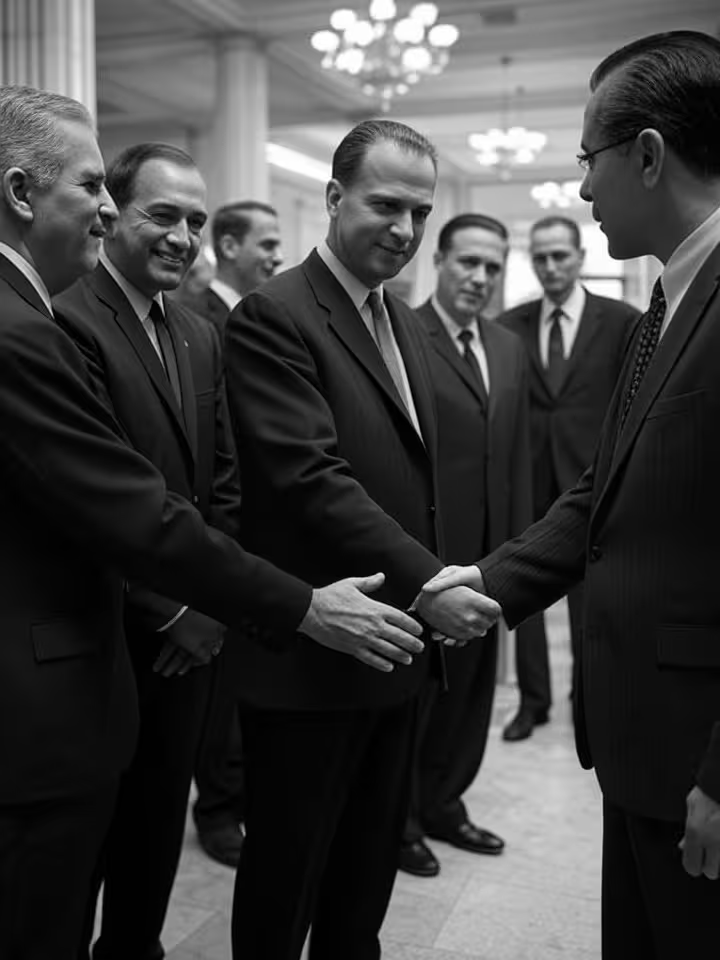
The Bilderberg Meetings originated in May 1954 at the Hotel de Bilderberg in Oosterbeek, Netherlands. The inaugural conference brought together approximately 50 delegates from 11 Western countries for three days of discussions from May 29-31.
The driving force behind this first meeting was Prince Bernhard of the Netherlands, working alongside Polish political advisor Józef Retinger. Their motivation was explicitly political: growing anti-American sentiment in Western Europe threatened the transatlantic alliance at a critical moment in the Cold War. They envisioned a private forum where European and American elites could build personal relationships and coordinate strategy away from public debate.
David Rockefeller became instrumental in funding and expanding the meetings through his foundation and personal networks. His involvement exemplified how organizations like the Council on Foreign Relations intersected with Bilderberg to create overlapping elite networks.
Evolution of the Organizational Structure (1950s-1970s)
By the 1960s, the meetings had established a reliable annual pattern. Locations rotated primarily between Europe and North America—the 1960 meeting in Bürgenstock, Switzerland, focused on East-West relations, while the 1973 gathering in Saltsjöbaden, Sweden, addressed the unfolding oil crisis.
During this formative period, the internal structure crystallized into the concentric circle model still used today:
- Inner Circle: A Steering Committee of long-serving members responsible for planning, invitations, and agenda-setting
- Middle Circle: Regular attendees invited multiple times based on ongoing relevance
- Outer Circle: First-time or occasional participants selected for specific expertise
This architecture allowed fresh perspectives while preserving institutional memory and continuity. The Steering Committee formalized its role as the permanent governing body, meeting several times annually between conferences to prepare agendas based on current events.

Institutional Maturation (1980s-Present)
The chairmanship of the Steering Committee has passed through several notable figures:
- Prince Bernhard (1954-1976)
- Alec Douglas-Home (1977-1980)
- Walter Scheel (1981-1985)
- Victor Halberstadt (2019-present)
A significant transparency evolution occurred in 2000 when Bilderberg began publishing participant lists on its official website (bilderbergmeetings.org). This represented a compromise between operational secrecy and public accountability, though detailed discussions remain strictly confidential.
The COVID-19 pandemic disrupted the pattern for the first time in decades—meetings were canceled in 2020 and 2021, resuming in Washington, D.C. in June 2022. This demonstrated both the group’s resilience and its dependence on in-person networking rather than virtual alternatives.
The Steering Committee: Architecture of the Inner Circle
Composition and Selection Process
The Steering Committee comprises 30-40 members from various countries, representing a balance of nationalities, sectors, and expertise. Current composition includes figures like:
- Victor Halberstadt (Chairman) – Dutch economics professor
- Marie-Josée Kravis – President Emerita of the Hudson Institute
- Marcus Wallenberg – Chairman of Investor AB
Members are nominated and approved internally, creating a self-perpetuating system. There’s no fixed term limit, allowing individuals to serve for decades and build deep institutional knowledge. This continuity has both advantages (consistent vision, historical perspective) and disadvantages (potential insularity, resistance to reform).
Core Responsibilities and Decision-Making
The Steering Committee exercises three primary powers:
- Agenda Setting: Selecting 10-15 topics for each annual conference based on current global challenges
- Participant Selection: Choosing all 130 attendees through a careful balance of sectors, nationalities, and perspectives
- Operational Logistics: Determining meeting location, timing, and security arrangements
For the 2023 meeting in Lisbon, Portugal (May 18-21), the committee selected topics including artificial intelligence, fiscal challenges, and geopolitical realignments. These choices reflect the group’s focus on emerging issues before they dominate public discourse.
The committee’s real power lies not in formal authority—Bilderberg has no legal status and makes no binding decisions—but in its ability to convene the right people at the right time. As one mainstream analysis noted, “The value is in the conversation, not the conclusion.”
Overlapping Networks and Institutional Connections
Steering Committee members typically hold multiple influential positions simultaneously. This creates interlocking networks across:
- The Trilateral Commission (founded by Rockefeller in 1973)
- The Council on Foreign Relations
- The World Economic Forum
- Various corporate boards and think tanks
These overlaps amplify Bilderberg’s influence beyond its annual three-day meeting. Ideas discussed in Oosterbeek might resurface at Davos, then influence policy through CFR recommendations, creating a feedback loop across elite institutions.
Critics argue this concentration of power lacks democratic accountability. Supporters counter that informal dialogue between responsible leaders prevents misunderstandings and conflicts. The truth likely contains elements of both perspectives.
Participant Layers: The Middle and Outer Circles
Regular Attendees: The Middle Circle
Beyond the permanent Steering Committee, approximately 50-70 participants per meeting are regular attendees invited multiple times over their careers. These individuals provide continuity and depth to discussions.
Henry Kissinger exemplified this category, attending numerous meetings from the 1950s onward and offering historical perspective on transatlantic relations. Other regulars include:
- Central bank governors discussing monetary policy coordination
- CEOs of multinational corporations addressing trade and investment
- Senior editors shaping how issues are covered in major media
This middle circle benefits from accumulated knowledge of previous discussions, allowing conversations to build on prior years rather than starting from scratch. They also serve as informal ambassadors, maintaining Bilderberg connections throughout the year.
Occasional Participants: The Outer Circle
The remaining 60-80 participants are typically first-time or occasional attendees selected for specific expertise relevant to that year’s agenda. Official participant lists show this outer circle breaks down roughly as:
- 33% from politics and government
- 33% from business and finance
- 33% from media, academia, and other sectors
Notable examples of strategic outer circle invitations include:
- Bill Clinton (1991 as Arkansas Governor) – attended months before announcing his presidential campaign
- Stacey Abrams (2022) – invited during her second Georgia gubernatorial campaign
- Jens Stoltenberg (2022) – NATO Secretary General during Ukraine crisis
These invitations often correlate with rising political trajectories, though direct causation remains unproven. Conspiracy theories about Bilderberg “selecting” world leaders exaggerate the group’s influence, but the networking opportunities clearly benefit attendees’ careers.

The Chatham House Rule and Information Flow
All participants—regardless of circle—operate under the Regola di Chatham House: “Participants are free to use the information received, but neither the identity nor the affiliation of the speaker(s), nor that of any other participant, may be revealed.”
This rule serves multiple functions:
- Encourages candid discussion without fear of public misquotation
- Allows participants to share ideas without committing their institutions
- Enables circulation of insights through attendees’ networks post-meeting
- Protects against immediate media sensationalism
The effect is that Bilderberg ideas spread through indirect channels—policy papers, corporate strategies, media narratives—rather than formal declarations. This diffuse influence is harder to track but potentially more pervasive than official statements would be.
Real-World Implications: How Structure Shapes Influence
Policy Coordination Without Formal Authority
Bilderberg’s structure creates opportunities for policy alignment without requiring formal agreements. Historical examples include:
- 1980 Aachen meeting: Discussion of Soviet Afghanistan invasion potentially influenced coordinated Western response
- 1991 meeting: Addressed post-Cold War European integration, preceding Maastricht Treaty negotiations
- 2008-2009 meetings: Focused on financial crisis response during peak of global economic turmoil
While no direct decisions were made, the private conversations allowed key players to test ideas, gauge reactions, and build consensus that later manifested in official channels.
Career Advancement and Network Effects
Attendance often correlates with subsequent career advancement, though causation is difficult to establish:
- Mario Draghi attended as Governor of the Bank of Italy before becoming ECB President in 2011
- Emmanuel Macron attended in 2014 as French Economy Minister before his presidential election
- Multiple current Fortune 500 CEOs attended earlier in their careers as rising executives
The structure facilitates this advancement by connecting promising leaders with established power brokers in settings that encourage relationship-building. Whether Bilderberg “selects” these individuals or simply identifies rising talent is debatable.
Transparency Versus Secrecy: The Ongoing Tension
Since 2000, Bilderberg has published participant lists, meeting dates, and general topics on its official website. The 2023 Lisbon meeting, for example, listed agenda items including:
- AI and its impact on society
- Banking system stability
- China’s influence
- Energy transition
- European security architecture
However, what remains secret are the actual discussions, recommendations, and who said what. This partial transparency satisfies neither critics demanding full openness nor participants wanting complete privacy.
The structure itself—with its inner circle controlling all decisions—ensures that true transparency would require fundamental reorganization, which the Steering Committee has shown no interest in pursuing.
Frequently Asked Questions
Q: Who actually controls the Bilderberg Meetings?
A: The Steering Committee of 30-40 members exercises full control over participant selection, agenda setting, and operational decisions. Currently chaired by Victor Halberstadt since 2019, this committee operates as a self-perpetuating body with no external oversight or democratic accountability. Members serve indefinite terms and select their own successors.
Q: Can anyone apply to attend a Bilderberg Meeting?
A: No. There is no application process or formal membership. All attendance is by invitation only from the Steering Committee. Invitations are typically extended to individuals holding significant positions in government, business, finance, media, or academia who are deemed relevant to that year’s agenda topics.
Q: What is the difference between Bilderberg and other elite groups like the World Economic Forum?
A: While both convene global elites, Bilderberg is much smaller (130 vs. thousands at Davos), strictly private (versus WEF’s significant public programming), and invitation-only (versus WEF’s membership model). Bilderberg has no formal organization beyond the annual meeting, while WEF operates year-round. The key distinction is Bilderberg’s emphasis on confidential dialogue over public positioning.
Q: Does Bilderberg make decisions that governments then implement?
A: No direct evidence supports this claim. Bilderberg has no decision-making authority and produces no policy recommendations. However, the private discussions likely influence how attendees think about issues, and given that attendees often hold powerful positions, their subsequent actions may reflect ideas discussed at meetings. The influence is indirect and untraceable rather than direct and conspiratorial.
Q: Why don’t mainstream media cover Bilderberg more extensively?
A: Several factors contribute: (1) senior media executives and editors often attend, creating potential conflicts of interest, (2) the Chatham House Rule prevents participants from revealing details, limiting reportable information, (3) the lack of concrete outcomes makes it less newsworthy than forums producing declarations, and (4) conspiracy theories surrounding Bilderberg may cause mainstream outlets to avoid seeming to validate fringe narratives.
Q: Has Bilderberg’s structure changed significantly since 1954?
A: The core three-circle structure (Steering Committee, regular participants, occasional attendees) has remained remarkably consistent. The main evolution has been toward greater transparency—publishing participant lists since 2000 and meeting agendas online—while maintaining operational secrecy. The composition has diversified somewhat in terms of nationalities and sectors represented, but the fundamental architecture persists.
Key Takeaways
- Bilderberg operates through three concentric circles of power: A permanent Steering Committee of 30-40 members controls everything, surrounded by 50-70 regular participants and 60-80 occasional attendees selected annually for specific expertise.
- The Steering Committee wields extraordinary informal influence: By controlling who attends and what gets discussed, this self-perpetuating inner circle shapes elite discourse on global issues without public accountability or democratic oversight.
- Structural continuity has persisted for 70 years: Despite cultural changes, technological advances, and geopolitical shifts since 1954, the basic organizational architecture remains unchanged—suggesting its effectiveness for the participants’ purposes.
- The Chatham House Rule amplifies diffuse influence: By allowing ideas to circulate without attribution, the structure ensures Bilderberg’s impact spreads through attendees’ networks rather than through traceable formal channels.
- Partial transparency creates strategic ambiguity: Publishing participant lists and topics since 2000 deflects criticism about total secrecy while protecting the actual substance of discussions, allowing the group to claim openness without sacrificing operational privacy.
- Overlapping elite networks multiply Bilderberg’s reach: Most participants hold multiple influential positions across corporations, think tanks, and other international forums, creating feedback loops that extend conversations far beyond the annual three-day meeting.
- The structure facilitates policy coordination without formal authority: By bringing key decision-makers together privately, Bilderberg enables alignment on approaches to global challenges that may later manifest as coordinated but nominally independent actions by governments and institutions.
Sources and Further Reading
- Official Bilderberg Meetings Website – Participant lists, meeting dates, and agenda topics (primary source)
- The Guardian: “Bilderberg 2010: Inside the secretive meeting of global elites” – Mainstream journalism on meeting structure
- BBC News: Coverage of 2023 Lisbon Meeting – Recent reporting on agenda and participants
- New York Times: David Rockefeller Obituary – Context on founding member’s role
- Academic research on elite networks and informal governance structures (various peer-reviewed journals)