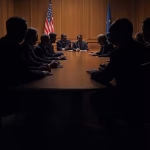
Every spring since 1954, approximately 120-150 influential figures gather behind closed doors to discuss pressing global issues. The Bilderberg Meetings—named after the Dutch hotel where they began—have attracted world leaders, CEOs, intellectuals, and media figures for seven decades of confidential conversations.
Germany’s relationship with this forum tells a remarkable story: from a defeated nation seeking acceptance in 1954 to a driving force in European policy today. Understanding this connection reveals how informal networks shape international cooperation—and why Germany’s postwar trajectory depended on exactly these kinds of quiet diplomatic channels.
In this article, you’ll learn:
How Germany’s 1954 participation marked its return to Western diplomatic circles
Which German chancellors and finance ministers attended—and what they discussed
Why these meetings mattered for NATO cohesion, European integration, and economic policy
What current German officials discuss at modern Bilderberg conferences
The verified facts versus unsubstantiated conspiracy theories
The Postwar Origins: Germany’s Return to the Western Table (1954-1960s)
Why Bilderberg Began—and Why Germany Mattered
The first Bilderberg Meeting convened May 29-31, 1954, at the Hotel de Bilderberg in Oosterbeek, Netherlands. Polish political adviser Józef Retinger, Dutch Prince Bernhard, and Belgian Prime Minister Paul van Zeeland initiated the gathering with a clear purpose: prevent another catastrophic European conflict by fostering transatlantic understanding.
Germany’s participation was symbolically crucial. Just nine years after Nazi Germany’s defeat, the newly established Federal Republic of Germany (founded 1949) needed integration into Western institutions. The steering committee deliberately included German representatives to signal acceptance and shared values.
Early German Attendees and Their Missions
Kurt Birrenbach, a politician and businessman, attended multiple early conferences. His advocacy for strong transatlantic ties aligned with Chancellor Konrad Adenauer’s Westpolitik—anchoring West Germany firmly in NATO (which it joined in 1955) and European institutions.
The 1955 meeting in Barbizon, France, included German representatives discussing European unity and anti-communist strategies during the height of Cold War tensions. These conversations occurred as West Germany navigated Marshall Plan reconstruction, denazification, and sovereignty restoration.
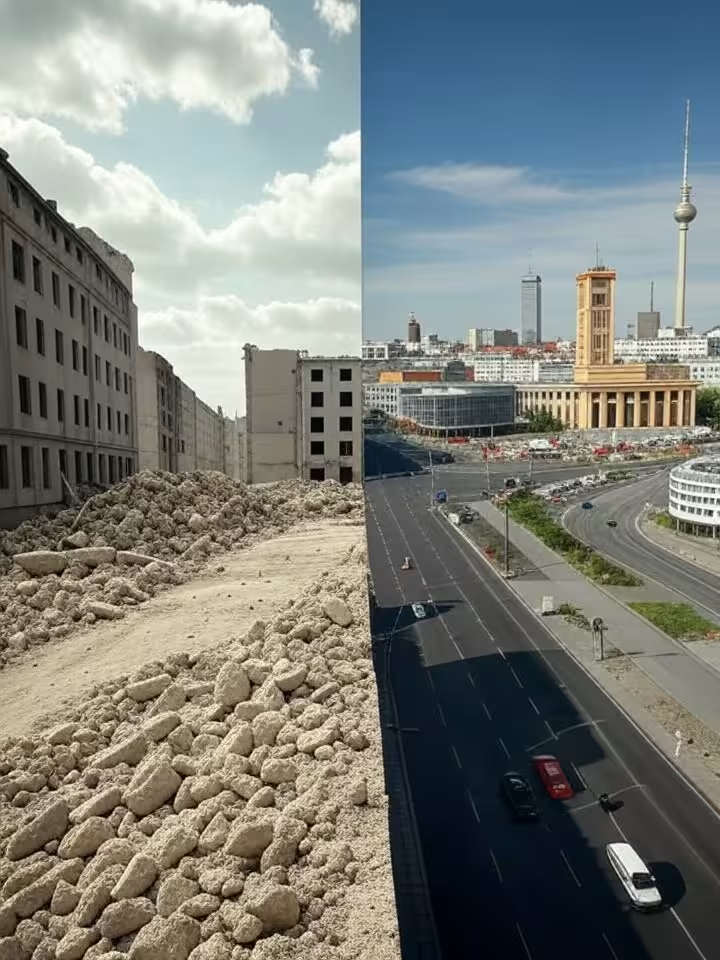
By the late 1950s, German industrial leaders like Fritz Berg (president of the Federation of German Industries) became regular participants. Their presence reflected Germany’s Wirtschaftswunder—the economic miracle that transformed the nation from rubble to Europe’s manufacturing powerhouse.
The Treaty of Rome Connection
The 1957 Treaty of Rome, which created the European Economic Community (EEC), featured prominently in Bilderberg discussions that year. German participants provided input on trade barriers, customs unions, and currency stability—foundational issues for what would eventually become the European Union.
While Bilderberg didn’t draft the treaty, it provided an informal space for cross-border consensus-building among elites who would later negotiate formal agreements. This pattern—private dialogue preceding public policy—defines Bilderberg’s actual function.
The Schmidt Era: Germany as Economic Powerhouse (1970s-1980s)
Helmut Schmidt’s Recurring Presence
Helmut Schmidt attended his first Bilderberg Meeting in 1967 in Cambridge, England, as a rising Social Democratic politician. By the time he became Chancellor (1974-1982), he was a veteran participant whose economic expertise shaped discussions during turbulent times.
The 1973 oil crisis and 1979 energy shock dominated agendas during Schmidt’s chancellorship. His advocacy for Deutsche Mark stability and coordinated Western monetary policy influenced broader economic strategies, though no documentary evidence shows Bilderberg issuing direct policy mandates.
Media Perspectives: Theo Sommer’s Role
Theo Sommer, longtime editor of Die Zeit, attended multiple Bilderberg conferences during this period. His participation illustrates the forum’s emphasis on including journalists—a controversial practice given the Chatham House Rule (statements may be reported, but not attributed to specific speakers).
Sommer’s reporting helped shape German public discourse on transatlantic relations, though he never disclosed specific Bilderberg conversations. This tension between journalistic transparency and forum confidentiality remains debated.
Cold War Security Discussions
The 1980s brought renewed superpower tensions. German representatives participated in discussions on arms control, particularly regarding intermediate-range nuclear missiles stationed in West Germany—a contentious domestic issue that sparked massive protests.
While Chancellor Helmut Kohl didn’t personally attend, his administration’s alignment with NATO positions reflected broader consensus developed partly through forums like Bilderberg. The line between influence and causation remains difficult to trace definitively.
Reunification and European Integration (1990s-2000s)
Joschka Fischer and Post-Cold War Realignment
Foreign Minister Joschka Fischer (1998-2005) attended Bilderberg conferences during Germany’s transition to reunified leadership. The 2003 meetings occurred amid deep transatlantic divisions over the Iraq War—a conflict Germany opposed alongside France.
Fischer’s participation demonstrated Bilderberg’s capacity to maintain dialogue during policy disagreements. The forum didn’t resolve the rift, but it provided space for understanding divergent perspectives on interventionism and multilateralism.
The Euro and Economic Governance
The 1990s Bilderberg agendas extensively covered the Maastricht Treaty (1992) and preparation for the euro currency launch (1999). German economists like Otmar Issing, who would become the European Central Bank’s first Chief Economist, contributed technical expertise.
These discussions reflected German concerns about currency stability—the Deutsche Mark’s strength being a source of national pride. The eventual euro compromise required convincing German skeptics that European monetary union wouldn’t sacrifice stability for political symbolism.
Contemporary German Participation (2010s-Present)
Post-Financial Crisis Leadership
Finance Minister Wolfgang Schäuble attended multiple Bilderberg conferences during the eurozone crisis following the 2008 financial collapse. Germany’s insistence on fiscal discipline (often criticized as austerity) shaped European responses to sovereign debt crises in Greece, Spain, and Portugal.
Bilderberg provided a venue for debating these contentious policies away from immediate political pressures. Critics argue this insulation from democratic accountability enables elite consensus divorced from public opinion—a criticism we’ve analyzed extensively elsewhere.
Recent Participants and Current Topics
The 2019 Montreux meeting included Jens Weidmann (then Bundesbank President) amid discussions on Brexit, trade tensions, and digital currencies. The 2023 Lisbon conference featured Finance Minister Christian Lindner focusing on artificial intelligence, energy security post-Russian invasion of Ukraine, and transatlantic technology regulation.
These contemporary topics reflect Germany’s current priorities: maintaining EU cohesion, managing energy transition away from Russian gas, competing with China technologically, and balancing security relationships between the U.S. and emerging powers.
The Transparency Evolution
Since 2010, Bilderberg has published participant lists and general topics on its official website—a response to decades of criticism about secrecy. This shift toward transparency (while maintaining private discussions) represents an adaptation to internet-era information demands.
German participants’ attendance is now publicly verifiable, eliminating some conspiratorial speculation while maintaining the forum’s core function: frank dialogue without immediate media scrutiny.
Economic and Security Dimensions
Germany’s Export Model and Globalization Debates
Germany’s export-driven economy makes it particularly invested in free trade discussions. Bilderberg conversations throughout the 1990s and 2000s addressed globalization’s winners and losers—a prescient concern given subsequent populist backlashes.
The German model—strong manufacturing, vocational training, works councils, export surpluses—has been both praised and criticized at these meetings. Some participants view it as exemplary; others see its surpluses as destabilizing for deficit countries.
NATO and Defense Spending
Germany’s historically low defense spending (below NATO’s 2% GDP target until recently) has been a recurring Bilderberg topic. The 2022 announcement of a €100 billion special defense fund following Russia’s Ukraine invasion marked a dramatic policy shift.
While no direct causation can be proven, the long-standing transatlantic pressure communicated through forums like Bilderberg contributed to the political environment enabling this reversal.
Cybersecurity and Digital Sovereignty
Recent meetings have emphasized cybersecurity, data protection, and digital infrastructure—areas where Germany advocates for European technological sovereignty. The tension between transatlantic data sharing (desired by U.S. security agencies) and European privacy standards (enshrined in GDPR) generates substantive policy debates.
German representatives consistently push for stronger European digital capabilities independent of U.S. and Chinese platforms—a position reflecting broader strategic autonomy discussions within the EU.
Frequently Asked Questions
Q: Has any German Chancellor attended Bilderberg while in office?
A: Helmut Schmidt attended Bilderberg conferences both before and during his chancellorship (1974-1982). Other chancellors like Adenauer, Kohl, and Merkel did not personally attend while in office, though their cabinet members and party associates participated. The practice of heads of government attending has generally decreased since the 1990s, with finance ministers and foreign ministers representing national leadership instead.
Q: Does Bilderberg determine German economic policy?
A: No evidence supports direct policy determination. Bilderberg operates under the Chatham House Rule, allowing frank discussion without attributable quotes. Participants may form perspectives that influence later decisions, but the forum itself issues no mandates, votes on no resolutions, and publishes no policy recommendations. It functions as an informal dialogue space, not a decision-making body.
Q: Why don’t more German politicians discuss their Bilderberg attendance publicly?
A: The Chatham House Rule prohibits attributing specific statements to individual participants, which limits what attendees can publicly disclose about conversations. Additionally, many participants view the private nature as enabling more honest dialogue than public forums allow. Critics argue this lack of transparency undermines democratic accountability, while defenders contend that not all diplomacy can occur in public view.
Q: How are German participants selected for Bilderberg?
A: The Steering Committee—which has included German members since the 1950s—issues invitations based on expertise, position, and perceived ability to contribute to discussions. Selection criteria aren’t published, leading to speculation. Generally, participants include current government officials, opposition leaders, business executives, academics, and journalists representing diverse (though establishment) perspectives.
Q: Has Germany ever hosted a Bilderberg Meeting?
A: Yes, Germany hosted the 2005 Bilderberg conference in Rottach-Egern, Bavaria. The meeting occurred during the grand coalition government of Angela Merkel’s first term. Hosting rotates among member countries, with locations chosen partly for security and logistical considerations.
Q: What’s the relationship between Bilderberg and German business interests?
A: German corporate leaders from major companies (automotive, finance, energy, technology sectors) regularly attend. This creates networking opportunities and alignment between political and business elites. Critics view this as corporate capture of policy; defenders argue business input improves practical policy understanding. The actual influence varies by individual and issue—no monolithic “business position” emerges from such diverse participants.
Key Takeaways
Germany’s 1954 participation marked symbolic reintegration into Western diplomatic networks after WWII’s devastation—a crucial step toward sovereignty and alliance membership.
Helmut Schmidt’s recurring attendance during the 1970s-80s reflected Germany’s evolution from postwar recovery to economic powerhouse shaping transatlantic monetary policy.
German industrialists used early Bilderberg meetings to rebuild international credibility and establish commercial relationships essential for export-driven growth.
Contemporary German officials focus on digital economy, energy security, and EU fiscal policy—priorities reflecting current geopolitical challenges from Russian aggression to U.S.-China competition.
No evidence supports conspiracy theories of world government or direct policy control—verified documentation shows an influential but informal dialogue forum, not a shadow government.
Increased transparency since 2010 addresses democratic accountability concerns while maintaining the private discussion format participants value for candid exchange.
Germany’s Bilderberg ties exemplify elite networking’s role in policy formation—neither as omnipotent as conspiracists claim nor as irrelevant as dismissive skeptics suggest.
Per fornire le migliori esperienze, utilizziamo tecnologie come i cookie per memorizzare e/o accedere alle informazioni del dispositivo. Il consenso a queste tecnologie ci consentirà di elaborare dati quali il comportamento di navigazione o gli ID univoci su questo sito. Il mancato consenso o la revoca del consenso possono influire negativamente su alcune caratteristiche e funzioni.
Funzionale
Sempre attivo
La memorizzazione tecnica o l'accesso sono strettamente necessari per il fine legittimo di consentire l'utilizzo di un servizio specifico esplicitamente richiesto dall'abbonato o dall'utente, o al solo scopo di effettuare la trasmissione di una comunicazione su una rete di comunicazione elettronica.
Preferenze
La memorizzazione tecnica o l'accesso sono necessari per il legittimo scopo di memorizzare preferenze non richieste dall'abbonato o dall'utente.
Statistiche
La memorizzazione tecnica o l'accesso utilizzati esclusivamente a fini statistici.La memorizzazione tecnica o l'accesso che viene utilizzato esclusivamente per scopi statistici anonimi. In assenza di una citazione, di un'adesione volontaria da parte del vostro Internet Service Provider o di registrazioni aggiuntive da parte di terzi, le informazioni memorizzate o recuperate a questo scopo non possono essere utilizzate per identificare l'utente.
Marketing
La memorizzazione tecnica o l'accesso sono necessari per creare profili di utenti per l'invio di pubblicità, o per tracciare l'utente su un sito web o su più siti web per scopi di marketing simili.