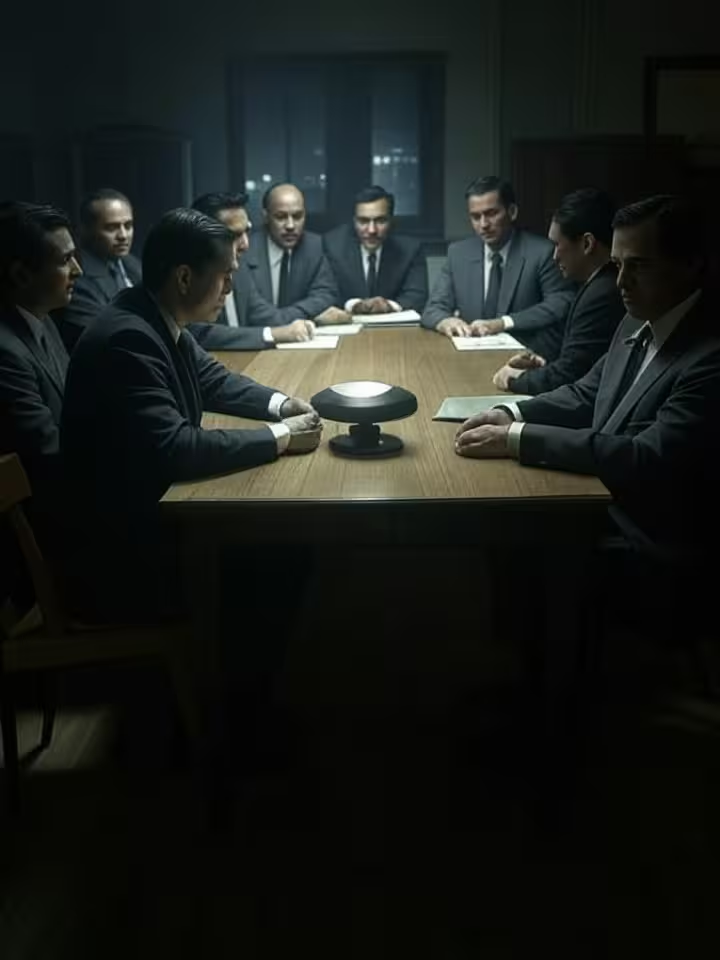
In May 1954, 50 of the most influential leaders from Europe and North America gathered secretly at a Dutch hotel to discuss the future of Western civilization. This meeting would become the foundation of the world’s most exclusive and controversial annual conference.
The inaugural Bilderberg Conference convened May 29-31, 1954, at Hotel de Bilderberg in Oosterbeek, Netherlands
Prince Bernhard of the Netherlands and Polish adviser Jozef Retinger organized the event to strengthen Cold War-era transatlantic cooperation
Approximately 50 elite delegates from 11 countries attended, including David Rockefeller and future diplomats
Discussions focused on communism, European integration, economic cooperation, and colonial issues—all held off-the-record
Private funding came from the Ford Foundation and reportedly CIA-linked sources
The meeting established a tradition of annual elite gatherings that continues seven decades later
No formal resolutions were passed, but the conference model influenced global power networks
Introduction: The Secret Meeting That Changed Everything
When approximately 50 influential figures quietly gathered at a secluded Dutch hotel in late May 1954, few could have predicted they were establishing what would become one of the most enduring—and controversial—institutions in modern international relations.
The first Bilderberg meeting represented a pivotal moment in post-war history. As Europe rebuilt from World War II’s devastation and the Cold War’s tensions escalated, Western elites recognized an urgent need for informal, confidential dialogue. The Hotel de Bilderberg in Oosterbeek, Netherlands, provided the perfect setting for discussions that would shape transatlantic relations for generations.
This gathering matters because it established a unique forum operating outside traditional diplomatic channels. Unlike governmental summits bound by protocol and public scrutiny, Bilderberg created space for frank exchanges between decision-makers who might otherwise never speak candidly. According to the official Bilderberg website, the conference aimed to promote “understanding between the cultures of the United States and Western Europe.”
The secrecy surrounding that first meeting has fueled decades of speculation. While conspiracy theories about Bilderberg often exaggerate its influence, the conference undeniably provided a platform for elite consensus-building on critical issues. The New York Times and other mainstream outlets have described it as an exclusive networking forum, though critics question its lack of transparency.
In this article, you’ll learn:
The Cold War context that made the first Bilderberg meeting necessary
Who attended and what they discussed during those three days in 1954
How the meeting was organized and funded
The immediate and long-term impacts on international relations
How this inaugural conference connects to today’s Bilderberg Group
The Cold War Context: Why Western Elites Needed to Talk
Post-War Europe’s Fragile Recovery
By 1954, Europe remained deeply scarred by World War II, though rebuilding was underway. The Marshall Plan, launched in 1948, had channeled over $12 billion in American aid to Western Europe—a massive investment aimed at preventing economic collapse and communist expansion.
Despite this assistance, transatlantic tensions simmered. Europeans resented American cultural and economic dominance, while Americans grew frustrated with European nationalism and protectionist trade policies. The Korean War (1950-1953) had strained resources and exposed divisions over Cold War strategy.
The Communist Threat and NATO’s Formation
The Soviet Union’s growing influence cast a long shadow. NATO, established in 1949, represented the West’s military alliance, but questions persisted about European commitment to collective defense. Il failed European Defense Community proposal highlighted these divisions—France would reject it just months after the first Bilderberg meeting.
Within this environment, Polish political adviser Jozef Retinger observed dangerous anti-American sentiment spreading across Europe. Having worked with British intelligence during the war, Retinger understood how misunderstandings could fracture crucial alliances.
The Genesis of an Idea
In 1952, Retinger approached Prince Bernhard of the Netherlands with a proposal: convene informal discussions between European and American leaders to address these strains. Prince Bernhard, consort to Queen Juliana and former Shell Oil executive, possessed the connections and credibility to make it happen.
The timing was strategic. The 1952 U.S. presidential election had brought Dwight Eisenhower to power, and his administration included figures receptive to transatlantic coordination. C.D. Jackson, Eisenhower’s psychological warfare expert, became a key American organizer.
Why Oosterbeek?
The Hotel de Bilderberg in Oosterbeek offered perfect conditions: seclusion, comfort, and symbolic significance. The town had been the site of fierce fighting during Operation Market Garden in September 1944, when Allied paratroopers attempted to secure bridges across the Rhine. Choosing this location subtly evoked themes of sacrifice and cooperation.
The hotel’s isolation ensured privacy—a critical requirement for the candid discussions organizers envisioned. No journalists would be admitted, and participants would be encouraged to speak freely without fear of public attribution.
Funding the Conference
The meeting required substantial financial backing. The Ford Foundation provided significant funding, as did individual wealthy supporters. Declassified documents later revealed CIA connections to some funding sources, though the extent remains debated. These financial arrangements reflected Cold War realities—private wealth and intelligence agencies both saw value in facilitating Western elite coordination.
The Guest List: Who Attended the First Bilderberg Meeting?
Selection Criteria and Balance
Organizers carefully curated approximately 50 attendees from 11 countries, seeking to balance diverse perspectives while ensuring participants shared fundamental Western values. The list spanned politics, business, finance, media, and academia.
Key European Participants
Prince Bernhard chaired the conference, with Jozef Retinger serving as secretary. Notable European attendees included:
Denis Healey – British Labour Party representative and future Defense Secretary
Alcide de Gasperi – Former Italian Prime Minister and architect of European integration
Paul van Zeeland – Former Belgian Prime Minister and economist
Guy Mollet – French labor leader and future Prime Minister
Giovanni Agnelli – Head of Fiat and Italian industrial titan
This mix deliberately included both conservatives and social democrats, recognizing that Cold War unity required bridging ideological differences within the democratic spectrum.
American Delegation
The American contingent brought Wall Street, Washington, and intellectual firepower:
David Rockefeller – Chase Manhattan Bank executive whose family would become synonymous with Bilderberg. David Rockefeller’s role in shaping the conference would grow substantially in subsequent decades
Dean Rusk – Rockefeller Foundation president and future Secretary of State under Kennedy and Johnson
George Ball – Lawyer and diplomat who would advise multiple administrations
Joseph E. Johnson – President of the Carnegie Endowment for International Peace
The American participants represented the Eastern Establishment—Ivy League-educated internationalists who believed in active U.S. global leadership.
Sectors Represented
The participant breakdown reflected deliberate diversity:
Politics: Current and former government officials
Finance: Banking and investment leaders
Industry: Manufacturing and oil executives
Media: Newspaper publishers and editors
Academia: University presidents and policy intellectuals
This cross-sectoral approach distinguished Bilderberg from purely governmental forums. By including business leaders and intellectuals alongside politicians, organizers sought to address economic and cultural dimensions of transatlantic relations.
The Agenda: What They Discussed Behind Closed Doors
Six Core Topics
Official press materials outlined the meeting’s focus areas, though specific discussions remain undocumented due to the no-minutes policy:
1. Attitudes Toward Communism and the Soviet Union
Participants debated Western strategy for containing Soviet expansion. Europeans and Americans held differing views on coexistence versus confrontation, with nuanced discussions about trade relations and diplomatic engagement.
2. Economic Policies and Problems
Trade barriers and currency issues dominated economic talks. The dollar’s dominance and European concerns about American economic hegemony required delicate navigation. Discussions addressed how to promote prosperity while maintaining security cooperation.
3. European Integration and Defense
The proposed European Defense Community—a plan for shared military forces—faced uncertain prospects. Attendees discussed whether political integration should precede military cooperation or vice versa. These debates proved prescient when France rejected the EDC later that year.
4. Political Aspects of Transatlantic Relations
Cultural misunderstandings and mutual stereotypes threatened the alliance. Americans saw Europeans as weak and unwilling to defend themselves; Europeans viewed Americans as culturally unsophisticated and militaristically aggressive. Addressing these perceptions required honest dialogue.
5. Colonial Issues and Decolonization
As independence movements swept Asia and Africa, European colonial powers faced difficult transitions. American anti-colonial traditions clashed with European interests, creating friction. The conference provided space to coordinate approaches to emerging nations.
6. Information and Public Understanding
Participants recognized that elite consensus meant little without public support. They discussed how media could foster transatlantic understanding while avoiding propaganda. This topic reflected Cold War information warfare concerns.
Discussion Format and Rules
The meeting operated under what became known as the Chatham House Rule: participants could share ideas discussed but not attribute them to specific individuals. This protocol encouraged candor by removing fear of public backlash.
Sessions alternated between prepared papers and open discussion. No votes were taken, and no resolutions passed. As Prince Bernhard explained in a 1954 statement, the goal was understanding, not decision-making.
The Press Release
After three days, organizers issued a brief public statement confirming the meeting occurred and listing general topics discussed. The New York Times and other newspapers covered the event modestly, describing it as an informal gathering without sensationalizing its secrecy.
Immediate Outcomes and the Decision to Continue
Success by Participants’ Accounts
Attendees reported satisfaction with the frank exchanges. Many had never spoken so openly with counterparts from across the Atlantic. While no formal agreements emerged, participants felt the dialogue improved mutual understanding.
This positive assessment led organizers to schedule a follow-up conference for 1955 in Barbizon, France. The Bilderberg model—annual meetings with evolving participant lists—was born.
Did the Meeting Influence Policy?
Direct causal links between 1954 discussions and subsequent policies remain difficult to establish. The European Defense Community failed months later, though NATO expanded its role. Economic cooperation continued developing through institutions like the European Coal and Steel Community.
Some historians argue Bilderberg discussions helped align elite opinion on European integration’s desirability, even when specific mechanisms remained contested. However, attributing policy outcomes to informal conversations requires caution—correlation doesn’t prove causation.
Establishing Traditions
The 1954 meeting established protocols that endure:
Rotating locations: Different countries host to share responsibility
Confidential discussions: The Chatham House Rule protects candor
Diverse attendance: Cross-sectoral participation continues
No formal authority: Bilderberg makes no binding decisions
These traditions shaped the conference’s character and contributed to its longevity.
Long-Term Impact: From 1954 to Today’s Bilderberg Group
Evolution Over Seven Decades
Since 1954, Bilderberg has convened annually (with rare exceptions), adapting to changing global circumstances. The conference expanded beyond its transatlantic focus to include Asian participants as economic power shifted eastward. Technology leaders joined in recent decades, reflecting digital transformation’s importance.
The Cold War’s end in 1991 removed the original communist threat but didn’t eliminate Bilderberg’s perceived relevance. New issues—terrorism, climate change, financial crises, technological disruption—provided fresh agenda items.
Continuity of Leadership
Prince Bernhard chaired Bilderberg until 1976, when scandal forced his resignation. Subsequent chairmen maintained the organization’s basic approach. The Steering Committee that guides Bilderberg today evolved from the original organizing group.
Influence on Participants’ Careers
Many Bilderberg attendees later achieved prominent positions. Whether the conference helped their careers or successful people naturally attracted invitations remains debated. Notable figures who attended early meetings include:
Henry Kissinger: Attended in the 1950s, became U.S. Secretary of State
Margaret Thatcher: Attended before becoming British Prime Minister
Bill Clinton: Attended in 1991, elected U.S. President in 1992
These examples fuel speculation about Bilderberg as a kingmaker, though concrete evidence of coordinated career advancement is lacking.
Connections to Other Elite Networks
Bilderberg participants often belong to overlapping organizations: the Council on Foreign Relations, the Trilateral Commission (founded by David Rockefeller in 1973), and various think tanks. These interconnections create networks of influence that shape policy debates, though their exact impact remains contested.
Public Perception and Criticism
Bilderberg’s secrecy has attracted criticism throughout its history. Transparency advocates argue that meetings involving powerful figures demand public scrutiny. The lack of minutes and journalists raises accountability concerns.
Conspiracy theories flourish in this information vacuum, often attributing implausible powers to the conference. While evidence doesn’t support claims of Bilderberg controlling world events, legitimate questions about elite influence persist.
In recent years, organizers have increased transparency by publishing participant lists and general agenda topics, though discussions remain private.
The 1954 Meeting’s Legacy: What It Means Today
A Model for Elite Dialogue
The first Bilderberg meeting pioneered a format that numerous other forums have emulated: bring influential people together privately to discuss major issues without formal decision-making authority. This model’s appeal lies in enabling frank conversations impossible in public settings.
Transatlantic Relations in the 21st Century
The original goal—strengthening Euro-American cooperation—remains relevant as new challenges test Western unity. Trade disputes, defense spending disagreements, and differing approaches to China and Russia echo 1954’s tensions in modern form.
Bilderberg provides continuity in transatlantic dialogue even as official diplomatic channels face strain. Whether this informal track significantly influences policy outcomes remains debatable, but it maintains relationships that might otherwise atrophy.
Questions About Democratic Accountability
The fundamental tension between elite expertise and democratic legitimacy that surrounded the 1954 meeting persists. Proponents argue that complex global problems require the kind of sustained, nuanced discussion Bilderberg enables. Critics contend that significant policy discussions involving powerful figures should occur transparently.
This debate reflects broader questions about governance in an interconnected world: How should democracies balance open processes with the need for candid expert dialogue? The Bilderberg model offers one answer, though not one universally accepted.
Frequently Asked Questions
Q: Who founded the Bilderberg Group and why?
A: Prince Bernhard of the Netherlands and Polish adviser Jozef Retinger organized the first meeting in 1954 to address growing transatlantic tensions during the Cold War. They believed informal, confidential discussions between European and American elites could strengthen Western unity against Soviet expansion and resolve economic and cultural misunderstandings.
Q: Why was the first meeting held at the Hotel de Bilderberg specifically?
A: The Hotel de Bilderberg in Oosterbeek, Netherlands, offered seclusion necessary for private discussions. Its location near the site of the 1944 Battle of Arnhem also provided symbolic resonance for post-war reconciliation. The hotel’s name subsequently became the conference’s permanent designation.
Q: Were any formal decisions or agreements made at the 1954 meeting?
A: No. The conference explicitly avoided making binding decisions or issuing formal resolutions. Discussions operated under the Chatham House Rule—ideas could be shared but not attributed to specific individuals. The goal was fostering understanding, not reaching agreements, which remains Bilderberg’s approach today.
Q: How was the first Bilderberg meeting funded?
A: Private sources funded the 1954 conference, including significant contributions from the Ford Foundation. Declassified documents later revealed CIA connections to some funding, reflecting Cold War-era cooperation between private wealth and intelligence agencies to support Western alliance-building efforts.
Q: Did the 1954 meeting actually influence any policies?
A: Direct causal links are difficult to establish definitively. While the European Defense Community failed shortly after the meeting, broader trends toward European integration continued. Participants reported improved mutual understanding that may have informed later policy decisions, but attributing specific outcomes to informal discussions requires caution.
Q: Why has Bilderberg remained so secretive since 1954?
A: Organizers maintain that confidentiality encourages candor by removing fear of public backlash or media misrepresentation. Participants can express tentative ideas and challenge orthodoxies without political risk. Critics argue this secrecy lacks democratic accountability, especially given attendees’ influence. Recent years have seen modest transparency increases with published participant lists.
Key Takeaways
The 1954 Bilderberg meeting emerged from Cold War anxieties about Western disunity, with organizers seeking to strengthen transatlantic cooperation through informal elite dialogue.
Approximately 50 carefully selected participants from 11 countries represented politics, business, finance, media, and academia, ensuring diverse perspectives within a shared Western framework.
Discussions covered communism, economic cooperation, European integration, colonial issues, and cultural understanding, conducted under confidentiality rules that encouraged frank exchanges.
The meeting established traditions that endure seven decades later: annual gatherings, the Chatham House Rule, cross-sectoral participation, and no formal decision-making authority.
Bilderberg’s long-term impact remains contested—it created enduring networks among Western elites and provided continuity in transatlantic dialogue, but attributing specific policy outcomes to informal discussions is difficult.
The conference’s secrecy has generated both legitimate accountability concerns and unfounded conspiracy theories, reflecting ongoing tensions between elite expertise and democratic transparency.
Understanding the 1954 origins provides context for evaluating modern Bilderberg—it was neither the benign discussion forum organizers claim nor the shadow government conspiracy theorists imagine, but rather an influential elite network operating in democratic systems’ gray areas.
Per fornire le migliori esperienze, utilizziamo tecnologie come i cookie per memorizzare e/o accedere alle informazioni del dispositivo. Il consenso a queste tecnologie ci consentirà di elaborare dati quali il comportamento di navigazione o gli ID univoci su questo sito. Il mancato consenso o la revoca del consenso possono influire negativamente su alcune caratteristiche e funzioni.
Funzionale
Sempre attivo
La memorizzazione tecnica o l'accesso sono strettamente necessari per il fine legittimo di consentire l'utilizzo di un servizio specifico esplicitamente richiesto dall'abbonato o dall'utente, o al solo scopo di effettuare la trasmissione di una comunicazione su una rete di comunicazione elettronica.
Preferenze
La memorizzazione tecnica o l'accesso sono necessari per il legittimo scopo di memorizzare preferenze non richieste dall'abbonato o dall'utente.
Statistiche
La memorizzazione tecnica o l'accesso utilizzati esclusivamente a fini statistici.La memorizzazione tecnica o l'accesso che viene utilizzato esclusivamente per scopi statistici anonimi. In assenza di una citazione, di un'adesione volontaria da parte del vostro Internet Service Provider o di registrazioni aggiuntive da parte di terzi, le informazioni memorizzate o recuperate a questo scopo non possono essere utilizzate per identificare l'utente.
Marketing
La memorizzazione tecnica o l'accesso sono necessari per creare profili di utenti per l'invio di pubblicità, o per tracciare l'utente su un sito web o su più siti web per scopi di marketing simili.