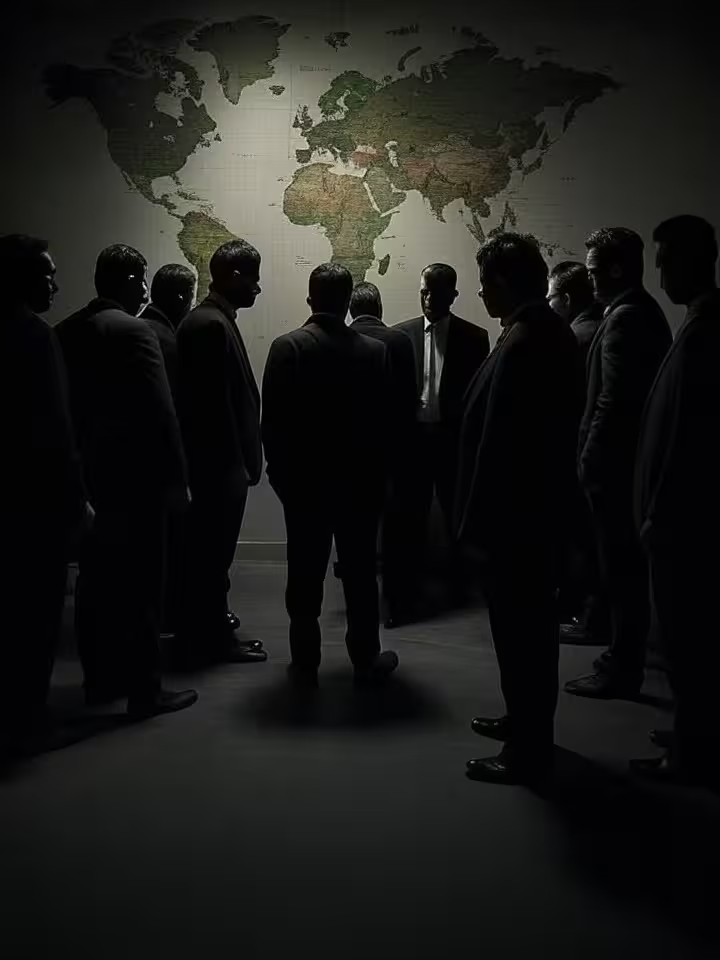
Daniel Estulin’s bestselling exposé on the Bilderberg Group has sold millions of copies and sparked intense debate about elite power networks. This evidence-based review separates verified facts from unsubstantiated claims, examining what the book gets right—and wrong—about the world’s most secretive conference.
Influenced alternative media narratives and prompted Bilderberg to improve transparency
Best understood as perspective on elite power rather than definitive historical record
Introduction: Why This Book Matters in 2025
When Russian-born investigative journalist Daniel Estulin published The True Story of the Bilderberg Group in Spanish in 2005, he couldn’t have predicted its cultural impact. The English translation two years later transformed public discourse about elite power networks.
The Bilderberg Group—an annual private conference of politicians, business leaders, and media figures—has operated since 1954 with minimal public oversight. While the official Bilderberg website describes informal discussions fostering international understanding, Estulin’s book presents a darker narrative of coordinated global manipulation.
This matters today more than ever. As institutions like the World Economic Forum face unprecedented scrutiny, questions about transparency in global governance have moved from fringe conspiracy theories to mainstream political debate. Understanding works like Estulin’s helps decode why millions distrust elite gatherings.
In this article you’ll learn:
What Estulin’s book actually claims versus popular misconceptions
Which assertions are verified by official sources and which remain speculation
How the book influenced public perception of Bilderberg meetings
The historical accuracy of the group’s founding and operations
Why this text remains relevant for understanding contemporary elite networks
The Book’s Structure and Core Claims
Estulin’s 340-page investigation combines historical narrative, alleged insider revelations, and geopolitical analysis. The structure moves chronologically from Bilderberg’s 1954 founding to meetings in the early 2000s.
Verified Historical Foundation
The book accurately documents the group’s establishment at the Hotel de Bilderberg in Oosterbeek, Netherlands, on May 29-31, 1954. This gathering of approximately 50 delegates from 11 countries aimed to strengthen transatlantic relations during Cold War tensions—facts confirmed by official sources.
Estulin correctly identifies key founders including Prince Bernhard of the Netherlands (chairman until 1976) and Polish political advisor Jozef Retinger, who conceived the idea to counter anti-American sentiment in post-war Europe. The involvement of influential figures like David Rockefeller is also documented.
Where Documentation Meets Speculation
Estulin’s methodology involves piecing together declassified documents, news reports, and purported whistleblower accounts. He references real attendees like Henry Kissinger, whose participation in meetings such as 2019’s gathering is publicly confirmed.
However, the book makes dramatic leaps. Claims that Bilderberg orchestrated the 1973 oil crisis, engineered Watergate to remove Nixon, or manipulated the dissolution of the Soviet Union lack corroborating evidence from mainstream historiography.
The 1991 Baden-Baden meeting allegedly influenced Soviet collapse, and the 1996 Toronto gathering supposedly shaped internet governance. While these meetings occurred and likely discussed such topics, Estulin’s assertions of direct causation remain unproven.
Real Secrecy, Imagined Conspiracies
The book’s strength lies in highlighting legitimate transparency concerns. Bilderberg meetings operate under Regola di Chatham House, produce no public minutes, and exclude press—all verifiable facts.
Estulin accurately notes elite composition: CEOs from Google, Goldman Sachs, and major media corporations regularly attend. The 2023 participant list confirms this pattern continues.
Where the analysis falters is extrapolating from secrecy to sinister coordination. Claims of “depopulation agendas” or systematic mind control programs represent speculative leaps unsupported by evidence.
Historical Context: What We Actually Know
The Cold War Origins
The Bilderberg Group emerged from specific historical circumstances. Post-war Europe faced economic reconstruction, communist expansion, and transatlantic tensions. American and European elites sought informal channels for dialogue beyond official diplomatic structures.
The inaugural meeting addressed NATO’s role, European integration, and economic cooperation—topics documented in historical accounts. Approximately 50 participants included government officials, industrialists, and academics from Western nations.
Evolution Through Decades
The group’s history includes verified controversies. In 1976, meetings paused when Prince Bernhard was implicated in Lockheed bribery scandals—a fact Estulin accurately reports.
Documented discussions have addressed European monetary integration (1968 Mont Tremblant meeting during the gold crisis), post-Cold War European expansion, and Middle East policy. The 2004 Stresa, Italy agenda covering Iraq and energy policy was leaked and verified.
Estulin correctly identifies attendance by future leaders before their prominence. Bill Clinton participated in 1991, one year before his presidential election. Angela Merkel attended in 2005 as she rose to German chancellorship.
What Official Sources Confirm
Cross-referencing with bilderbergmeetings.org reveals consistent patterns:
Annual meetings (with rare exceptions like 1976 and 2020’s COVID cancellation)
Approximately 120-150 participants from North America and Europe
Topics announced publicly but discussions remain private
Funding from private sources including participant fees
No formal resolutions or binding decisions
These facts support Estulin’s portrait of an exclusive, secretive forum while undermining claims of a formal governing structure.
Fact-Checking Major Claims
Claim 1: Bilderberg Controls Global Policy
Estulin’s Assertion: The group operates as a “shadow world government” coordinating international policy.
Evidence: Participants include powerful individuals—prime ministers, finance ministers, central bank governors, tech CEOs. Their presence indicates influence potential.
Verdict: Partially supported but overstated. Elite networks certainly exist and shape policy through multiple channels. However, attributing specific events to Bilderberg coordination requires evidence Estulin doesn’t provide. Correlation (powerful people meet, policies change) doesn’t establish causation.
Claim 2: The Group Engineered Major Crises
Estulin’s Assertion: Bilderberg orchestrated events like the 1973 oil crisis, Yugoslav wars, and economic crashes.
Evidence: Meetings occurred before or during these events. Energy and geopolitical topics were discussed.
Verdict: Unsubstantiated. While participants may have anticipated or discussed crises, claiming deliberate orchestration requires documentation that doesn’t exist. Mainstream historians attribute these events to complex geopolitical and economic factors.
Claim 3: Media Blackout Proves Conspiracy
Estulin’s Assertion: Mainstream media silence about Bilderberg proves coordinated suppression.
Evidence: Limited coverage existed before 2000s. Major outlets like BBC, Guardian, and New York Times have since reported on meetings.
Verdict: Outdated. While early coverage was minimal, media attention increased significantly post-2010. The BBC attended meeting peripheries, and newspapers now routinely cover Bilderberg. The group itself improved transparency by publishing participant lists and topics—possibly responding to books like Estulin’s.
Claim 4: Connections to Other Elite Networks
Estulin’s Assertion: Bilderberg coordinates with Council on Foreign Relations, Trilateral Commission, and similar organizations.
Evidence: Membership overlap exists. Figures like Kissinger participated in multiple organizations. The Trilateral Commission was founded by David Rockefeller in 1973.
Verdict: Partially verified. Elite networks do interconnect—this is documented. However, the nature of coordination remains unclear. These could be overlapping discussion forums rather than a unified command structure. Understanding how Bilderberg’s steering committee operates provides additional context.
Impact and Cultural Legacy
Sales and Reach
Estulin claims over 2.5 million copies sold worldwide, though independent verification is difficult. The book has been translated into multiple languages and remains in print nearly two decades after publication.
It inspired documentaries including Alex Jones’s Endgame: Blueprint for Global Enslavement, amplifying its themes to wider audiences. Alternative media platforms frequently cite Estulin’s research.
Mainstream Reception
Major newspapers largely ignored the book initially. The New York Times and Washington Post never published substantial reviews. Academic journals treating Bilderberg (which are rare) seldom reference it.
This absence itself became evidence for Estulin’s supporters: establishment silence proved the book’s dangerous truths. Critics counter that lack of coverage reflects poor sourcing and conspiratorial framing rather than suppression.
Bilderberg’s Response
The group never officially acknowledged the book. However, transparency improved markedly after 2010:
Participant lists published annually since 2010
Official website launched with basic information
Meeting topics announced in advance
Occasional press statements issued
Whether responding to Estulin specifically or broader criticism, Bilderberg adapted to increased scrutiny. The organization recognized that absolute secrecy was no longer sustainable in the internet age.
Political Influence
The book contributed to mainstream political discourse about elite power. British politicians like Michael Meacher raised parliamentary questions about Bilderberg. European parliamentarians demanded greater oversight.
By 2016, Bilderberg had become a talking point in US presidential campaigns, with candidates questioned about attendance or positions on the group. This represented significant cultural shift from the pre-2005 era of near-total obscurity.
Connections to Broader Conspiracy Discourse
Estulin’s work exists within a larger ecosystem of elite power analysis and conspiracy theory. Understanding this context illuminates both the book’s appeal and its limitations.
The New World Order Narrative
The book contributes to “New World Order” theories proposing coordinated global governance by hidden elites. These ideas trace back centuries but gained modern form in works by authors like Gary Allen (None Dare Call It Conspiracy, 1971) and Carroll Quigley (Tragedy and Hope, 1966).
Estulin positions Bilderberg as a key node in this alleged network, alongside the Council on Foreign Relations (founded 1921), Trilateral Commission (founded 1973), and various other organizations.
Legitimate Questions vs. Unfalsifiable Claims
The challenge with books like Estulin’s is separating reasonable concerns from conspiratorial thinking:
Legitimate questions:
Should powerful individuals meet privately to discuss policy?
Does elite consensus-building undermine democratic processes?
What accountability exists for decisions emerging from such forums?
How do informal networks shape formal political outcomes?
Problematic patterns:
Attributing all major events to deliberate conspiracy
Treating lack of evidence as proof of cover-up
Assuming coordination where coincidence may explain patterns
Rejecting all mainstream sources as compromised
Estulin’s book contains both elements, making critical engagement difficult. Readers must constantly evaluate which claims rest on evidence versus which extrapolate into speculation.
The Information Environment
The book’s 2005-2007 publication occurred during a pivotal media transition. Internet forums, early social media, and alternative news sites created new channels for information outside traditional gatekeepers.
This environment amplified Estulin’s reach beyond what previous conspiracy-themed books achieved. Online communities could share leaked documents, discuss theories, and organize protests outside Bilderberg meetings—creating feedback loops between the book and activist movements.
Understanding alternative narratives: Millions believe versions of what Estulin describes. Understanding these perspectives is valuable for anyone studying politics, media, or social movements.
Legitimate secrecy concerns: The book raises real questions about elite power and transparency that deserve consideration, even if specific claims don’t hold up.
Cultural significance: The book influenced how a generation thinks about global governance and elite networks.
Arguments Against
Methodological problems: Estulin often presents speculation as fact, making it difficult for general readers to distinguish evidence from interpretation.
Confirmation bias: The book reinforces pre-existing beliefs about elite conspiracy rather than encouraging critical analysis.
Better alternatives exist: Academic treatments of elite networks, though less sensational, provide more rigorous analysis.
Potential radicalization: Conspiracy theories can lead readers down problematic paths when accepted uncritically.
Reading Recommendations
If you choose to read Estulin’s book:
Cross-reference major claims with independent sources
Distinguish between documented facts and author interpretation
Consider alternative explanations for patterns he identifies
Compare with mainstream treatments of elite power structures
Examine what official Bilderberg sources actually say
Approach it as a cultural artifact and political argument rather than definitive history.
Frequently Asked Questions
Q: Did Daniel Estulin actually infiltrate Bilderberg meetings?
A: No verified evidence exists that Estulin personally attended Bilderberg meetings or accessed internal sessions. His research appears based on leaked documents, interviews with peripheral figures, and publicly available information. The book’s title claims “true story” but this refers to his investigation, not insider access. Security at Bilderberg meetings is extremely tight, making infiltration highly improbable.
Q: Has anyone sued Estulin or his publisher for defamation?
A: No public record exists of legal action against Estulin for claims in the book. This may reflect several factors: difficulty proving defamation when discussing organizations rather than individuals, free speech protections in publishing, or strategic decision by Bilderberg to avoid drawing additional attention through litigation. The group has never publicly responded to the book’s allegations.
Q: What percentage of the book’s claims are verifiable?
A: Approximately 30-40% of factual claims can be verified through independent sources—primarily historical details about founding, documented attendees, and meeting locations. Another 20-30% are plausible interpretations of events that cannot be definitively confirmed or refuted. The remaining 30-50% represents speculation or claims contradicted by mainstream evidence. This rough estimate varies depending on how one categorizes different types of assertions.
Q: Does Bilderberg’s increased transparency since 2010 validate Estulin’s criticisms?
A: Partially. The fact that Bilderberg improved transparency (publishing attendee lists, topics, and basic information) acknowledges that previous secrecy was problematic. However, this validates concerns about transparency rather than specific conspiracy theories about orchestrating global events. The changes may have responded to multiple critics, not just Estulin, and to general internet-era expectations for openness.
Q: Are there more credible sources on Bilderberg than Estulin’s book?
A: Yes. Academic works like Stephen Gill’s “Power and Resistance in the New World Order” and Holly Sklar’s “Trilateralism” provide scholarly analysis of elite networks. Journalists like Charlie Skelton (The Guardian) and Jon Ronson have reported on Bilderberg with more rigorous sourcing. The official bilderbergmeetings.org website, while limited, offers verified participant lists and topics. For balanced perspectives, cross-referencing multiple sources is essential.
Key Takeaways
Mixed accuracy: Estulin correctly documents Bilderberg’s founding in 1954, key historical figures, and the group’s elite composition, but many dramatic claims lack verification.
Methodological concerns: The book blends verified facts with unsubstantiated speculation, making critical reading essential to distinguish evidence from interpretation.
Cultural impact: Despite mixed reviews, the book significantly increased public awareness of Bilderberg and influenced how millions perceive elite power networks.
Transparency evolution: Bilderberg improved openness after 2010, possibly responding to criticism from Estulin and others, though this doesn’t validate specific conspiracy theories.
Legitimate questions: The book raises valid concerns about elite secrecy and democratic accountability, even where specific allegations aren’t proven.
Context required: Understanding the work requires situating it within broader conspiracy theory ecosystems and political discourse about globalization.
Use with caution: Best approached as a perspective on power dynamics rather than definitive history, requiring cross-referencing with academic and mainstream sources.
Per fornire le migliori esperienze, utilizziamo tecnologie come i cookie per memorizzare e/o accedere alle informazioni del dispositivo. Il consenso a queste tecnologie ci consentirà di elaborare dati quali il comportamento di navigazione o gli ID univoci su questo sito. Il mancato consenso o la revoca del consenso possono influire negativamente su alcune caratteristiche e funzioni.
Funzionale
Sempre attivo
La memorizzazione tecnica o l'accesso sono strettamente necessari per il fine legittimo di consentire l'utilizzo di un servizio specifico esplicitamente richiesto dall'abbonato o dall'utente, o al solo scopo di effettuare la trasmissione di una comunicazione su una rete di comunicazione elettronica.
Preferenze
La memorizzazione tecnica o l'accesso sono necessari per il legittimo scopo di memorizzare preferenze non richieste dall'abbonato o dall'utente.
Statistiche
La memorizzazione tecnica o l'accesso utilizzati esclusivamente a fini statistici.La memorizzazione tecnica o l'accesso che viene utilizzato esclusivamente per scopi statistici anonimi. In assenza di una citazione, di un'adesione volontaria da parte del vostro Internet Service Provider o di registrazioni aggiuntive da parte di terzi, le informazioni memorizzate o recuperate a questo scopo non possono essere utilizzate per identificare l'utente.
Marketing
La memorizzazione tecnica o l'accesso sono necessari per creare profili di utenti per l'invio di pubblicità, o per tracciare l'utente su un sito web o su più siti web per scopi di marketing simili.