The 30-40 influential figures who decide who gets invited to the world’s most exclusive annual meeting—and what they’ll discuss behind closed doors
TL;DR
- The Steering Committee organizes the annual Bilderberg Meetings, selecting 120-150 participants and discussion topics since 1954
- Current chairman Victor Halberstadt leads 30-40 members from business, politics, academia, and media across Europe and North America
- Members serve by invitation only, often for decades, with no public application process or formal charter
- The committee enforces strict confidentiality under Chatham House Rules to enable frank dialogue among world leaders
- Critics question transparency and elite influence, while supporters view it as essential for transatlantic cooperation
- Recent agendas have addressed AI governance, energy transitions, and geopolitical tensions
- Membership connects to broader networks like the World Economic Forum and Trilateral Commission
Introduction
Every spring, approximately 120-150 of the world’s most powerful people gather in a luxury hotel for three days of closed-door discussions. No minutes are taken. No policy statements are issued. Media is barred from entry. This is the Bilderberg Meeting—and behind it stands a little-known body that decides who sits at those tables and what they discuss: the Steering Committee.
Understanding how Bilderberg operates requires examining this governing body. Established alongside the first conference in 1954, the Steering Committee comprises 30-40 influential figures who meet several times annually to plan the event that has facilitated informal dialogue on global issues for nearly seven decades.
In this article, you’ll learn:
- The historical origins and evolution of the Steering Committee since 1954
- Who serves on the committee and how members are selected
- The committee’s specific organizational responsibilities and influence
- Why critics question its transparency and what supporters say in response
- How the committee connects to broader international networks
Historical Origins: From Cold War Concerns to Global Forum
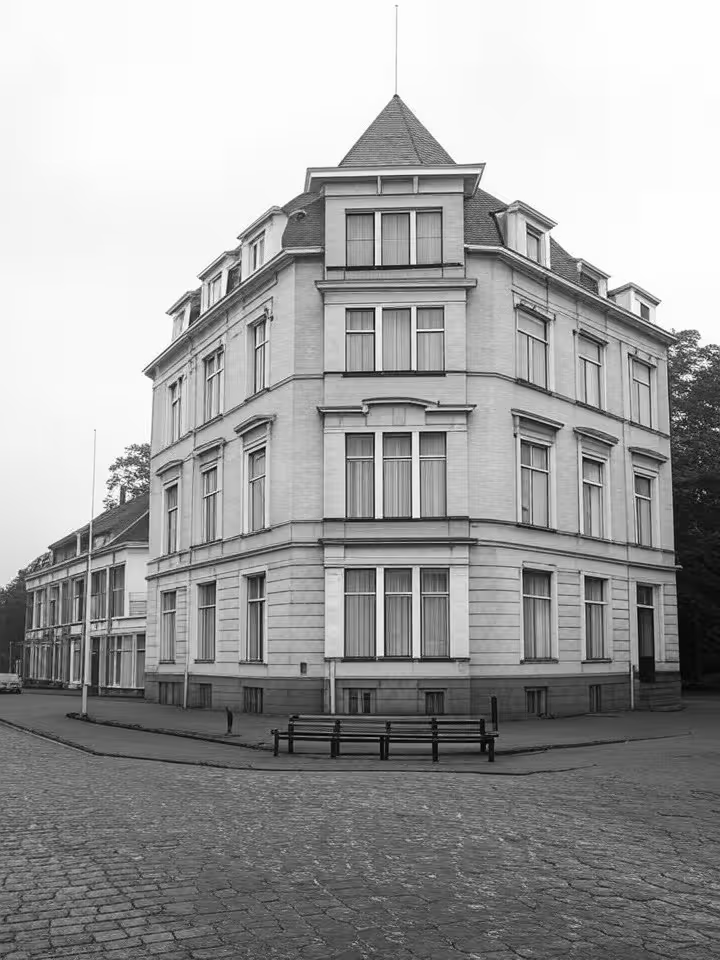
The Bilderberg Steering Committee was born from post-World War II anxieties about the Atlantic alliance. In 1954, Polish political adviser Jozef Retinger and Dutch Prince Bernhard convened the first meeting at the Hotel de Bilderberg in Oosterbeek, Netherlands, concerned about growing anti-American sentiment in Western Europe.
From day one, an organizing body was essential. The initial Steering Committee included founding members such as Belgian former Prime Minister Paul van Zeeland and American businessman John S. Coleman. Their mandate was straightforward: ensure continuity, handle logistics, and maintain the discretion that would become Bilderberg’s trademark.
Evolution Through Geopolitical Shifts
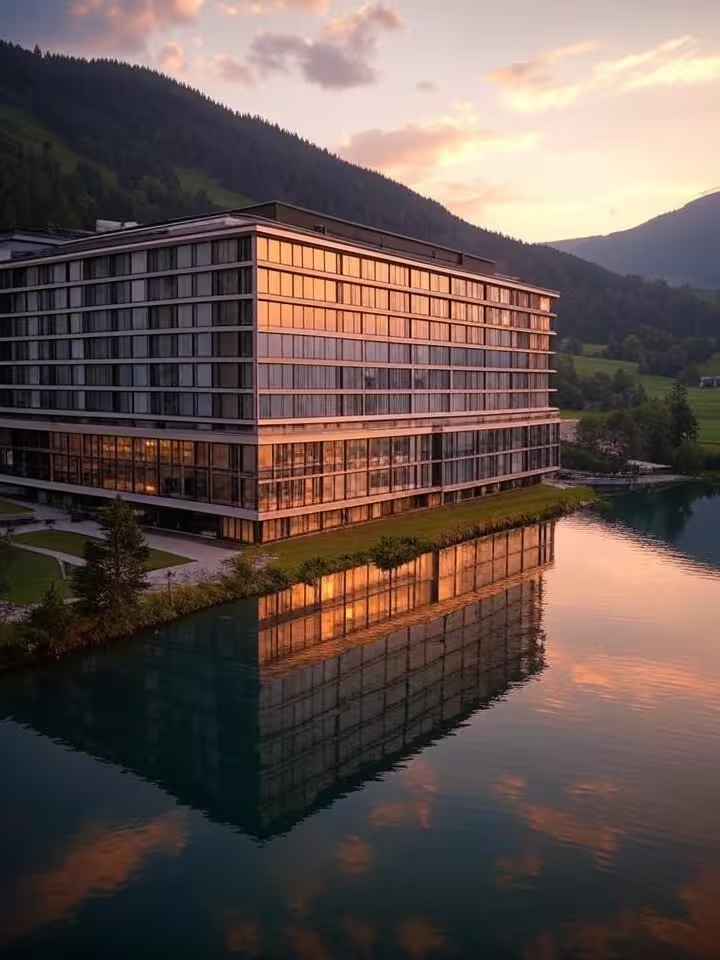
The committee’s composition has mirrored global changes. During the 1960s Cold War escalation, it expanded to include more financial and industrial leaders. The 1973 Saltsjöbaden meeting addressed the oil crisis—a topic the committee selected as OPEC’s embargo shook Western economies.
After the Berlin Wall fell, the committee began inviting Eastern European participants, reflecting the new geopolitical reality. The 2008 Chantilly, Virginia meeting during the financial crisis focused on economic stability. Most recently, the 2023 Lisbon gathering addressed AI governance and energy transitions.
According to the official Bilderberg website, the committee has maintained its informal structure throughout—no official charter exists beyond its organizational mandate. This flexibility has allowed it to adapt while preserving the core mission of facilitating transatlantic dialogue.
Who Sits on the Steering Committee?
The current Steering Committee includes approximately 35 members representing diverse sectors and nationalities. Victor Halberstadt, a Dutch economics professor, has chaired the committee since 2019, succeeding longtime chairman Étienne Davignon.
Current Notable Members Include:
- Marie-Josée Kravis (USA) – Senior Fellow at the Hudson Institute, economist
- Zanny Minton Beddoes (UK) – Editor-in-Chief of The Economist
- Oscar Stenström (Sweden) – State Secretary for International and EU Trade
- Josef Ackermann (Switzerland) – Former CEO of Deutsche Bank
- Jens Stoltenberg (Norway) – NATO Secretary General (invited participant)
The Invitation-Only Selection Process
There is no application to join the Steering Committee. Members are selected through an opaque process based on expertise, influence, and prior Bilderberg participation. Existing committee members nominate candidates, and decisions are made collectively within the group.
Tenure can span decades. Some members have served for over twenty years, providing institutional continuity. This long-term involvement helps maintain Bilderberg’s character across changing global circumstances.
The committee deliberately seeks geographical balance, with representatives from multiple European nations, the United States, and Canada. Recent years have seen increased gender diversity, though men still predominate. Sectoral balance is also prioritized—mixing government officials, corporate executives, academics, and journalists.
What Does the Steering Committee Actually Do?
The committee’s primary responsibilities center on organizing each annual conference:
Selecting Participants
Perhaps the committee’s most influential role is deciding who receives the coveted invitation. Each year, roughly two-thirds of attendees are returning participants, while one-third are newcomers. The committee aims for a balance of established voices and fresh perspectives.
Selection criteria include current position, expertise in relevant topics, and ability to contribute meaningfully to off-the-record discussions. According to multiple reports, committee members nominate potential invitees from their networks, with final decisions made collectively.
Setting the Agenda
The committee determines discussion topics months in advance. Recent agendas have addressed:
- Artificial intelligence governance (2023)
- Post-pandemic economic recovery (2022)
- Climate change and energy security (2019)
- Cyber threats and digital sovereignty (2018)
- Geopolitical realignments and populism (2017)
Topics reflect current global concerns, though the committee has no formal research apparatus. Instead, members draw on their professional expertise and networks to identify issues warranting discussion.
Enforcing Confidentiality
The Steering Committee maintains the Chatham House Rule: participants may use information received but cannot reveal the identity or affiliation of speakers or other attendees. This confidentiality is Bilderberg’s defining feature, allowing frank exchanges without fear of misrepresentation.
Committee members take this responsibility seriously. Security arrangements are extensive, and violations are rare. The trade-off is obvious: privacy enables candor but fuels speculation about what’s actually said.
Managing Logistics and Funding
The committee handles practical arrangements—selecting venues, coordinating security with host governments, and managing finances. Funding comes primarily from participant contributions and corporate sponsors, though exact figures aren’t disclosed.
The Transparency Question: Criticism and Defense
The Steering Committee’s opacity has made it a lightning rod for criticism. Understanding both critiques and defenses provides necessary context.
Common Criticisms
Elite Exclusivity: Critics argue the committee represents an unaccountable power elite making decisions affecting ordinary people. The invitation-only model, combined with participants’ influential positions, raises questions about democratic accountability.
Lack of Transparency: No minutes, no press conferences, no public accountability. The BBC and The Guardian have both questioned whether such secretive gatherings are appropriate in democratic societies, especially when attended by sitting government officials.
Potential Policy Influence: While Bilderberg doesn’t issue formal recommendations, critics note that participants often hold positions where they can implement ideas discussed. This informal influence is harder to track than formal policy processes.
Protests have occurred at multiple meetings. The 2013 Watford conference saw demonstrators demanding transparency. However, these protests have generally been peaceful and small-scale.
The Committee’s Defense
Supporters, including committee members who’ve spoken publicly, offer several counterarguments:
Privacy Enables Honesty: Off-the-record discussions allow participants to test ideas, admit uncertainties, and explore topics without political posturing. This is impossible in public forums where every word is scrutinized.
No Formal Authority: The committee doesn’t make binding decisions or issue directives. It facilitates conversations among people who would meet informally anyway—Bilderberg simply provides structure.
Track Record of Responsibility: Over seven decades, no verified evidence has emerged of Bilderberg directing specific policies or coordinating hidden agendas. The conspiracy theories that surround it remain unsupported by credible evidence.
Value of Informal Diplomacy: In an era of polarized public discourse, private forums where leaders can speak candidly serve important functions. Track II diplomacy has long played this role in international relations.
Connections to Broader Networks
The Steering Committee doesn’t operate in isolation. Many members maintain positions in overlapping international networks:
- World Economic Forum: Several committee members are WEF trustees or regular Davos participants
- Trilateral Commission: Founded by Bilderberg attendee David Rockefeller, this body shares similar goals of fostering international cooperation
- Council on Foreign Relations: Multiple committee members hold CFR positions or fellowships
- Think Tanks: Committee members often lead or sit on boards of policy institutes like the Hudson Institute, Chatham House, or Bruegel
These connections amplify Bilderberg’s role in international policy discussions. Ideas generated at Bilderberg meetings may resurface in CFR publications, WEF initiatives, or government policies—though tracing direct causation is nearly impossible due to confidentiality.
This interconnected elite network has existed throughout the post-World War II period. Bilderberg is one node in a larger ecosystem of informal international governance mechanisms that complement formal institutions like the UN or EU.
Frequently Asked Questions
Who currently chairs the Bilderberg Steering Committee?
Victor Halberstadt, a Dutch economics professor, has served as chairman since 2019. He succeeded Belgian statesman Étienne Davignon, who held the position for many years. The chairman role involves coordinating committee activities and serving as the public face of Bilderberg on the rare occasions when it engages with media.
How many people serve on the Steering Committee?
The committee typically includes 30-40 members at any given time. The exact number fluctuates as members join or step down. Membership is by invitation and often long-term, with some individuals serving for decades. The committee seeks geographical and sectoral balance among its members.
Can someone apply to join the Steering Committee?
No. There is no public application process. Members are selected through internal nomination by existing committee members, with decisions made collectively. Selection is based on expertise, influence, and previous Bilderberg participation. The opaque process is consistent with Bilderberg’s broader emphasis on privacy.
Does the Steering Committee have any formal authority over policy?
No. The committee has no legal authority, doesn’t issue policy recommendations, and doesn’t coordinate participant actions after meetings. Its role is purely organizational—planning the annual conference and facilitating discussions. Any influence is indirect, emerging from individual participants’ positions and the ideas exchanged during meetings.
How is the Bilderberg Meeting funded?
The Steering Committee manages funding through participant contributions and corporate sponsorships. Exact financial details aren’t publicly disclosed. The budget covers venue costs, security, logistics, and administrative expenses. Participants typically pay their own travel expenses, though this isn’t uniformly confirmed.
Why doesn’t the Steering Committee release meeting minutes or agendas in advance?
The committee maintains that confidentiality is essential for frank discussion among participants who might otherwise feel constrained by public scrutiny. Agendas are published on the official website after each meeting, listing discussion topics but not specific positions or proposals. This approach prioritizes candor over transparency—a trade-off the committee considers necessary for productive dialogue.
Key Takeaways
- The Steering Committee is Bilderberg’s organizing body, consisting of 30-40 influential members who plan the annual conference, select participants, and set discussion topics.
- Membership is opaque and long-term, with selection by internal nomination based on expertise and influence. Some members serve for decades, providing institutional continuity.
- The committee has no formal authority beyond organization. It doesn’t make policy, issue directives, or coordinate participant actions—only facilitates off-the-record discussions.
- Confidentiality is the core principle, enforced through Chatham House Rules to enable frank exchanges. This privacy fuels both productive dialogue and public skepticism.
- Criticism focuses on transparency and elite influence, with questions about accountability when powerful figures meet privately. Defenders argue privacy enables honest conversation impossible in public forums.
- The committee connects to broader networks including the World Economic Forum, Council on Foreign Relations, and Trilateral Commission, amplifying Bilderberg’s role in international policy discussions.
- Historical evolution reflects global changes, from Cold War concerns to post-9/11 security to current AI governance, showing adaptability while maintaining core mission of transatlantic cooperation.
Sources
Official Sources
- Bilderberg Meetings Official Website – Committee member lists, meeting agendas, and historical information
- Bilderberg Press Release Archive – Official announcements and participant lists
- Chatham House Rule Explanation – Official description of confidentiality protocol used at Bilderberg
News Coverage and Analysis
- The Guardian Bilderberg Coverage – Multiple articles on meetings, criticisms, and historical context
- BBC News: Bilderberg Mystery – Public perceptions and transparency questions
- Politico: 2023 Bilderberg Meeting Coverage – Recent agenda topics and participants