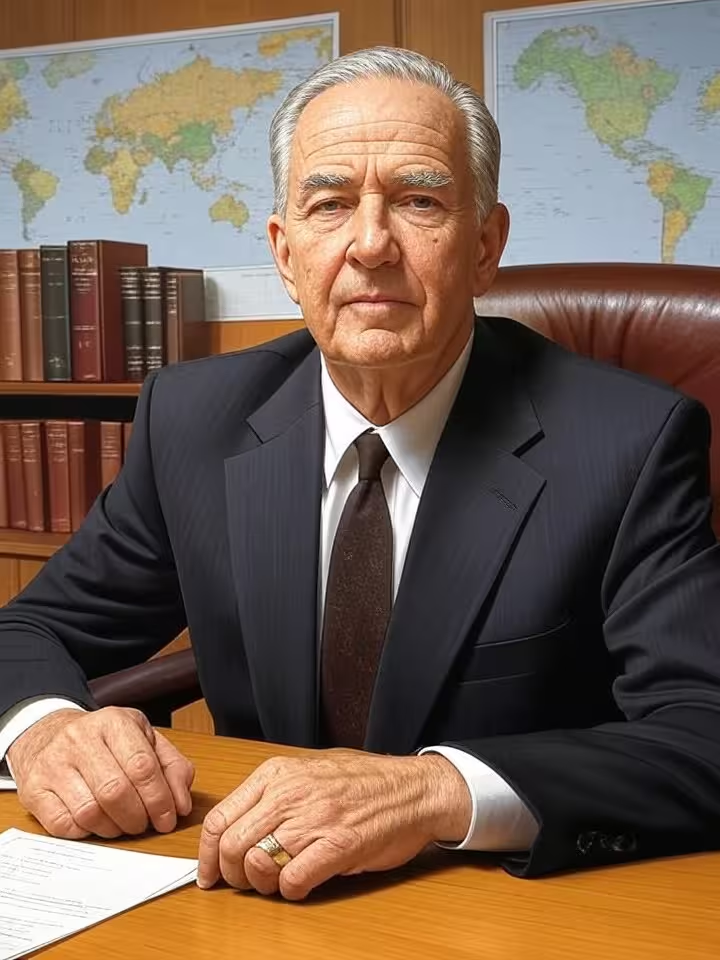
The youngest grandson of America’s first billionaire transformed global finance and created the world’s most influential private diplomatic forum. David Rockefeller’s century-long life shaped international banking, Cold War diplomacy, and the secret meetings that still convene world leaders today.
- David Rockefeller (1915-2017) co-founded the Bilderberg Meetings in 1954 to foster transatlantic cooperation during the Cold War
- Led Chase Manhattan Bank for decades, expanding it into a global financial powerhouse with operations in over 50 countries
- Donated over $1 billion to causes including education, arts, and global health initiatives
- Founded the Trilateral Commission in 1973 to extend dialogue beyond the Atlantic to include Japan
- His legacy continues through institutions like Bilderberg, which held its 70th anniversary meeting in 2024
- Bridged the worlds of finance, diplomacy, and philanthropy unlike any figure of his generation
Introduction
On a spring weekend in 1954, a small group of European and American leaders gathered at the Hotel de Bilderberg in the Netherlands for conversations that would reshape transatlantic relations. Behind this historic meeting stood David Rockefeller, a 39-year-old banker from America’s most powerful family, who believed informal dialogue could prevent another world war.
David Rockefeller wasn’t just born into wealth—he was born into responsibility. As the youngest son of John D. Rockefeller Jr. and grandson of Standard Oil’s founder, he inherited both a fortune and an expectation to use it wisely. Over his 101 years, he transformed that inheritance into something unprecedented: a network of global institutions that connected world leaders, business titans, and intellectuals across continents.
This matters because Rockefeller’s life reveals how modern international cooperation actually works. While governments negotiate treaties publicly, figures like Rockefeller created private spaces where frank conversations could happen away from political pressures. Understanding his role in founding the steering mechanisms of Bilderberg illuminates the informal architecture that underpins global governance today.
In this article, you’ll learn:
- How Rockefeller’s education and early career prepared him for global influence
- The circumstances that led to Bilderberg’s founding in 1954
- His transformation of Chase Manhattan into a multinational banking giant
- The philanthropic empire he built across six decades
- Why his vision of international cooperation remains relevant in 2024
Early Life: Born Into America’s Most Powerful Dynasty
A Privileged Childhood With Purpose
David Rockefeller entered the world on June 12, 1915, in New York City as the youngest of six children. His grandfather, John D. Rockefeller Sr., had revolutionized the oil industry and become America’s first billionaire. But wealth in the Rockefeller family came with expectations.
Growing up at the family estate in Pocantico Hills, New York, David witnessed a parade of influential visitors—politicians, artists, scientists—who came to seek his family’s support or counsel. His father, John D. Rockefeller Jr., had dedicated his life to philanthropy, establishing institutions like Colonial Williamsburg and donating the land for the United Nations headquarters.
This environment shaped young David’s worldview. The family motto—”every right implies a responsibility”—wasn’t just words. It was a daily practice.
An Education in Economics and Global Affairs
Rockefeller attended the Lincoln School in New York, an experimental institution his family funded that emphasized progressive education. In 1932, he enrolled at Harvard University, where he studied history, government, and economics, graduating in 1936.
His education didn’t stop at Harvard. From 1936 to 1937, Rockefeller studied at the London School of Economics, where he attended lectures by Friedrich Hayek, the Austrian economist who would later win the Nobel Prize. This exposure to European economic thought during the Great Depression profoundly influenced his understanding of international finance.
In 1940, Rockefeller earned his Ph.D. in economics from the University of Chicago with a dissertation titled “Unused Resources and Economic Waste.” This academic grounding gave him theoretical tools that most bankers lacked—an advantage he would leverage throughout his career.
These formative years coincided with rising tensions in Europe. As Hitler consolidated power and war loomed, Rockefeller developed a conviction that would drive his life’s work: American isolation was dangerous, and transatlantic cooperation was essential for peace and prosperity.
From Public Service to Global Banking
Early Career and Military Service
Rather than immediately joining the family business, Rockefeller began his career in public service. In 1940, he worked as a secretary to New York City Mayor Fiorello La Guardia, gaining firsthand experience in municipal governance during a period of urban reform.
When America entered World War II, Rockefeller enlisted in the U.S. Army in 1942. He served in military intelligence in North Africa and France, rising to the rank of captain. This wartime experience exposed him to the devastation of Europe and reinforced his belief that preventing future conflicts required sustained dialogue between continents.
Building a Banking Empire
In 1946, Rockefeller joined Chase National Bank, beginning at an entry-level position despite his family name. The bank merged with the Bank of the Manhattan Company in 1955 to form Chase Manhattan Bank, and Rockefeller rose steadily through the ranks.
He became president in 1960 and chairman and CEO in 1969, positions he held until 1981. Under his leadership, Chase transformed from a primarily domestic institution into a truly global bank with branches in over 50 countries. By 1980, the bank’s assets exceeded $80 billion—a remarkable expansion driven by Rockefeller’s vision of international finance.
His innovations included pioneering the use of consumer credit cards and establishing banking relationships with communist countries during the Cold War, including the Soviet Union and China—controversial moves that demonstrated his pragmatic approach to global economics.
Founding Bilderberg: A Forum for Transatlantic Dialogue
The Cold War Context
By the early 1950s, the world had divided into hostile camps. The Soviet Union had acquired nuclear weapons, communist parties were gaining strength in Western Europe, and anti-American sentiment was rising among European intellectuals who saw U.S. culture as crass and American policy as imperialistic.
Rockefeller and other Atlantic-minded leaders worried that this divide could undermine the Western alliance that had defeated fascism. What was needed, they believed, was a private forum where European and American elites could speak frankly without diplomatic protocols or press coverage.
The First Meeting: May 1954
Working with Polish diplomat Józef Retinger, Dutch Prime Minister Willem Drees, and Prince Bernhard of the Netherlands, Rockefeller helped organize what would become the first Bilderberg Meeting. From May 29 to 31, 1954, approximately 50 delegates gathered at the Hotel de Bilderberg in Oosterbeek, Netherlands.
The agenda focused on pressing issues: the threat of communist expansion, European integration, economic cooperation, and the future of the Atlantic alliance. Participants included prime ministers, foreign ministers, business leaders, and intellectuals—all attending in their private capacity, not as official representatives of their governments.
The format was deliberately informal: no votes, no resolutions, no formal statements. Just conversation. This approach, championed by Rockefeller, allowed for candid discussion impossible in official diplomatic channels.
Rockefeller’s Vision Takes Root
The success of that first meeting led to annual conferences. Rockefeller attended dozens of Bilderberg Meetings over the subsequent decades, often helping to shape agendas and select participants. His banking expertise proved invaluable as discussions increasingly focused on global financial architecture, international trade, and monetary policy.
Official records from the Bilderberg Meetings website confirm that the organization was founded to address transatlantic tensions and promote mutual understanding. While many have speculated about the group’s influence, examining conspiracy theories versus documented facts reveals a more nuanced reality.
Rockefeller helped invite influential figures who would later shape global affairs, including Henry Kissinger, who first attended in the 1950s, and Bill Clinton, who attended before becoming president. This networking function—connecting rising leaders with established power brokers—became one of Bilderberg’s most significant but least understood roles.
Expanding the Vision: The Trilateral Commission
By the early 1970s, the global balance of power was shifting. Japan had emerged as an economic powerhouse, and Rockefeller recognized that transatlantic dialogue needed to expand to the Pacific. In 1973, he founded the Trilateral Commission to foster cooperation among North America, Europe, and Japan.
Like Bilderberg, the Trilateral Commission brought together leaders from government, business, and academia for private discussions about global challenges. Rockefeller served as its chairman and recruited Zbigniew Brzezinski, who would later become President Carter’s National Security Advisor, as the commission’s first director.
Critics saw these organizations as elite clubs seeking to impose a “new world order,” but Rockefeller consistently defended them as necessary forums for addressing complex international problems that required coordination beyond official diplomacy.
Philanthropy: Giving Away a Billion Dollars
Following the Family Tradition
Philanthropy wasn’t an afterthought for Rockefeller—it was central to his identity. Over his lifetime, he donated more than $1 billion to causes spanning education, healthcare, arts, and environmental conservation.
In 1958, he helped establish the Rockefeller Brothers Fund, which continues to support initiatives in democratic practice, sustainable development, and peace-building. The fund has distributed hundreds of millions of dollars to organizations working on climate change, poverty reduction, and human rights.
Patron of the Arts
Rockefeller had a particular passion for modern art, inherited from his mother, Abby Aldrich Rockefeller, who co-founded the Museum of Modern Art (MoMA) in New York in 1929. David served as MoMA’s chairman from 1962 to 1972 and again from 1987 to 1993, during which time he helped build one of the world’s finest collections of modern art.
His personal collection was legendary. When portions were auctioned after his death, they fetched over $800 million, with proceeds going to charitable causes he had designated.
Global Health and Development
Through the Rockefeller Foundation, established by his grandfather in 1913, David supported initiatives that transformed global health. The foundation played a crucial role in the Green Revolution of the 1960s and 1970s, funding agricultural research that dramatically increased crop yields in developing countries and prevented mass starvation.
The foundation also pioneered work in population control, disease eradication, and medical research—efforts that saved millions of lives but sometimes sparked controversy over methods and motivations.
Later Years and Enduring Influence
Retirement But Not Withdrawal
Rockefeller retired from active management of Chase Manhattan in 1981 but remained influential in global affairs through his network of organizations. He continued attending Bilderberg Meetings as an honored participant, watched the Trilateral Commission expand its reach, and advised world leaders who sought his counsel.
In 2002, at age 87, he published his memoirs simply titled “Memoirs.” The book provided unprecedented insight into his worldview and confirmed many details about Bilderberg that had been subjects of speculation. Notably, he defended the group’s privacy while acknowledging its role in shaping transatlantic policy discussions.
A Century of Life
David Rockefeller died on March 20, 2017, at his home in Pocantico Hills at the age of 101. His death marked the end of an era—he was the last surviving grandchild of John D. Rockefeller Sr. and represented a direct link to America’s Gilded Age.
Obituaries in major newspapers celebrated his accomplishments while noting controversies. Critics pointed to his support for authoritarian regimes when it served banking interests and questioned whether organizations like Bilderberg undermined democratic accountability. Supporters emphasized his role in preventing Cold War escalation and promoting international cooperation.
The Legacy Continues
As of 2024, Bilderberg continues to meet annually, having held its most recent conference in Madrid, Spain, from May 30 to June 2, 2024. The participant list now includes tech entrepreneurs, AI researchers, and cybersecurity experts alongside traditional government and business leaders—reflecting how the challenges Bilderberg addresses have evolved while its fundamental purpose remains unchanged.
The Trilateral Commission remains active, having expanded to include members from China and India. The Rockefeller Foundation continues its work in public health and sustainable development with an endowment exceeding $5 billion.
These institutions, all connected to Rockefeller’s vision, form part of the informal infrastructure of global governance—networks that operate alongside official diplomacy to address challenges that transcend national borders.
Frequently Asked Questions
Q: Was David Rockefeller really the founder of the Bilderberg Group?
A: Rockefeller was a co-founder and key organizer, but not the sole founder. The first meeting in 1954 was organized by a group that included Polish diplomat Józef Retinger, Prince Bernhard of the Netherlands, and Belgian Prime Minister Paul Van Zeeland, along with Rockefeller. However, Rockefeller’s financial support and networking abilities were crucial to making the first meeting happen and ensuring it became an annual event.
Q: How did David Rockefeller make his money?
A: Rockefeller inherited substantial wealth from his family but also earned significant income through his banking career. As CEO of Chase Manhattan Bank, he received executive compensation, and he grew his personal fortune through investments. However, the majority of his wealth came from his share of the Rockefeller family fortune, which he actively managed and expanded throughout his life.
Q: What was David Rockefeller’s net worth when he died?
A: Estimates placed Rockefeller’s net worth at approximately $3.3 billion at the time of his death in 2017. However, given that he donated over $1 billion during his lifetime, his wealth would have been considerably higher had he not been so philanthropically active. His estate was divided among numerous charitable causes and family members.
Q: Did David Rockefeller meet with dictators and authoritarian leaders?
A: Yes, Rockefeller met with numerous controversial leaders throughout his career, including Nikita Khrushchev, Fidel Castro, and various Middle Eastern monarchs. He defended these meetings as necessary for conducting international banking business and promoting dialogue. Critics argued that these relationships legitimized oppressive regimes, while supporters noted that engagement sometimes promoted gradual liberalization.
Q: What influence did Bilderberg actually have on global policy?
A: This remains debated. Bilderberg has no formal authority to make policy decisions, and attendees participate as individuals rather than official representatives. However, the meetings facilitated relationships and information-sharing that likely influenced subsequent policy decisions. Specific policy outcomes are difficult to trace directly to Bilderberg discussions due to the private nature of the meetings, but participants have acknowledged that conversations influenced their thinking on major issues.
Q: Why are Bilderberg Meetings held in private?
A: Organizers, including Rockefeller, argued that privacy allows for candid discussion without participants worrying about media misinterpretation or political backlash. The format is modeled on the Chatham House Rule, where participants can use information discussed but cannot attribute statements to specific individuals. Critics counter that this secrecy undermines democratic accountability when powerful figures shape policy away from public scrutiny.
Key Takeaways
- Rockefeller bridged multiple worlds: He uniquely combined roles as banker, diplomat, and philanthropist, using each position to reinforce the others and create unprecedented international influence.
- Bilderberg emerged from Cold War anxieties: The 1954 founding addressed real concerns about transatlantic division and communist expansion, not a master plan for world domination—though its influence on elite consensus-building was significant.
- Global banking transformation: His expansion of Chase Manhattan into a multinational institution helped create the architecture of modern international finance, for better and worse.
- Institutional legacy matters more than individual power: Rockefeller’s lasting impact comes from organizations he created or shaped that continue operating decades after his retirement and death.
- The philanthropy-power nexus: His billion-dollar giving demonstrated how strategic philanthropy can extend influence across generations, funding institutions that shape policy debates and social priorities.
- Informal diplomacy’s growing importance: Rockefeller pioneered forms of private international cooperation that have become increasingly important as formal diplomacy struggles with complex, transnational challenges.
- Controversy is inherent to concentrated influence: Even well-intentioned efforts to promote global cooperation raise legitimate questions about accountability when conducted privately by unelected elites.
Sources
- Bilderberg Meetings Official Website – Official history, participant lists, and conference agendas
- New York Times: David Rockefeller, Philanthropist and Head of Chase Manhattan, Dies at 101 – Comprehensive obituary
- Washington Post: David Rockefeller, banker and philanthropist, dies at 101 – Detailed biographical coverage
- Council on Foreign Relations – Archives on Rockefeller’s chairmanship and activities
- Rockefeller Foundation – Historical records of family philanthropy and institutional history
- Encyclopaedia Britannica: David Rockefeller – Verified biographical information
- Rockefeller, David. “Memoirs” (Random House, 2002) – Autobiography providing firsthand account of his life and work
- Harvard University Alumni Records – Educational background verification
- University of Chicago Dissertation Archives – Ph.D. research documentation