Since 1954, the Bilderberg Meetings have gathered influential figures in private annual conferences. While official sources confirm the group’s existence and basic structure, numerous documentaries have attempted to examine its activities. This comprehensive guide analyzes the most significant films, separating verified information from speculation.
- The Bilderberg Group was established in 1954 at Hotel de Bilderberg in the Netherlands for transatlantic dialogue
- Jon Ronson’s “The Secret Rulers of the World” (2001) provides balanced investigative journalism on the meetings
- Alex Jones’ “Endgame” (2007) presents a more controversial perspective linking Bilderberg to global governance theories
- BBC’s “Inside the Bilderberg Group” (2009) offers mainstream analysis with participant interviews
- Documentaries range from factual reporting to speculative interpretations of the group’s influence
- Official Bilderberg website now publishes partial agendas and participant lists since 2010
- These films significantly shaped public discourse on elite gatherings and transparency
Introduction
The Bilderberg Meetings represent one of the most discussed yet least understood gatherings of global elites. Since its inception in 1954, this annual conference has brought together approximately 130 participants from politics, business, academia, and media across Europe and North America. The group takes its name from the Hotel de Bilderberg in Oosterbeek, Netherlands, where the first meeting occurred.
Why does this matter? The private nature of these meetings has spawned decades of public curiosity, investigative journalism, and documentary filmmaking. While Bilderberg’s secrecy protocol officially aims to encourage candid discussion, it has also fueled speculation about the group’s influence on world affairs.

In this comprehensive guide, you’ll learn:
- The historical context that led to Bilderberg’s creation
- Detailed analysis of the most significant documentaries examining the group
- How these films have shaped public perception and media coverage
- The documented connections between Bilderberg discussions and global policy
- Critical evaluation distinguishing verified facts from speculation
Historical Context of the Bilderberg Meetings
The Cold War Origins (1954)
The first Bilderberg meeting was organized during a critical period of post-World War II tension. Polish political advisor Jozef Retinger, Dutch Prince Bernhard, and other European and American leaders convened from May 29-31, 1954, with approximately 50 delegates. According to the official Bilderberg website, the primary goal was strengthening Western ties amid rising anti-Americanism and Soviet expansion.
The founding participants included prominent figures from both sides of the Atlantic. The meeting addressed concerns about European integration and transatlantic cooperation. This historical foundation is crucial for understanding why documentarians became interested in the group—it represented a tangible example of elite networking at the highest levels.

Evolution Through Decades
Throughout the 1960s and 1970s, Bilderberg meetings addressed evolving global challenges. The 1968 conference in Mont Tremblant, Canada, discussed international monetary relations. The 1973 meeting in Saltsjöbaden, Sweden, occurred amid the oil crisis and featured discussions on energy policy.
Notable participants over the years have included Henry Kissinger, who attended multiple conferences, and business leaders like Eric Schmidt. The group’s structure remained consistent: a steering committee extends invitations, and discussions follow the Chatham House Rule, where comments are not attributed to specific individuals.
Modern Transparency Efforts
Public interest intensified in the 1990s and 2000s with internet growth and alternative media expansion. Mainstream outlets like the BBC and The Guardian began covering the meetings more extensively. In 2010, Bilderberg started publishing partial agendas and participant lists on its official website, responding to demands for transparency.
The 2010 meeting in Sitges, Spain, included documented topics like global economy and sustainability. This gradual openness provided documentary filmmakers with more verifiable information, though the core discussions remained private.
Notable Documentaries Exploring Bilderberg
“The Secret Rulers of the World” (2001) – Jon Ronson
This five-part Channel 4 series remains one of the most acclaimed examinations of conspiracy culture. The fourth episode specifically follows Alex Jones attempting to document the 1999 Bilderberg meeting in Sintra, Portugal. Ronson’s journalistic approach balances skepticism with factual reporting.
The documentary captures Jones’ confrontations with security while providing context on verified participant lists. The Guardian praised Ronson’s ability to examine conspiracy theories without sensationalism, instead using humor to explore the tension between secrecy and public interest. The film includes interviews with observers and references real attendees from that year’s conference.
“Endgame: Blueprint for Global Enslavement” (2007) – Alex Jones
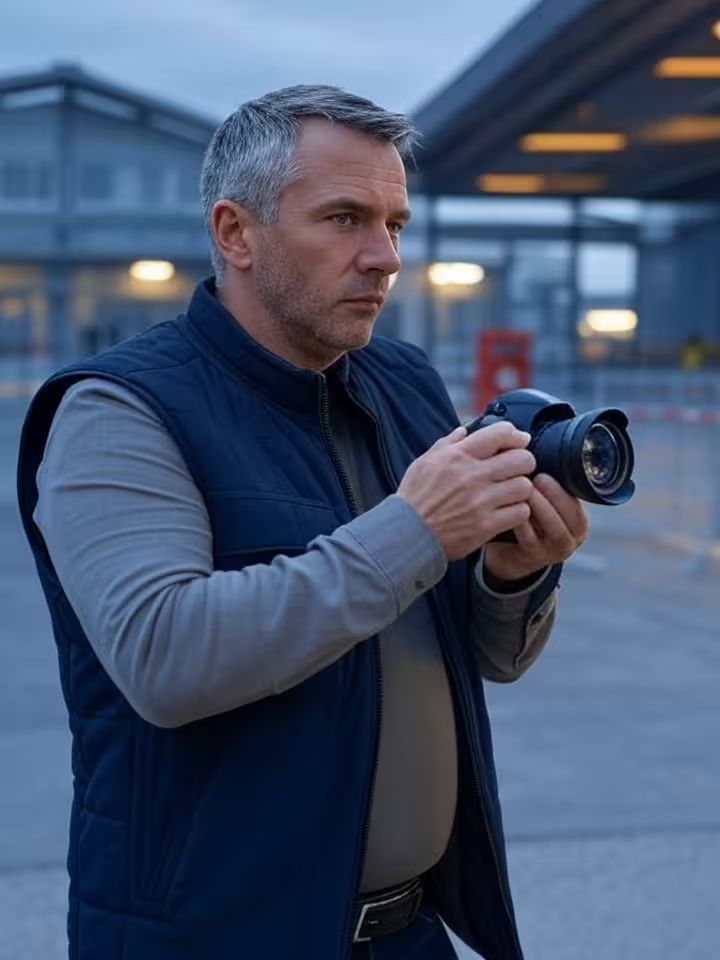
Alex Jones’ most comprehensive work on elite organizations positions Bilderberg within broader narratives of global governance. The film references the 1954 founding and uses Jones’ own footage from outside conferences, including the 2006 Ottawa meeting where he filmed protesters and security measures.
The documentary discusses verifiable participants like David Rockefeller while extending into more speculative territory. The New York Times noted its polemical style, yet it remains significant for understanding public perceptions. “Endgame” reportedly reached millions through online platforms, influencing alternative media discussions on globalism.
“Inside the Bilderberg Group” (2009) – BBC Radio 4
Presented by journalist Simon Cox, this audio documentary represents mainstream media’s investigative approach. Cox interviewed past participants and analyzed the 2009 Athens meeting, which addressed the global financial crisis. The production cross-referenced official agendas with media reports, providing grounded exploration without unsubstantiated claims.
BBC News praised the documentary for prompting official responses. Following its broadcast, the Bilderberg group issued clarifications about its non-decision-making role. This represents a rare instance of documentaries directly influencing organizational transparency.
“ShadowRing” (2015) – Philip Gardiner
Narrated by actor Kevin Sorbo, this film examines Bilderberg alongside other elite organizations like the Council on Foreign Relations. Using archival footage and references to the 1954 founding, the documentary received mixed reviews. Critics praised production quality while questioning some broader assertions about elite networks.
“The Bilderberg Connection” (2011) – James Corbett
James Corbett of The Corbett Report compiled open-source information on meetings including the 2011 St. Moritz conference. Corbett emphasizes transparency, citing official participant lists that have included tech executives in recent years. His methodical approach focuses on documented facts, making it valuable for researchers seeking evidence-based analysis.
Impact and Reception of Bilderberg Documentaries
Shaping Public Discourse
Documentaries about Bilderberg have significantly influenced media coverage and public awareness. Following Ronson’s 2001 series, outlets like The Times increased reporting on the group’s political influence. The film’s balanced tone earned critical praise for introducing audiences to real events, such as the 2000 Brussels meeting, without endorsing conspiracy theories.
Viewer feedback on platforms like IMDb highlights these films’ educational role. Many viewers reported learning about Bilderberg’s existence for the first time through these documentaries, prompting independent research into official sources.
Alternative Media Impact
Alex Jones’ “Endgame” galvanized alternative media communities, reportedly reaching millions via YouTube and other platforms. While Skeptic magazine criticized the film for blending facts with speculation, others credited it with highlighting underreported aspects, such as the 2008 Chantilly, Virginia meeting.
The documentary’s reception underscores a divide in public perception. Mainstream critics view it as alarmist, while supporters appreciate its attention to elite gatherings that receive limited conventional coverage.
Mainstream Journalism Contributions
BBC’s 2009 documentary contributed to mainstream journalism by prompting official clarifications. The Telegraph noted its factual depth and responsible approach to investigating private meetings. This demonstrates how quality documentaries can advance transparency without sensationalism.
These films have inspired subsequent books and articles, including works by investigator Daniel Estulin. They’ve promoted ongoing dialogue about accountability in global affairs and the balance between privacy and public interest.
Connections to Broader Global Issues
Economic Policy and International Relations
Several documentaries connect Bilderberg discussions to broader economic trends. “Endgame” links the 1973 Saltsjöbaden meeting’s discussions on oil prices to the subsequent energy crisis, as documented in official agendas. This connection, also reported in The Economist at the time, illustrates how documentaries use verifiable events to explore potential influence.
Ronson’s film explores how Bilderberg’s transatlantic focus may have influenced NATO policies during the Cold War, drawing on verified historical contexts. These examinations help viewers understand the group within legitimate geopolitical frameworks.
Technology and Media Influence
Films like “The Bilderberg Connection” examine tech industry participation, citing documented attendees such as Peter Thiel at the 2016 Dresden meeting. These connections are grounded in official participant lists, illustrating how documentaries use facts to discuss globalization and technological governance.
Experts writing in Foreign Affairs have argued that while Bilderberg facilitates elite networking, it does not directly dictate policy outcomes. This academic perspective helps contextualize documentary claims about the group’s influence.
Recent Focus on Artificial Intelligence
Recent Bilderberg meetings have increasingly focused on emerging technologies. AI discussions at Bilderberg conferences from 2024-2025 represent a new area of interest for documentary filmmakers, as artificial intelligence governance becomes a critical global issue.
Frequently Asked Questions
Jon Ronson’s “The Secret Rulers of the World” (2001) is widely considered the most balanced and factual documentary. It combines investigative journalism with critical analysis while avoiding sensationalism. The BBC’s “Inside the Bilderberg Group” (2009) is also highly regarded for its mainstream journalistic approach and interviews with actual participants.
Yes, several Bilderberg documentaries are freely available on platforms like YouTube and the Internet Archive. Alex Jones’ “Endgame” can be found on various video platforms. James Corbett’s “The Bilderberg Connection” is available on The Corbett Report website. However, some high-quality productions like Jon Ronson’s Channel 4 series may require subscription services or purchase.
Cross-reference claims with the official Bilderberg website (bilderbergmeetings.org), which publishes participant lists and partial agendas since 2010. Check mainstream media archives from outlets like The Guardian, BBC, and The New York Times. Compare multiple documentaries to identify consistent facts versus speculation. Look for verifiable sources, dates, and attendee names that can be independently confirmed through news reports or official records.
No documentary filmmaker has been granted official inside access to the actual Bilderberg conference discussions. The meetings remain closed to media and the public. Filmmakers like Jon Ronson and Alex Jones have documented the exterior of venues and interviewed participants before or after events, but none have filmed inside the private sessions. The BBC’s Simon Cox interviewed former participants, but these were retrospective conversations, not live access.
Documentaries present varying interpretations rather than definitive proof. Films like Ronson’s demonstrate that while Bilderberg gatherings occur and influential people attend, this doesn’t automatically validate broader conspiracy theories. More speculative documentaries make connections between meetings and world events, but correlation doesn’t prove causation. The most reliable documentaries distinguish between verified facts (participant lists, dates, locations) and interpretive analysis about potential influence.
Key Takeaways
- The Bilderberg Club Meetings began in 1954 to foster transatlantic dialogue during the Cold War, with documented annual conferences continuing to the present day.
- Jon Ronson’s “The Secret Rulers of the World” (2001) provides the most balanced investigative approach, combining journalism with critical examination of conspiracy culture.
- Alex Jones’ “Endgame” (2007) represents influential alternative media coverage that connects Bilderberg to broader geopolitical narratives, though with varying degrees of speculation.
- BBC’s “Inside the Bilderberg Group” (2009) demonstrates how mainstream journalism can examine elite gatherings while maintaining factual standards.
- These documentaries collectively shaped public discourse, prompting greater transparency including official publication of partial agendas since 2010.
- Viewers should cross-reference documentary claims with official sources and mainstream media archives to distinguish facts from interpretation.
- The best documentaries about Bilderberg serve as entry points for understanding elite networking while encouraging critical thinking about power and transparency.
Sources and Further Reading
- Official Bilderberg Meetings website: bilderbergmeetings.org
- The Guardian coverage of Jon Ronson documentary (2001): Guardian article
- BBC News on Bilderberg 2009 documentary: BBC coverage
- CBC News on 2006 Ottawa meeting protests
- The Independent review of “Secret Rulers of the World”
- The New York Times coverage of Alex Jones films (2007)
- Foreign Affairs analysis of elite networks (2014)
- The Corbett Report Bilderberg archives
- IMDb entries for documentary verification
- The Telegraph coverage of Bilderberg meetings