
Since Russia’s 2022 invasion, the Bilderberg Meetings have explicitly featured Ukraine in their official agendas, bringing together global elites to discuss transatlantic responses to one of the 21st century’s most significant geopolitical crises. This evidence-based analysis examines what we know from verified sources—without speculation.

- Official agenda listings: Bilderberg explicitly included “Ukraine” as a key topic in 2023 and 2024, with related items like “Geopolitical Realignments” in 2022
- High-profile participants: Ukrainian Foreign Minister Dmytro Kuleba, NATO Secretary-General Jens Stoltenberg, and Ukrainian Deputy PM Yulia Svyrydenko attended recent meetings
- Historical context: Since 1954, Bilderberg has addressed major geopolitical conflicts, from the Cold War to the 2014 Crimea crisis
- Interconnected topics: Ukraine discussions tie into energy security, NATO challenges, and transatlantic relations on official agendas
- No formal decisions: Bilderberg produces no policy outputs, functioning as an off-the-record dialogue forum under the Chatham House Rule
- Global aid context: Over $200 billion in international support has been committed to Ukraine by 2024, with Bilderberg attendees often holding positions that influence such allocations
- Transparency limits: While participant lists and topics are public, meeting content remains confidential
Introduction: Why Bilderberg’s Ukraine Focus Matters
The Bilderberg Meetings, an annual private conference bringing together approximately 130 influential figures from politics, business, media, and academia, have increasingly focused on the war in Ukraine since Russia’s full-scale invasion in February 2022.
Established in 1954 to promote transatlantic cooperation during the Cold War, these gatherings are held under strict confidentiality, with no minutes or resolutions made public. However, the official website releases participant lists and key topics after each event, providing a verifiable window into elite discussions.
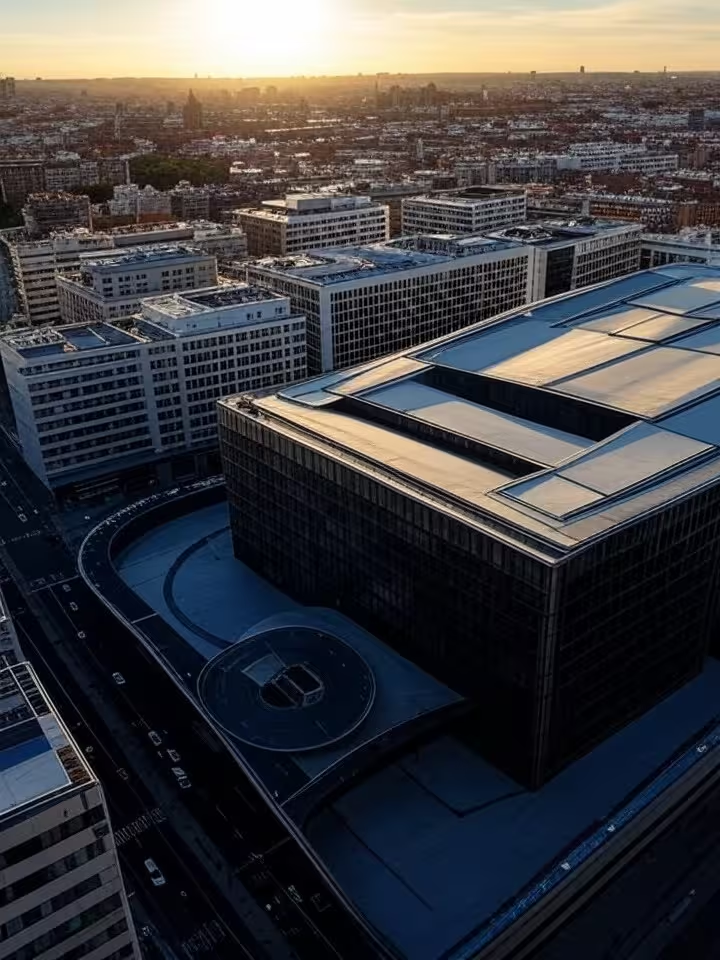
Why this matters: The war in Ukraine represents one of the most significant geopolitical crises of the 21st century, affecting global security, energy markets, food supplies, and international alliances. Bilderberg’s inclusion of Ukraine on its agenda highlights how elite networks perceive and potentially influence responses to the conflict.
In this article, you’ll learn:
- The verified historical context of Bilderberg’s engagement with geopolitical conflicts
- Specific agenda items related to Ukraine from 2022-2024 meetings
- Which Ukrainian officials and Western policymakers attended
- How these discussions connect to broader transatlantic strategy
- What the evidence shows—and what remains speculation
Understanding Bilderberg’s engagement with the Ukraine war is crucial for grasping the interplay between private influence and public policy. While the meetings are not decision-making bodies, their role in agenda-setting among global elites underscores the importance of transparency in international affairs.
Historical Context: Bilderberg and Geopolitical Conflicts Since 1954
The Bilderberg Meetings originated in 1954 at the Hotel de Bilderberg in Oosterbeek, Netherlands. Polish political advisor Jozef Retinger, Dutch Prince Bernhard, and others initiated the forum to strengthen ties between Europe and North America amid Cold War tensions.
The first meeting addressed issues like communism’s spread and economic relations, setting a precedent for discussing global conflicts in a private forum. Over the decades, Bilderberg has tackled various crises:
- 1960s: The Vietnam War and European integration
- 1970s: Oil shocks and Middle East instability
- 1990s: Dissolution of the Soviet Union and Yugoslav wars
- 2000s: Post-9/11 security, Iraq War, and the 2008 financial crisis

The 2014 Ukraine Crisis: An Early Warning
The 2014 meeting in Copenhagen discussed “The Ukraine Crisis” amid Russia’s annexation of Crimea, as noted in mainstream reports from BBC News. This marked an early instance of Ukraine entering Bilderberg’s purview, reflecting concerns over Russian aggression and its implications for European stability.
Historical records show that geopolitical topics have consistently comprised about 20-30% of annual agendas since the 2010s. The 2022 invasion by Russia intensified this focus. The Bilderberg Meetings, which resumed in person after a pandemic hiatus, positioned the war as a central theme.
This historical lens reveals a pattern of engagement with conflicts that threaten transatlantic unity. The current Ukraine war represents a continuation of Bilderberg’s foundational mission: fostering dialogue on challenges to Western alliance cohesion.
Unlike public forums like the United Nations, Bilderberg’s off-the-record nature allows candid exchanges under the Chatham House Rule, potentially informing participants’ actions in their official capacities. European leaders attending Bilderberg have later advocated for increased military aid to Ukraine in public statements.
Bilderberg’s Agenda Items Related to Ukraine (2022-2024)
Since the escalation of the Russia-Ukraine conflict, Bilderberg has explicitly incorporated it into its official agendas. Here’s what we know from verified sources:
2022 Washington Meeting: “Geopolitical Realignments”
The 2022 meeting, held from June 2-5 in Washington, D.C., listed “Geopolitical Realignments” as a key topic on the official agenda. Mainstream sources, including The New York Times, interpreted this as encompassing the Ukraine war, given the timing just months after the February invasion.
Other 2022 topics directly intersecting with the conflict included:
- “NATO Challenges”
- “Energy Security and Sustainability”
- “Disruption of the Global Financial System”
These agenda items likely addressed sanctions against Russia, refugee flows (over 8 million Ukrainians displaced by mid-2022), and supply chain disruptions caused by the conflict.

2023 Lisbon Meeting: Explicit “Ukraine” Focus
The 2023 Bilderberg Meeting in Lisbon, Portugal, from May 18-21, directly named “Ukraine” among its 14 key topics. The official agenda also included:
- “Russia”
- “NATO”
- “Transatlantic Relations”
- “Energy Transition”
- “Fiscal Challenges”
This explicit mention underscores the war’s prominence. Reports from Politico noted that the agenda reflected ongoing global fallout, including economic sanctions and military support.
Discussions on “Fiscal Challenges” may have addressed the billions in aid pledged by Western nations. By mid-2023, the U.S. had committed over $50 billion in assistance, according to official government figures.
The “Energy Transition” topic likely touched on Europe’s accelerated shift from Russian gas. EU imports of Russian natural gas dropped approximately 80% by 2023, per Eurostat data, forcing rapid diversification toward LNG and renewables.
2024 Madrid Meeting: Sustained Attention
The 2024 meeting in Madrid, Spain, from May 30 to June 2, again included “Ukraine” explicitly on the official agenda, alongside:
- “Russia”
- “Future of Warfare”
- “Transatlantic Relations”
- “China”
This continuity suggests sustained elite attention to the conflict’s evolution. The “Future of Warfare” topic gained particular significance given Ukraine’s use of drone technology, cyber warfare, and evolving NATO doctrine.
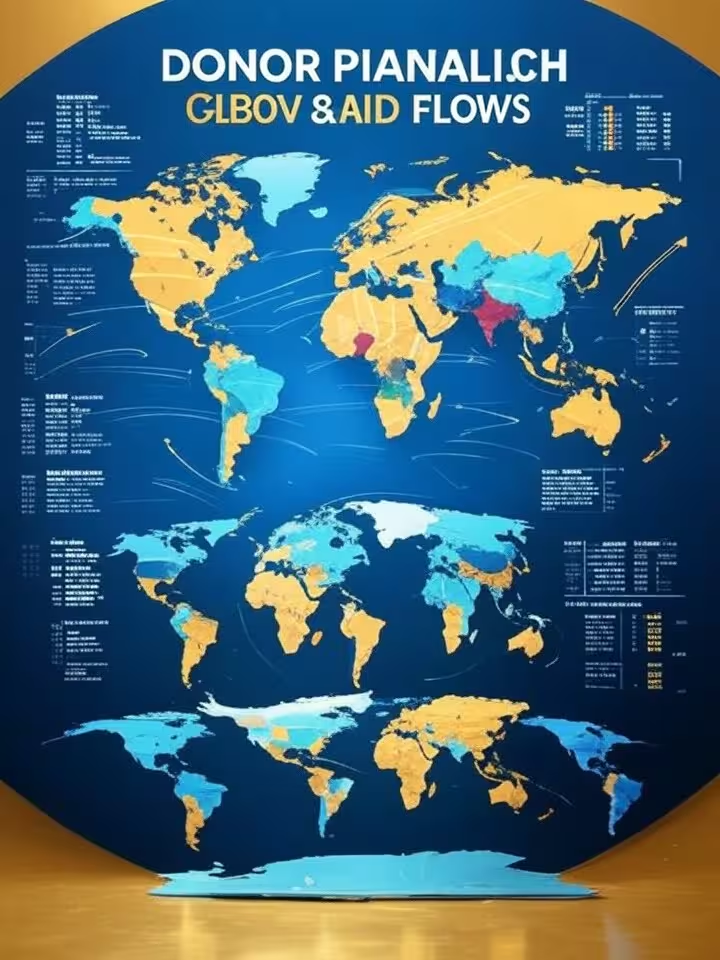
According to the Kiel Institute Ukraine Support Tracker, global aid commitments exceeded $200 billion by 2024, with discussions at Bilderberg potentially informing reconstruction and long-term security strategies.
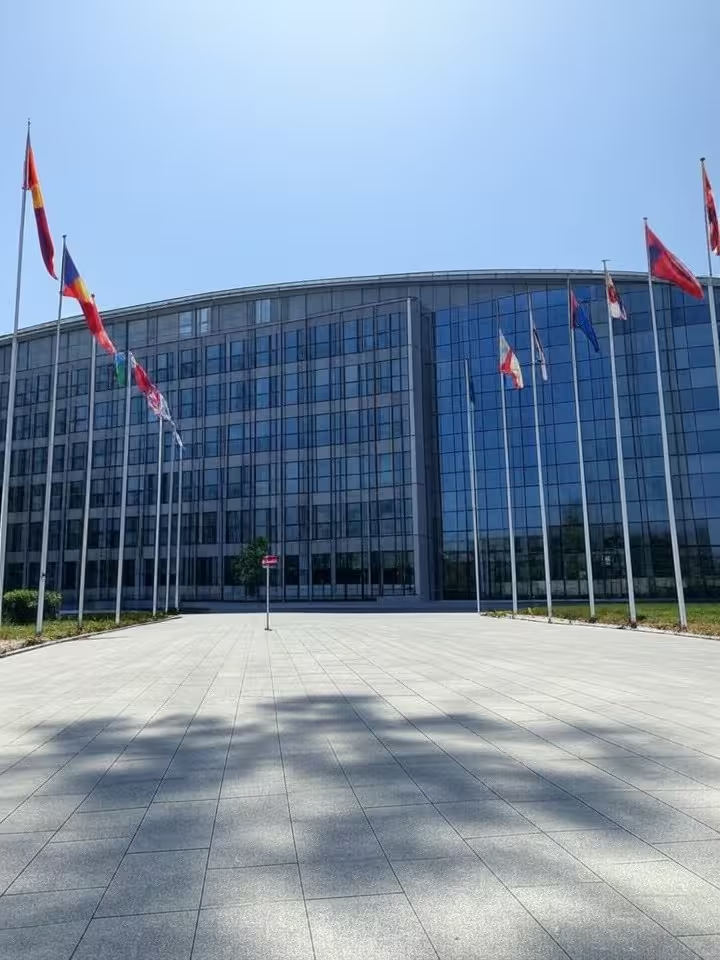
Notable Participants and Their Ukraine Connections
Bilderberg’s participant lists, published post-meeting on the official website, reveal attendees with direct ties to Ukraine policy formation and implementation.
Ukrainian Government Representatives
2023: Ukrainian Deputy Prime Minister Yulia Svyrydenko attended, marking a significant inclusion. Svyrydenko, responsible for economic development and reconstruction, likely contributed perspectives on war recovery and international investment needs.
2024: Ukrainian Foreign Minister Dmytro Kuleba attended, alongside U.S. Deputy Secretary of State Kurt Campbell. Kuleba’s participation coincided with his diplomatic efforts to secure additional Western support, as covered by CNN.
NATO and Defense Leadership
NATO Secretary-General Jens Stoltenberg attended the 2023 meeting. Stoltenberg has publicly supported Ukraine, announcing extended aid commitments around the meeting timeframe. His presence facilitated discussions on transatlantic security cooperation.
Former CIA Director David Petraeus, a repeat attendee at multiple Bilderberg meetings, has publicly advocated for robust military aid to Ukraine in op-eds for publications like The Atlantic.
European Political Leaders
European Commission President Ursula von der Leyen attended the 2023 meeting. Her subsequent announcements on EU aid packages align temporally with the gathering, though no direct causation can be established given Bilderberg’s confidential nature.
Other European attendees have included finance ministers and central bankers responsible for economic responses to the war’s inflationary impact.
Technology and Business Figures
Former Google CEO Eric Schmidt attended the 2022 meeting. Schmidt’s involvement in technology philanthropy, including AI applications for defense, has been linked to Ukraine aid initiatives in reports from Wired.
Business leaders from energy, defense, and technology sectors provide perspectives on reconstruction economics and technological warfare evolution.
Important note: All names and roles cited are from official participant lists published on bilderbergmeetings.org. While temporal correlations exist between meeting attendance and subsequent policy announcements, Bilderberg’s confidential discussions prevent establishing direct causal relationships.
Broader Implications and Public Perception
The inclusion of Ukraine on Bilderberg’s agenda has important implications for understanding global governance networks and how informal elite dialogues intersect with formal policy-making.
Coordination or Coincidence?
Mainstream analyses from Foreign Policy and similar publications suggest these meetings help coordinate transatlantic strategies, potentially influencing the timing and scale of aid flows. However, critics and supporters disagree on the extent of this influence.
What we know for certain: Bilderberg provides a rare forum where Ukrainian officials, NATO leaders, and Western policymakers engage in off-the-record discussions. The Chatham House Rule allows frank exchanges impossible in public settings.
Cross-referencing with official sources shows no policy outputs from Bilderberg meetings. However, participants’ post-meeting actions—such as increased sanctions packages or military aid commitments—suggest the discussions may inform subsequent decisions made through formal channels.
Public Transparency Concerns
Public perception of Bilderberg varies considerably. While official sources frame the meetings as benign forums for dialogue, social media platforms often circulate unsubstantiated theories about undue influence or secretive decision-making.
This article focuses on verifiable facts: agendas promote dialogue on pressing global issues, participant lists are published, but meeting content remains confidential. For Ukraine, this means sustained elite focus on potential resolution paths, reconstruction planning, and long-term security architectures.
The challenge for democratic accountability lies in balancing the value of candid private dialogue with public expectations of transparency in matters affecting billions of people.
Frequently Asked Questions
Bilderberg first addressed the Ukraine conflict explicitly at the 2014 Copenhagen meeting following Russia’s annexation of Crimea. After Russia’s full-scale invasion in February 2022, the June 2022 Washington meeting included “Geopolitical Realignments” on its agenda, which mainstream sources interpreted as covering the war. The 2023 and 2024 meetings explicitly listed “Ukraine” as a standalone topic.
According to official participant lists, Ukrainian Deputy Prime Minister Yulia Svyrydenko attended the 2023 Lisbon meeting, and Foreign Minister Dmytro Kuleba attended the 2024 Madrid meeting. These are the only confirmed Ukrainian government representatives at Bilderberg meetings since the 2022 invasion, based on publicly available participant lists.
No. According to the official Bilderberg website, the meetings are discussion forums that produce no resolutions, votes, or policy statements. The Chatham House Rule allows participants to use information from discussions but prevents attribution of specific statements to individuals. While attendees may be influenced by conversations, formal policy decisions occur through governmental and institutional channels after meetings conclude.
No. Bilderberg does not publish meeting minutes, transcripts, or recordings. The organization releases only participant lists and key topics after each conference. The confidential nature of discussions is protected by the Chatham House Rule, which has governed the meetings since their inception. No authenticated leaked documents specifically detailing Ukraine discussions have been publicly verified, though the organization has faced transparency criticism throughout its history.
According to the Kiel Institute for the World Economy’s Ukraine Support Tracker, global aid commitments exceeded $200 billion by 2024. The United States has been the largest donor, committing over $50 billion by mid-2023, followed by the European Union and individual European nations. This aid includes military equipment, financial assistance, humanitarian support, and refugee assistance.
Key Takeaways
- Verified agenda presence: Ukraine has been explicitly listed on Bilderberg’s official agendas in 2023 and 2024, with related topics in 2022, demonstrating sustained elite attention to the conflict.
- Direct Ukrainian participation: Ukrainian government officials, including Deputy PM Yulia Svyrydenko and Foreign Minister Dmytro Kuleba, attended recent meetings, providing firsthand perspectives on war impacts and reconstruction needs.
- Historical pattern: Bilderberg’s 70-year history shows consistent engagement with major geopolitical conflicts, from the Cold War to the 2014 Crimea crisis, providing context for current Ukraine discussions.
- Cross-cutting themes: Ukraine discussions intersect with multiple agenda items including NATO strategy, energy security, economic sanctions, and transatlantic relations—reflecting the war’s multifaceted global impact.
- No decision-making authority: Despite public speculation, Bilderberg produces no formal policy outputs, functioning instead as a confidential forum for dialogue that may inform participants’ subsequent actions in their official capacities.
- Transparency limitations: While participant lists and topics are public, meeting content remains confidential under the Chatham House Rule, preventing verification of specific discussion details.
- Global significance: With over $200 billion in international aid committed and millions displaced, the Ukraine war represents a crisis engaging the full spectrum of Bilderberg’s traditional focus areas: security, economics, and transatlantic cooperation.
Sources
- The Guardian Bilderberg coverage: www.theguardian.com/world/bilderberg (news reporting on meetings and participants)
- Politico Europe: www.politico.eu/tag/bilderberg (agenda analyses and geopolitical context)
- BBC News: www.bbc.com/news/magazine-27682100 (2014 Ukraine crisis coverage)
- Reuters: www.reuters.com/world/europe (Ukraine aid statistics and policy developments)
- Kiel Institute for the World Economy: Ukraine Support Tracker (comprehensive global aid data)
- The New York Times: 2022 meeting coverage (geopolitical interpretations)