Two of the world’s most influential gatherings—the public spectacle of Davos and the private discussions of Bilderberg—shape global policy in fundamentally different ways. Understanding their contrasting approaches reveals how elite networks influence international affairs.
Founded: Bilderberg in 1954 for transatlantic dialogue; WEF in 1971 for economic cooperation
Transparency: Bilderberg operates under strict confidentiality; Davos broadcasts sessions publicly
Focus: Bilderberg emphasizes Western political-economic relations; Davos addresses global economic challenges
Outcomes: Bilderberg produces no public resolutions; Davos generates initiatives, reports, and policy frameworks
Access: Bilderberg is invitation-only by steering committee; Davos requires membership or paid participation
Media: Bilderberg allows minimal press access; Davos partners extensively with global media
Introduction: Two Forums, Two Philosophies
Every January, the world’s attention turns to the Swiss Alps where business titans, heads of state, and celebrities gather for the World Economic Forum in Davos. Meanwhile, each spring, approximately 130 of the world’s most influential figures meet in complete secrecy for the Bilderberg Meeting—an event most people have never heard of.
These two gatherings represent fundamentally different approaches to global elite networking. Davos champions transparency, stakeholder capitalism, and public engagement with thousands of participants and live-streamed sessions. Bilderberg operates under the Chatham House Rule, where discussions remain confidential to encourage frank dialogue among Western power brokers.
Understanding these differences matters because both forums influence policy discussions that affect billions of people. While critics accuse both of being undemocratic “shadow governments,” the evidence reveals more nuanced realities about how global elites exchange ideas and build consensus.
In this article, you’ll learn:
The verified historical origins and evolution of both forums
How their structures, attendance policies, and transparency levels differ
Their distinct focus areas and measurable global impacts
Documented connections and overlaps between the two gatherings
Evidence-based analysis without conspiracy theories or speculation
Historical Origins: Cold War Dialogue vs. European Management
The Birth of Bilderberg (1954)
The first Bilderberg Meeting took place in May 1954 at the Hotel de Bilderberg in Oosterbeek, Netherlands. Polish political adviser Jozef Retinger, Prince Bernhard of the Netherlands, and CIA director Walter Bedell Smith organized this gathering amid deepening Cold War tensions.
According to the official Bilderberg website, the conference aimed “to foster dialogue between Europe and North America” during a period when transatlantic misunderstandings threatened Western unity. The initial meeting brought together approximately 50 participants from 11 countries to discuss European integration, communism, and economic cooperation.
The geopolitical context was critical. Western Europe was recovering from World War II, NATO had just been formed (1949), and the United States was establishing its role as a global superpower. Bilderberg provided a private forum for American and European elites to build personal relationships away from public scrutiny.
The Creation of the World Economic Forum (1971)
Seventeen years later, German economist Klaus Schwab founded the European Management Forum in 1971, which would become the World Economic Forum. Unlike Bilderberg’s geopolitical origins, the WEF emerged from academic and business management concerns.
According to the WEF’s official history, Schwab’s initial vision focused on introducing European firms to American management practices. The first meeting in Davos attracted 444 participants from 31 countries, primarily business executives.
Throughout the 1980s and 1990s, the forum expanded its scope dramatically. It launched the Global Competitiveness Report in 1979, invited political leaders alongside business figures, and increasingly addressed worldwide challenges beyond corporate management.
Diverging Evolutionary Paths
The subsequent decades reveal contrasting trajectories. Bilderberg maintained its focus on transatlantic elite dialogue, adapting topics to changing circumstances—from Cold War strategy in the 1960s to European monetary union in the 1990s to artificial intelligence in the 2020s—but preserving its intimate, confidential format.
The WEF transformed into a massive global platform. It established regional meetings across continents, created the Young Global Leaders program (2004), and positioned itself as the world’s premier multistakeholder organization addressing issues from climate change to pandemic preparedness.
Structure and Attendance: Intimate Secrecy vs. Grand Spectacle
Bilderberg’s Exclusive Model
Bilderberg Meetings remain remarkably consistent in structure. Each year, a steering committee invites approximately 120-150 participants for a three-day conference, typically held at secluded luxury hotels. Recent venues include Washington DC (2022), Lisbon (2023), and Madrid (2024), according to official attendee lists.
The invitation process is opaque and non-democratic. The steering committee—composed of former participants—selects attendees based on influence, expertise, and the need for balanced representation between Europeans and North Americans (roughly two-thirds to one-third ratio).
All discussions operate under the Chatham House Rule: participants may use information received, but cannot reveal the identity or affiliation of speakers. No resolutions are voted upon, no policy statements are issued, and no binding decisions are made. The only public-facing elements are a brief press release listing topics and a participant roster published after the meeting concludes.
Davos’s Massive Platform
The World Economic Forum Annual Meeting operates on an entirely different scale. Held every January in Davos, Switzerland, the event spans five days and hosts over 2,500 official participants. When including security personnel, media, and support staff, the total presence exceeds 10,000 people in a town with a normal population of approximately 11,000.
Participation at Davos requires either WEF membership (with annual fees exceeding $60,000 for corporations) or special invitation. The forum features hundreds of sessions simultaneously—official panels, private roundtables, corporate events, and networking receptions spread across multiple venues.
Unlike Bilderberg’s secrecy, many Davos sessions are broadcast live on the WEF website and YouTube channel. Detailed agendas are published in advance, and the forum produces extensive post-meeting documentation including session summaries, white papers, and initiative announcements.
Transparency Comparison
The transparency gap between these forums is vast. Bilderberg’s media policy allows only a brief press conference with no Q&A, and journalists cannot observe discussions. Participant lists were not publicly released until 2010, and even now, only names and affiliations are provided—no photographs, no session details, no outcomes.
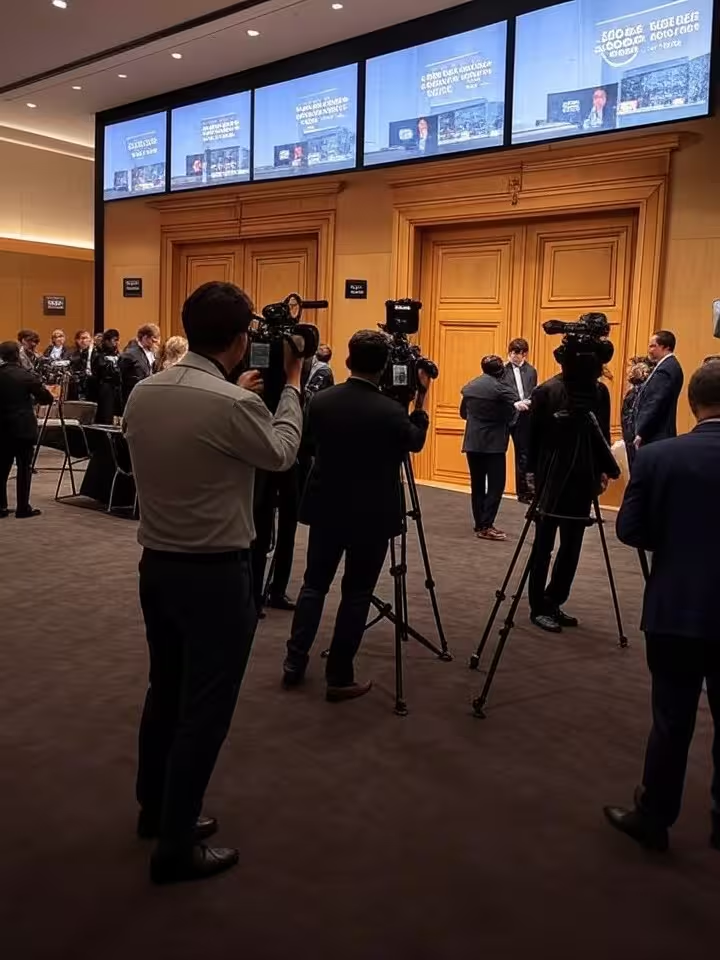
Davos, conversely, partners with major media outlets that establish temporary studios in town. Journalists from hundreds of organizations attend, conducting interviews and covering sessions extensively. The WEF actively encourages social media engagement, with official hashtags trending globally during the meeting.
This structural difference reflects their foundational philosophies: Bilderberg believes privacy enables honest dialogue among decision-makers, while Davos champions public discourse as essential for legitimacy in democratic societies.
Focus Areas and Documented Impacts
Bilderberg’s Thematic Priorities
Official Bilderberg agendas reveal consistent focus areas: transatlantic relations, global economic conditions, geopolitical tensions, technology, and security. The 2023 Lisbon meeting agenda included topics such as “Banking System,” “Deglobalisation,” “China,” “AI,” and “Energy Transition.”
These topics reflect Western elite concerns at specific moments. The 2022 Washington meeting discussed Ukraine extensively following Russia’s invasion. The 2019 meeting addressed “The Future of Capitalism” as populist movements gained strength globally.
Measuring Bilderberg’s impact is challenging precisely because of its confidentiality. Advocates argue this privacy allows participants to explore ideas without political constraints or media misinterpretation. Critics contend this lack of accountability enables coordination that bypasses democratic processes.
Some documented connections exist: The meeting in 1955 discussed European integration, years before the Treaty of Rome established the European Economic Community. Discussions in the 1990s addressed monetary union prior to the euro’s 1999 launch. However, correlation does not prove causation, and Bilderberg produces no policy papers or formal recommendations.
Davos’s Actionable Initiatives
The World Economic Forum explicitly aims to produce tangible outcomes. Each annual meeting concludes with announcements of initiatives, commitments, and partnerships. The forum publishes influential reports, including the Global Risks Report (analyzing threats like climate change, cybersecurity, and pandemics) and the Global Competitiveness Report (ranking national economies).
Verifiable initiatives launched at or through Davos include:
Gavi, the Vaccine Alliance (2000): Created at Davos, this public-private partnership has immunized over 981 million children worldwide
The Global Alliance for Improved Nutrition (2002): Addresses malnutrition affecting over 2 billion people
The Net-Zero Challenge: Hundreds of companies have committed to science-based climate targets through WEF initiatives
Digital transformation frameworks: The forum’s Centre for the Fourth Industrial Revolution works with governments on AI, blockchain, and IoT governance
The WEF also influences international discourse by setting agenda themes. The 2019 theme “Globalization 4.0” helped frame discussions about technology’s impact on work. The 2024 theme “Rebuilding Trust” responded to erosion of confidence in institutions globally.
Comparing Influence Mechanisms
Bilderberg’s influence operates through informal networks and personal relationships developed during meetings. Participants return to their institutions—governments, corporations, media organizations—potentially shaped by conversations held in confidence.
Davos’s influence is more visible: through published research, public commitments by leaders, media coverage that shapes public opinion, and formal partnerships that allocate resources. The forum positions itself as facilitating global cooperation, though critics note that solutions often reflect elite perspectives rather than grassroots needs.
Both face similar criticisms regarding representation. Bilderberg’s Western focus excludes voices from the Global South, while Davos’s high participation costs limit attendance despite efforts at geographic diversity. Neither forum represents democratic decision-making, but rather elite consensus-building.
Connections, Overlaps, and Shared Networks
The Revolving Door of Elite Participation
Significant overlap exists in attendance between Bilderberg and Davos. Many prominent figures participate in both forums, including business leaders from major corporations, senior government officials, central bankers, and influential academics.
Analysis of published participant lists reveals common attendees such as former European Commission presidents, CEOs of major financial institutions, and technology company founders. This overlap is unsurprising given both forums target global elites, though Bilderberg’s much smaller size makes it significantly more exclusive.
However, no formal institutional relationship exists between the Bilderberg Meetings and the World Economic Forum. They remain independent organizations with separate governance structures, funding sources, and operational models. The connection is primarily through individuals who move within elite networks rather than organizational coordination.
Complementary Rather Than Competitive
Rather than competing, these forums appear to serve complementary functions within global elite discourse. Bilderberg provides a space for confidential, strategic conversations among Western decision-makers. Davos offers a platform for public positioning, announcement of initiatives, and broader networking across sectors and regions.
The timing also differs strategically. Davos occurs in January, effectively setting agenda themes for the year ahead. Bilderberg meets in late spring, potentially allowing for more reflective discussions about issues that have developed since winter.
Connections to Other Elite Forums
Both Bilderberg and Davos exist within a broader ecosystem of elite gatherings. Bilderberg shares participants with the Trilateral Commission (founded 1973), while Davos connects to the WEF’s regional summits and specialized meetings.
Understanding these networks requires avoiding conspiracy theories while acknowledging documented connections. These forums facilitate relationship-building among elites who subsequently make decisions in their official capacities. Whether this represents efficient coordination or undemocratic concentration of power remains a matter of legitimate political debate.
Frequently Asked Questions
Which forum is more influential: Bilderberg or Davos?
This depends on how influence is measured. Bilderberg’s confidential format may enable franker discussions among decision-makers, potentially leading to aligned positions when participants return to their institutions. Davos produces measurable outcomes through published initiatives, corporate commitments, and policy frameworks. Bilderberg likely has greater influence on Western strategic thinking, while Davos shapes global economic discourse more broadly.
Can ordinary people attend either forum?
No. Bilderberg is strictly invitation-only by steering committee decision with no application process. Davos requires either WEF membership (costing tens of thousands of dollars annually) or special invitation, effectively limiting attendance to wealthy individuals, corporate representatives, or those sponsored by organizations. Neither forum offers public access, though Davos streams some sessions online for viewing.
Do decisions made at these forums affect government policy?
Neither forum makes binding decisions or issues policy directives. However, when government officials, central bankers, and corporate leaders discuss issues and potentially reach informal consensus, this can influence subsequent policy development. The causal relationship is difficult to prove definitively, but the presence of decision-makers at both forums suggests conversations likely inform their thinking. Democratic accountability remains a legitimate concern.
Why does Bilderberg maintain such strict secrecy compared to Davos?
The official explanation is that confidentiality enables participants to speak candidly without concern for media misrepresentation or political backlash. This follows the Chatham House Rule used in diplomatic and policy circles. Critics argue secrecy enables coordination without public accountability. The contrasting approaches reflect different philosophies: Bilderberg prioritizes frank dialogue among elites, while Davos embraces public engagement as essential for legitimacy in democratic societies.
Has anyone attended both Bilderberg and Davos in the same year?
Yes, numerous individuals have attended both forums within the same year, including prominent business leaders, senior government officials, and central bankers. Cross-referencing published participant lists reveals significant overlap, though Bilderberg’s much smaller size (130 vs. 2,500+ participants) makes it far more exclusive. These individuals often hold positions that make participation in multiple elite forums professionally relevant.
Are conspiracy theories about these forums based on evidence?
Most conspiracy theories about both forums lack credible evidence. Claims that either organization controls world governments, orchestrates economic crises, or implements secret agendas are not supported by documentation. However, legitimate questions exist about elite networking, democratic accountability, and concentration of influence. Critical analysis should focus on verified information rather than speculation. Both organizations are secretive or exclusive to degrees that warrant public scrutiny, but this doesn’t validate unfounded conspiracy claims.
Key Takeaways
Fundamental structural differences: Bilderberg hosts approximately 130 participants in complete confidentiality for three days annually, while Davos convenes 2,500+ attendees with extensive media coverage over five days, reflecting contrasting philosophies about elite dialogue.
Historical origins reveal different purposes: Bilderberg emerged in 1954 to strengthen transatlantic relations during the Cold War, while the WEF was founded in 1971 to address European business management, later expanding to global economic challenges.
Transparency creates the starkest contrast: Bilderberg operates under the Chatham House Rule with no public outputs beyond topic lists, while Davos broadcasts sessions globally, publishes extensive research, and actively engages media—demonstrating opposite approaches to public accountability.
Measurable outcomes differ significantly: Davos produces verifiable initiatives like Gavi (immunizing 981M+ children) and influential reports, while Bilderberg’s impact remains indirect through informal networks, making its influence difficult to document but potentially significant through elite consensus-building.
Both warrant democratic scrutiny: Despite their differences, neither forum represents democratic decision-making processes. The concentration of influential figures discussing global issues away from public oversight raises legitimate questions about accountability, regardless of whether discussions are private (Bilderberg) or public (Davos).
To provide the best experiences, we use technologies like cookies to store and/or access device information. Consenting to these technologies will allow us to process data such as browsing behavior or unique IDs on this site. Not consenting or withdrawing consent, may adversely affect certain features and functions.
Functional
Always active
The technical storage or access is strictly necessary for the legitimate purpose of enabling the use of a specific service explicitly requested by the subscriber or user, or for the sole purpose of carrying out the transmission of a communication over an electronic communications network.
Preferences
The technical storage or access is necessary for the legitimate purpose of storing preferences that are not requested by the subscriber or user.
Statistics
The technical storage or access that is used exclusively for statistical purposes.The technical storage or access that is used exclusively for anonymous statistical purposes. Without a subpoena, voluntary compliance on the part of your Internet Service Provider, or additional records from a third party, information stored or retrieved for this purpose alone cannot usually be used to identify you.
Marketing
The technical storage or access is required to create user profiles to send advertising, or to track the user on a website or across several websites for similar marketing purposes.