Declassified CIA documents from the Cold War era reveal the U.S. intelligence community’s monitoring of Bilderberg conferences, offering rare insights into how the agency viewed this elite transatlantic forum. These files, released under FOIA, show awareness and tracking of participants but no evidence of direct control, providing a factual foundation to assess Bilderberg’s role in global power structures.
TL;DR
- Declassified CIA documents from the 1950s-1970s reference Bilderberg meetings in intelligence memos and diplomatic cables
- A 1955 CIA memorandum discusses the second Bilderberg conference in France with U.S. official participation
- Documents mention key figures like Prince Bernhard and track discussions on transatlantic security and economic policy
- No declassified files provide evidence of CIA control over Bilderberg operations
- Files are accessible via CIA’s FOIA Electronic Reading Room, offering verifiable research material
- Documents emphasize Cold War diplomatic intelligence rather than covert manipulation
- Further declassifications may reveal additional information, but current evidence supports monitoring over orchestration
Introduction: Why CIA Documents on Bilderberg Matter
The Bilderberg Group has operated as one of the world’s most exclusive forums for over seven decades, bringing together influential figures from politics, business, academia, and media. Since its founding in 1954, the group’s closed-door discussions have generated intense public interest and speculation about its true influence on global affairs.
Declassified CIA documents provide a unique window into how U.S. intelligence viewed this elite gathering during its formative years. These files matter because they offer verifiable evidence about Bilderberg’s role in transatlantic relations during the Cold War, separate from speculation and conspiracy theories.

In this article, you’ll learn:
- What specific CIA documents mention Bilderberg and what they reveal
- The historical context of CIA interest in the conference
- Key participants and topics tracked by U.S. intelligence
- How to access these declassified files for your own research
- The factual limitations and what remains unknown
Historical Context: Bilderberg’s Founding and Early CIA Awareness
The Bilderberg Group emerged from post-World War II concerns about growing anti-American sentiment in Western Europe. The inaugural meeting took place from May 29 to 31, 1954, at the Hotel de Bilderberg in Oosterbeek, Netherlands.
Polish political advisor Jozef Retinger and Prince Bernhard of the Netherlands organized the gathering with the explicit goal of fostering dialogue between American and European leaders. The timing was strategic—occurring during the height of Cold War tensions when Western unity against Soviet influence was paramount.

The CIA’s Cold War Intelligence Priorities
During the 1950s, the CIA actively monitored European political movements and gatherings that could influence U.S. foreign policy interests. This surveillance was part of broader efforts to strengthen NATO and counter communist expansion.
Declassified CIA documents first mention Bilderberg in the mid-1950s. A notable example is a CIA memorandum dated March 18, 1955, discussing preparations for the second Bilderberg conference in Barbizon, France, held from March 18 to 20, 1955. Released in 2001 under the Freedom of Information Act, this document notes the participation of C.D. Jackson, a former psychological warfare advisor to President Eisenhower.
The memo describes the conference as a platform for “frank and open discussions” on European integration and Atlantic cooperation. Importantly, it does not suggest CIA orchestration—only awareness and monitoring of discussions relevant to U.S. interests.
Early Meeting References in Intelligence Files
A 1960 CIA report references a Bilderberg meeting in Switzerland, noting discussions on economic policies amid the European Economic Community’s formation. These references suggest the CIA viewed Bilderberg as a valuable diplomatic intelligence source rather than a covert operation under its control.
Cross-referencing with official Bilderberg sources confirms the dates and locations of these early meetings. Mainstream news outlets like The New York Times reported on the group’s existence as early as 1954, describing it as a gathering of “prominent citizens.”
Key Declassified Documents: What the Files Actually Say
Several specific CIA documents provide concrete references to Bilderberg meetings, primarily in the form of information reports and diplomatic cables from the 1950s through the 1970s.
The 1957 St. Simons Island Conference
One prominent file is a 1957 CIA memo on the Bilderberg conference held in St. Simons Island, Georgia, from February 15 to 17, 1957. Declassified in 1997, this document lists participants including David Rockefeller and summarizes discussions on Middle East stability and nuclear energy.

The memo emphasizes the group’s non-binding nature—participants attended in personal capacities rather than as official government representatives. This distinction is crucial for understanding Bilderberg’s actual function versus speculative claims about its power.
The 1962 Sweden Meeting
A 1962 document references the Bilderberg meeting in Saltsjobaden, Sweden, from May 18 to 20, 1962. This diplomatic cable notes U.S. Ambassador J. Graham Parsons’ involvement and highlights talks on trade liberalization amid the Kennedy Round of GATT negotiations.
The CIA’s interest appears tied to economic intelligence gathering—the agency monitored global financial trends that could affect American economic interests during this period of rapid international trade expansion.
The 1975 Turkey Conference
A 1975 document mentions the Bilderberg conference in Cesme, Turkey, from April 25 to 27, 1975, in the context of post-Watergate intelligence reforms. It briefly notes the attendance of then-Secretary of State Henry Kissinger, who had been a regular participant since the 1950s.
These documents are accessible via the CIA’s FOIA Electronic Reading Room, which hosts over 12 million pages of declassified material from various intelligence operations and monitoring activities.
Common Themes in Declassified Files
Analysis of available documents shows consistent themes:
- Transatlantic security cooperation during the Cold War
- Economic policy discussions affecting Western trade
- Anti-communist strategies for European stability
- Diplomatic intelligence on key European and American figures
A 1959 report discusses the Fiuggi, Italy, meeting from October 2 to 4, 1959, focusing on European unity. No documents reveal classified agendas or decision-making processes, aligning with Bilderberg’s official stance on confidentiality while allowing information sharing.

What the Documents Don’t Show: Separating Fact from Speculation
It’s crucial to understand what declassified CIA documents do not contain regarding Bilderberg. No available files indicate:
- Direct CIA funding or financial support of Bilderberg operations
- CIA orchestration of meeting agendas or participant selection
- Evidence of Bilderberg as a covert CIA operation
- Instructions from the agency to Bilderberg organizers
- CIA manipulation of conference outcomes or decisions
The documents show awareness and intelligence gathering—standard practice for significant international gatherings—rather than control or manipulation. This distinction is essential for accurate analysis.
The Limitation of Declassified Materials
Many CIA documents remain classified, and FOIA requests continue to yield new releases. A 2018 batch included memos from the 1980s, but none directly tied to Bilderberg beyond peripheral references.
This scarcity emphasizes the need for cautious interpretation. Absence of evidence in declassified files doesn’t prove absence of any relationship, but it also doesn’t support unverified conspiracy theories without additional documentation.
Notable Participants in CIA Documents
Declassified files mention several key figures who attended early Bilderberg meetings, providing insight into the group’s composition during its formative decades.
Prince Bernhard of the Netherlands
CIA documents reference Prince Bernhard as Bilderberg’s co-founder and early leader. A 1954 CIA biographical sketch of Bernhard mentions his role in establishing the group but focuses primarily on his royal status and wartime activities with Allied intelligence.
The files do not suggest ongoing CIA coordination with Bernhard regarding Bilderberg operations. Official sources confirm Bernhard’s resignation from Bilderberg leadership in 1976 following the Lockheed bribery scandal, though no declassified CIA document directly links this scandal to the conference itself.

American Officials and Diplomats
Several U.S. government figures appear in CIA documents as Bilderberg participants:
- C.D. Jackson – Psychological warfare advisor who attended the 1955 France conference
- David Rockefeller – Listed in the 1957 Georgia meeting files
- Henry Kissinger – Mentioned in connection with the 1975 Turkey conference
- J. Graham Parsons – U.S. Ambassador noted in 1962 Sweden documents
These references show high-level American participation but don’t indicate CIA direction of these individuals’ involvement. Most attended in personal or diplomatic capacities rather than as intelligence operatives.
Connections to Broader Intelligence Networks
While declassified CIA documents provide limited direct links between Bilderberg and intelligence operations, participant histories reveal informal connections to broader security networks.
Allen Dulles, CIA Director from 1953 to 1961, reportedly attended early meetings, though this is not detailed in available declassified memos. Instead, documents highlight diplomatic figures and discussions on policy rather than covert operations.
The group’s relevance to intelligence appears through its alignment with U.S. foreign policy goals during the Cold War. A 1973 document references the Torremolinos, Spain, meeting from May 11 to 13, 1973, in economic intelligence contexts during the oil crisis period.
These connections underscore Bilderberg’s role in elite transatlantic networks focused on soft power and diplomatic coordination rather than covert manipulation.
How to Access CIA Declassified Documents on Bilderberg
Researchers interested in examining these documents firsthand can access them through several official channels:
CIA FOIA Electronic Reading Room
The CIA maintains an online archive of declassified documents at cia.gov/readingroom. Users can search for “Bilderberg” to find relevant memos, cables, and reports.
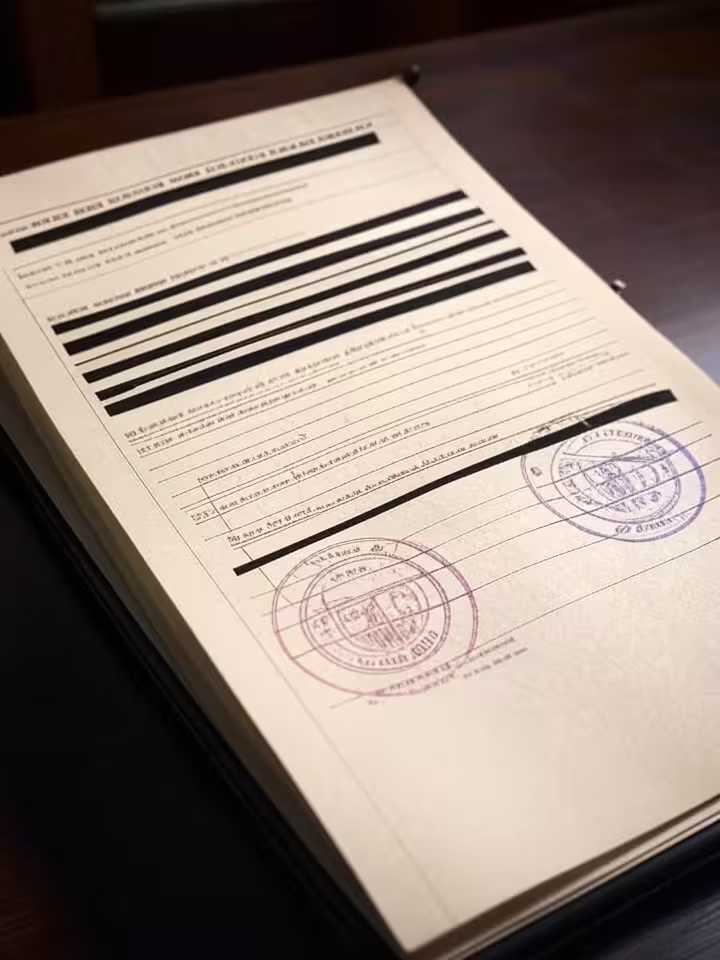
The reading room provides PDF downloads of original documents, allowing verification of sources and context. However, many files are partially redacted for national security reasons.
FOIA Request Process
Additional documents not yet in the public database can be requested through formal FOIA applications. The CIA website provides instructions for submitting requests, though responses can take months or years depending on classification review requirements.
Cross-Referencing Official Sources
For comprehensive research, CIA documents should be cross-referenced with:
- Official Bilderberg participant lists at bilderbergmeetings.org
- Historical news coverage from mainstream outlets
- Academic research on Cold War diplomacy
- Presidential library archives for U.S. participants
Ongoing Relevance and Recent Developments
While most declassified CIA references to Bilderberg date from the Cold War era, the group continues to generate intelligence community interest in the 21st century.
Documents from the 1980s reference meetings amid Reagan-era policies, such as the 1985 event in Rye Brook, New York. These show continued U.S. monitoring of transatlantic elite forums even as Cold War tensions began to ease.
No major new CIA declassifications specifically on Bilderberg have emerged since 2020, though FOIA requests remain active. The official Bilderberg website lists recent meetings, including the 2023 Lisbon conference focusing on artificial intelligence and energy policy—topics of clear interest to intelligence services globally.
Understanding historical CIA documents helps provide context for contemporary discussions about Bilderberg’s influence without resorting to unsubstantiated theories.
Frequently Asked Questions
What do declassified CIA documents reveal about Bilderberg?
Declassified CIA documents from the 1950s-1970s show that U.S. intelligence monitored Bilderberg meetings, tracking participants and discussion topics relevant to transatlantic relations and Western security. The files indicate awareness and intelligence gathering but provide no evidence of CIA control, funding, or orchestration of the conference. Documents reference specific meetings, key attendees like Prince Bernhard and David Rockefeller, and topics including European integration, economic policy, and Cold War strategy.
How can I access CIA files on Bilderberg meetings?
CIA documents mentioning Bilderberg are accessible through the CIA’s FOIA Electronic Reading Room at cia.gov/readingroom. You can search for “Bilderberg” to find relevant declassified memos, cables, and reports from the 1950s onward. Additional documents not yet publicly available can be requested through formal FOIA applications, though processing times vary. Many files are partially redacted for national security reasons, so complete information may not be available.
Did the CIA create or control the Bilderberg Group?
No declassified CIA documents provide evidence that the agency created or controlled the Bilderberg Group. Available files show the CIA monitored meetings as part of standard diplomatic intelligence gathering during the Cold War, but do not indicate funding, agenda-setting, or operational control. Bilderberg was founded in 1954 by European figures including Prince Bernhard of the Netherlands and Polish advisor Jozef Retinger to foster transatlantic dialogue, independent of U.S. intelligence direction.
Which CIA directors or officials attended Bilderberg meetings?
Declassified documents do not provide comprehensive lists of CIA officials who attended Bilderberg. Allen Dulles, CIA Director from 1953 to 1961, is reported to have attended early meetings, though this is not explicitly detailed in available declassified memos. Documents mention U.S. diplomats and advisors like C.D. Jackson and Henry Kissinger (in later governmental roles) but focus on their diplomatic rather than intelligence capacities. Many participants likely had intelligence community connections, but specific CIA operational involvement is not documented in declassified files.
What topics did CIA documents say Bilderberg discussed?
CIA files reference discussions on transatlantic security cooperation, European economic integration, NATO strengthening, anti-communist strategies, trade liberalization, Middle East stability, nuclear energy policy, and Cold War diplomatic coordination. A 1955 memo noted talks on European unity, while 1962 documents mentioned GATT negotiations. The 1973 file referenced oil crisis discussions. These topics aligned with U.S. foreign policy interests during the Cold War, explaining CIA monitoring without implying manipulation of conference outcomes.
Are there recent CIA documents on Bilderberg meetings?
Most declassified CIA documents referencing Bilderberg date from the 1950s through the 1980s, with the most detailed files from the Cold War period. A 2018 FOIA release included some 1980s memos, but none contained substantial new information on Bilderberg. No major declassifications specifically focused on the group have emerged since 2020. Documents from recent decades likely remain classified under standard intelligence protection timelines, and future FOIA releases may provide additional information about CIA awareness of contemporary meetings.
Key Takeaways
- Declassified CIA documents mention Bilderberg primarily in Cold War-era diplomatic intelligence reports from the 1950s through 1970s, showing monitoring rather than control.
- Specific verifiable references include a 1955 memo on the France conference, 1957 Georgia meeting files, and 1962 Sweden cables tracking transatlantic discussions.
- No available declassified files provide evidence of CIA funding, agenda-setting, or operational control over Bilderberg conferences.
- Documents track key participants including Prince Bernhard, David Rockefeller, and Henry Kissinger, emphasizing their diplomatic rather than intelligence roles.
- Files emphasize topics like European integration, NATO strengthening, and economic policy—standard U.S. foreign policy interests during the Cold War period.
- Researchers can access these documents through the CIA FOIA Electronic Reading Room at cia.gov/readingroom by searching for “Bilderberg.”
- Many documents remain classified, and future declassifications may reveal additional information about the intelligence community’s relationship with the group.
Sources
- CIA FOIA Electronic Reading Room – Declassified documents on Bilderberg conferences (https://www.cia.gov/readingroom/)
- Official Bilderberg Meetings website – Past meetings and participant lists (https://bilderbergmeetings.org/past-meetings)
- National Archives – FOIA process and declassified intelligence materials (https://www.archives.gov)
- The New York Times – Historical coverage of Bilderberg meetings (https://www.nytimes.com)
- The Guardian – Reporting on declassified intelligence documents (https://www.theguardian.com)
- CIA specific document references: CIA-RDP80B01676R004200210002-9 (1955 memo), CIA-RDP82-00457R005000140009-1 (1960 report), CIA-RDP80-01446R000100060001-2 (1959 report)