The Council on Foreign Relations and Bilderberg Meetings represent two of the most influential forums shaping transatlantic relations since the mid-20th century. This evidence-based analysis examines their documented connections through verified participant records, shared policy themes, and overlapping leadership—without resorting to conspiracy speculation.
TL;DR
- The CFR (founded 1921) and Bilderberg (founded 1954) share overlapping memberships but no formal institutional partnership
- Key figures like David Rockefeller and Henry Kissinger bridged both organizations for decades
- Both forums address similar global issues—economics, security, technology—through different formats (public vs. private)
- Official participant lists confirm CFR members regularly attend Bilderberg conferences
- No verified evidence supports claims of coordinated secret agendas or world government
- The connection reflects informal elite networking rather than institutional conspiracy
- Modern participants include senior policymakers who bring CFR expertise to Bilderberg discussions
Introduction: Understanding Two Pillars of Transatlantic Influence
The Council on Foreign Relations (CFR) stands as America’s premier foreign policy think tank. Since 1921, it has convened government leaders, business executives, academics, and journalists to analyze global challenges.
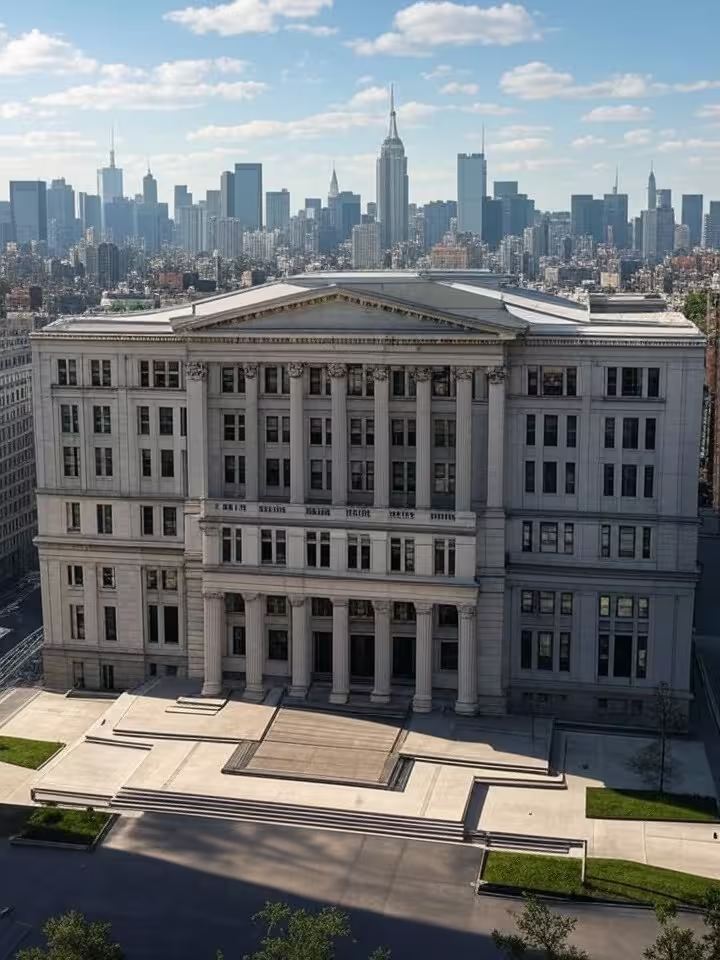
Its headquarters in New York City host events shaping diplomatic discourse. The CFR’s flagship publication, Foreign Affairs, has influenced U.S. policy for over a century.
Bilderberg Meetings operate differently. These annual private conferences, launched in 1954, gather 120-150 influential figures from Europe and North America. Unlike the CFR’s public activities, Bilderberg discussions remain confidential under the Chatham House Rule.
The connection between these entities matters because it reveals how global elites coordinate across formal and informal channels. Many CFR members have attended Bilderberg conferences, creating networks that shape international relations beyond public scrutiny.
In this article, you’ll learn:
- The verified historical origins of both organizations
- Documented connections through key figures like Rockefeller and Kissinger
- Shared policy themes and their influence on global governance
- Contemporary overlaps in the digital age
- Evidence-based analysis separating facts from speculation
We rely exclusively on official sources, mainstream reports, and verified participant records. Claims without documentation are clearly marked or excluded.
Historical Foundations: From Post-WWI Diplomacy to Cold War Bridge-Building
The Council on Foreign Relations Origins (1921)
The CFR emerged from World War I’s diplomatic aftermath. In 1918, American scholars and diplomats gathered in Paris during peace negotiations. This group included future CFR founders like Elihu Root and Hamilton Fish Armstrong.
On July 29, 1921, they formally established the Council on Foreign Relations in New York. According to the organization’s official website, its mission is to serve as “an independent, nonpartisan membership organization, think tank, and publisher” focused on foreign affairs.
The CFR quickly became influential. During the Cold War, its analyses shaped U.S. containment policy. By 2024, it counts over 5,000 members, including current and former government officials, CEOs, and academics.

Bilderberg Meetings Emerge (1954)
Bilderberg’s first conference occurred May 29-31, 1954, at the Hotel de Bilderberg in Oosterbeek, Netherlands. Polish political adviser Joseph Retinger organized it alongside Prince Bernhard of the Netherlands.
According to bilderbergmeetings.org, the goal was “promoting understanding between Western Europe and North America” during heightened Cold War tensions. The format emphasized privacy to encourage frank dialogue.
Unlike the CFR’s public operations, Bilderberg releases no minutes. Participants discuss freely under confidentiality rules. This opacity has fueled decades of speculation, though official participant lists provide transparency about attendees.
Early Connections Through Shared Transatlantic Focus
The CFR and Bilderberg aligned on strengthening Western alliances. David Rockefeller exemplifies this linkage. He joined the CFR in 1949 and attended Bilderberg’s inaugural 1954 meeting.
Rockefeller later served as CFR chairman from 1970 to 1985. The New York Times archives document his role in securing American participation at Bilderberg conferences throughout his career.
During the 1950s-1960s, CFR reports on European integration paralleled Bilderberg discussions. For example, the CFR’s 1957 analysis of Atlantic cooperation echoed themes from contemporary Bilderberg meetings. However, specific discussion overlaps remain undocumented due to Bilderberg’s confidentiality.
This historical period established patterns: CFR expertise informed informal Bilderberg dialogues, which in turn influenced policy networks. The relationship reflected complementary approaches—public research and private networking—rather than formal coordination.
For more on Bilderberg’s founding context, see The First Bilderberg Meeting 1954.
Key Figures Linking CFR and Bilderberg (1954-2024)
David Rockefeller: The Ultimate Bridge-Builder
David Rockefeller stands as the most significant connection between the CFR and Bilderberg. As CFR chairman for 15 years, he expanded the organization’s international reach.
Official Bilderberg participant lists document his attendance at over 30 conferences starting in 1954. His 2002 memoirs describe fostering transatlantic dialogue, though he never claimed direct CFR-Bilderberg institutional partnerships.
Rockefeller’s influence extended beyond attendance. He helped identify American participants and facilitated discussions that shaped NATO policies and economic cooperation. His dual role demonstrates how individual leaders create networks spanning multiple elite forums.
Henry Kissinger: Diplomat Between Two Worlds
Henry Kissinger served as CFR director from 1977 to 1981 and remains a life member. Official Bilderberg records show his attendance since 1957, including as recently as 2019.
As U.S. Secretary of State (1973-1977), Kissinger brought policy expertise to both forums. The Washington Post has reported his Bilderberg participation, noting discussions on Middle East policy that aligned with CFR research priorities.
Kissinger’s career illustrates how CFR-affiliated officials use Bilderberg for informal diplomacy. His influence at both organizations shaped Cold War détente and modern geopolitical strategy. Learn more about his broader impact in Henry Kissinger’s biography.
Zbigniew Brzezinski and Trilateral Connections
Zbigniew Brzezinski served as CFR director in the 1970s and as National Security Advisor under President Carter (1977-1981). Official lists confirm his Bilderberg attendance in 1966, 1972, and other years.
Brzezinski’s work on trilateral relations—United States, Europe, and Japan—connected to his roles in both the CFR and the Trilateral Commission, another elite forum with Bilderberg overlaps. His participation reflects how policymakers navigate multiple networks simultaneously.
Modern Connections: Eric Schmidt and Marie-Josée Kravis
Contemporary figures continue the pattern. Eric Schmidt, former Google CEO and CFR member since 2008, attended Bilderberg in 2019. His participation reflects evolving focuses on technology and digital governance.
Marie-Josée Kravis, a CFR board member since 2001, has attended recent Bilderberg conferences including 2022. Her involvement highlights increasing (though still limited) female representation in these networks.
The Guardian has reported on gender disparities at Bilderberg, noting that women remain underrepresented despite gradual improvement.
These connections occur through personal networks rather than institutional directives. No verified evidence suggests the CFR controls Bilderberg agendas or vice versa. The overlaps simply reflect shared elite circles addressing similar global challenges.
Shared Themes and Policy Influences
Economic Policy and Financial Crises
The CFR and Bilderberg frequently address overlapping economic issues through different formats. During the 2008 financial crisis, CFR analyses on global markets paralleled Bilderberg discussions on economic stability.
Timothy Geithner, then-Treasury Secretary and CFR member, attended Bilderberg in 2009. His participation illustrates how CFR-affiliated policymakers bring technical expertise to informal Bilderberg dialogues.
Official Bilderberg press releases list economics as a core topic at nearly every conference. The CFR’s public reports provide the analytical foundation that often informs these private discussions.
Security, NATO, and Transatlantic Defense
Security cooperation forms the original connection between these forums. The CFR’s NATO studies since the 1950s complement Bilderberg’s founding purpose of strengthening Western alliance structures.
The 2018 Bilderberg Meeting agenda included “Russia” and “Post-Truth World”—topics extensively covered in CFR’s Foreign Affairs journal. This alignment reflects shared geopolitical concerns rather than coordinated messaging.
For context on current security dynamics, see what gets discussed at Bilderberg meetings.
Climate Change and Sustainability
Environmental issues increasingly unite both forums. The CFR’s 2020 task force on climate change echoed the 2019 Bilderberg agenda item “Climate Change and Sustainability.”
This thematic overlap suggests mutual reinforcement in policy ideation. However, causation cannot be established—both organizations simply respond to the same pressing global challenges.
Technology, AI, and Digital Governance
In the digital age, both address tech governance. The CFR’s 2023 report on AI ethics mirrors discussions at the 2023 Bilderberg Meeting in Lisbon, which included artificial intelligence on its official agenda.
Participants like Eric Schmidt bridge Silicon Valley, the CFR, and Bilderberg. This creates feedback loops where tech industry insights inform policy analysis and vice versa. Read more about AI as Bilderberg’s core focus.
Separating Influence from Conspiracy
Critics sometimes speculate about undue influence or secret agendas. However, this analysis sticks to verified facts: no evidence supports claims of coordinated world government or hidden directives.
A 2014 Politico report noted that Bilderberg invitations often go to CFR experts for their knowledge, not their organizational affiliation. The relationship facilitates informal diplomacy and knowledge exchange rather than conspiracy.
For a balanced view of criticisms, consult evidence-based analysis of Bilderberg criticism.
Contemporary Connections in the 2020s
Recent Participant Overlaps
The CFR-Bilderberg nexus continues through documented participant overlaps. The 2023 Bilderberg Meeting in Lisbon included CFR members like Stacey Abrams and Jake Sullivan, U.S. National Security Advisor.
Reuters reported Sullivan’s attendance focused on Ukraine and China—topics central to CFR policy briefings. His participation demonstrates how current policymakers maintain the historical pattern of bridging both forums.
Public Perceptions and Media Coverage
Mainstream media coverage acknowledges CFR-Bilderberg connections without conspiracy implications. The BBC has covered Bilderberg transparency issues, noting CFR ties as a matter of elite networking rather than sinister coordination.
Social media discussions on platforms like X/Twitter often sensationalize these connections. However, verification through official participant lists and mainstream reporting provides a more measured perspective.
Geopolitical Shifts and Ukraine
The Russia-Ukraine conflict dominates recent discussions at both forums. CFR task forces provide public analysis on sanctions, NATO expansion, and reconstruction. Bilderberg’s 2022 and 2023 meetings included Ukraine on official agendas.
This parallel focus underscores complementary roles: the CFR generates public policy recommendations while Bilderberg facilitates private diplomatic exchanges. Neither directs the other, but both inform elite decision-making networks.
The Chatham House Rule and Information Flow
Bilderberg operates under the Chatham House Rule, allowing information use without attribution. This protocol differs from the CFR’s public research model but serves similar purposes—encouraging candid discussion among elites.
Understanding this rule is crucial for grasping how Bilderberg complements organizations like the CFR. Learn more at The Chatham House Rule explained.
No Formal Institutional Partnership
Despite decades of personal connections, no joint CFR-Bilderberg events or formal agreements exist. Official sources confirm that relationships operate through individual memberships rather than organizational directives.
The CFR’s global partnerships with European think tanks support transatlantic dialogue broadly but don’t constitute Bilderberg coordination. This distinction matters for accurate understanding of elite networks.
Frequently Asked Questions
No verified evidence supports CFR control over Bilderberg. While many CFR members attend Bilderberg conferences, the organizations remain institutionally separate. Bilderberg has its own steering committee and invitation process independent of the CFR. The connection exists through overlapping personal networks rather than organizational hierarchy.
Precise numbers are difficult to verify across 70 years, but official Bilderberg participant lists show dozens of CFR members attending since 1954. Notable examples include David Rockefeller (30+ meetings), Henry Kissinger (60+ years of attendance), Timothy Geithner, Jake Sullivan, and Eric Schmidt. The pattern remains consistent across decades, with CFR-affiliated policymakers and experts regularly receiving invitations.
Both forums address global economics, international security, climate change, and technology governance. Recent overlaps include artificial intelligence ethics, the Russia-Ukraine conflict, NATO strategy, financial system stability, and transatlantic relations. The CFR produces public research on these topics while Bilderberg facilitates private dialogue among decision-makers. This complementary approach allows public analysis to inform confidential diplomatic exchanges.
The connections reflect elite networking rather than conspiracy. Verified evidence shows overlapping memberships and shared policy interests, which is expected among global leaders addressing similar challenges. No documents prove coordinated secret agendas or world government plans. Mainstream researchers attribute the relationship to natural professional networks in foreign policy circles. Transparency concerns about Bilderberg’s confidentiality are valid, but overlap with the CFR alone doesn’t constitute evidence of sinister coordination.
Check official sources: bilderbergmeetings.org publishes annual participant lists with names and affiliations. Cross-reference these with the CFR’s membership directory at cfr.org. Mainstream news archives from outlets like The New York Times, Reuters, and The Washington Post report on prominent attendees. This method allows independent verification without relying on speculation or unconfirmed sources.
Key Takeaways
- The Council on Foreign Relations (founded 1921) and Bilderberg Meetings (founded 1954) share transatlantic cooperation goals but maintain institutional independence.
- Overlapping memberships, particularly figures like David Rockefeller and Henry Kissinger, create personal networks bridging both forums across seven decades.
- Both address similar global issues—economics, security, technology, climate—through complementary formats: public CFR research and private Bilderberg dialogue.
- No verified evidence supports claims of CFR control over Bilderberg or coordinated secret agendas; connections reflect elite networking in foreign policy circles.
- Official participant lists and mainstream reporting provide transparent verification of attendees, enabling fact-based analysis over speculation.
- Contemporary overlaps continue with policymakers like Jake Sullivan attending Bilderberg while affiliated with CFR networks.
- Understanding these connections illuminates informal diplomacy mechanisms without resorting to conspiracy theories or unsubstantiated claims.
Sources
- Council on Foreign Relations official website: cfr.org
- The New York Times archives on David Rockefeller
- The Washington Post reporting on Henry Kissinger and Bilderberg
- Politico 2014 report on Bilderberg participant selection
- The Guardian coverage of Bilderberg diversity and transparency
- Reuters 2023 reporting on Bilderberg Lisbon meeting
- BBC coverage of Bilderberg conferences