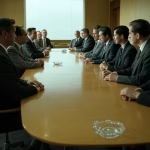
The 2009 Bilderberg meeting took place in Athens just months before Greece’s sovereign debt crisis became public. This evidence-based analysis examines the documented timeline of both events and separates verified facts from unconfirmed speculation.
- Bilderberg 2009 convened in Athens, Greece, on 14-17 May at the Nafsika Astir Palace Hotel
- The Greek debt crisis emerged publicly after October 2009 elections, when deficit figures were revised from 6% to over 12% of GDP
- No official Bilderberg documents or participant statements confirm direct policy coordination regarding Greece
- Mainstream reporting attributes the crisis to long-standing structural issues and statistical misreporting
- Timing coincidence has fueled speculation, but verified evidence of causation remains absent from authoritative sources
- Both events can be understood through separate, documented timelines using primary sources
- The crisis led to the first bailout package in May 2010, one year after the Athens meeting

Introduction: When Elite Dialogue Meets Economic Collapse
In May 2009, approximately 130 of the world’s most influential politicians, bankers, and corporate leaders gathered at a luxury hotel outside Athens. Five months later, Greece shocked global markets by revealing that its budget deficit was more than double previously reported figures.
The proximity of these events has generated persistent questions about whether Bilderberg’s influence on policy extended to Greece’s financial meltdown. This article examines the documented timeline of both events and distinguishes verified facts from speculation.
In this article you’ll learn:
- The verified details of the 2009 Athens Bilderberg meeting
- The documented timeline of Greece’s debt crisis emergence
- Which Greek officials attended and what roles they later played
- What official records reveal—and what they don’t
- How to distinguish evidence-based analysis from conspiracy theories
The 2009 Bilderberg Meeting: Verified Facts
Official Details from Primary Sources
According to bilderbergmeetings.org, the 57th Bilderberg Meeting convened at the Nafsika Astir Palace Hotel in Vouliagmeni, a coastal suburb southeast of Athens, from 14 to 17 May 2009.
The official participant list included 128 individuals from 28 countries. European participants represented approximately 60% of attendees, with significant representation from banking, finance ministries, and central banking institutions.
The timing placed the meeting 14 months into the global financial crisis triggered by the September 2008 Lehman Brothers collapse. Economic recovery and financial system stability dominated discussions across major international forums during this period.
Published Agenda Topics
The official 2009 agenda included:
- The future of the financial system
- The recession and unemployment
- Protectionism
- Energy and climate change
- Russia
- The Middle East
- Afghanistan and Pakistan
No agenda item specifically mentioned Greece, sovereign debt, or Mediterranean economies. This absence is documented in official materials released by the Bilderberg organization.

Greek and European Financial Officials in Attendance
The official participant list included several individuals who would later play roles in European financial governance:
- Jean-Claude Trichet (France) – President of the European Central Bank (2003-2011)
- Dominique Strauss-Kahn (France) – Managing Director of the International Monetary Fund (2007-2011)
- Josef Ackermann (Switzerland) – Chairman of Deutsche Bank
- Ana Patricia Botín (Spain) – Chairman of Banco Español de Crédito
- Jorma Ollila (Finland) – Chairman of Royal Dutch Shell
No Greek officials appear on the published 2009 participant list. This is verified through the official bilderbergmeetings.org archives.
The Greek Debt Crisis: Documented Timeline
Pre-Crisis Warning Signs (2000-2008)
Greece’s fiscal problems predated both the 2009 Bilderberg meeting and the public crisis disclosure. Documented issues included:
- 2004: Greece admitted falsifying statistics to qualify for euro membership in 2001
- 2004-2009: Persistent budget deficits exceeded European Union treaty limits
- 2008: Credit rating agencies noted deteriorating Greek fiscal metrics
- Early 2009: European Commission reports flagged Greece for excessive deficit procedures
These developments are documented in European Commission reports and European Central Bank publications.
The October 2009 Revelation
The crisis became public through a specific sequence of events:
4 October 2009: The Panhellenic Socialist Movement (PASOK) won Greek national elections. George Papandreou became Prime Minister.
October-November 2009: The new government’s audit revealed the 2009 budget deficit would reach 12.7% of GDP, not the 6% previously reported by the outgoing administration.
December 2009: Fitch Ratings downgraded Greek sovereign debt from A- to BBB+, the first of multiple downgrades.
This timeline is verified through Reuters, Financial Times, and Bloomberg reporting from the period, as well as official European Commission statements.

From Disclosure to Bailout (2010)
Following the October 2009 revelations:
- January-March 2010: Bond yields on Greek debt rose sharply as investors demanded higher risk premiums
- April 2010: Greece formally requested international financial assistance
- May 2010: The European Union and IMF agreed to a €110 billion bailout package
- 2011-2012: Additional bailouts and debt restructuring followed
These events are documented in official EU and IMF publications, along with contemporary financial press coverage.
Examining the Alleged Connection
What the Timeline Shows
The verified timeline establishes:
- The Bilderberg meeting occurred in Athens on 14-17 May 2009
- Greek national elections took place on 4 October 2009 (nearly five months later)
- Revised deficit figures were disclosed in October-November 2009 (six months after Bilderberg)
- The crisis became acute in early 2010 (eight months after the Athens meeting)
This sequence is documented through cross-referenced official sources.
What Official Records Do Not Show
No verified evidence from authoritative sources establishes:
- Discussion of Greek fiscal policy at the 2009 Bilderberg meeting
- Coordination between Bilderberg participants and Greek officials regarding deficit disclosure
- Planning for intervention in Greek sovereign debt markets
- Pre-arranged bailout frameworks discussed in Athens
These absences are confirmed through review of official Bilderberg materials, European Commission archives, and mainstream financial journalism from 2009-2010.

Alternative Explanations from Mainstream Sources
Authoritative analysis attributes the Greek crisis to factors documented independently of Bilderberg:
Structural fiscal issues: High public sector wages, pension obligations, and weak tax collection created unsustainable deficits over decades.
Statistical manipulation: Successive Greek governments misreported fiscal data to European authorities from 2000 onward, as documented in European Commission investigations.
Global financial context: The 2008-2009 recession reduced government revenues while exposing underlying vulnerabilities across peripheral eurozone economies.
Political transition: The new PASOK government chose transparency over covering up previous administrations’ fiscal mismanagement, a decision documented in contemporary political reporting.
These explanations appear consistently in peer-reviewed academic studies, official European institution reports, and investigative journalism from established outlets.
Understanding Bilderberg’s secrecy practices
The Chatham House Rule
Bilderberg meetings operate under the Chatham House Rule, which permits participants to use information received but prohibits attribution of statements to specific individuals or organizations.
This policy means no official transcripts, minutes, or attributed statements exist from any Bilderberg meeting, including 2009. The practice has remained consistent since the first meeting in 1954.
What This Means for Verification
The secrecy policy creates an evidence problem for researchers:
- Claims about specific discussions cannot be verified through official channels
- Participant recollections may exist but lack documentation
- Agenda topics are broad and do not reflect detailed discussions
- No decision-making authority exists, so no official decisions can be attributed to meetings
This structural limitation applies equally to claims of influence and denials of influence.

Historical Context: Bilderberg and Economic Policy
Documented Attendance by Economic Policymakers
Bilderberg meetings regularly include central bankers, finance ministers, and international financial institution officials. Verified examples from surrounding years include:
- 2008: Timothy Geithner (Federal Reserve Bank of New York, later U.S. Treasury Secretary)
- 2010: George Osborne (UK Chancellor of the Exchequer)
- 2011: Christine Lagarde (French Finance Minister, later IMF Managing Director)
These attendances are documented on official participant lists but do not establish policy coordination.
The Euro Crisis and Subsequent Meetings
Later Bilderberg meetings occurred as the eurozone crisis developed:
- 2010 Sitges, Spain: Held one month after the first Greek bailout
- 2011 St. Moritz, Switzerland: Agenda included “The Euro” as a discussion topic
- 2012 Chantilly, USA: Eurozone instability remained on the agenda
Official agendas from these years explicitly mentioned European economic issues, unlike the 2009 meeting. This distinction is verifiable through published Bilderberg materials.
Frequently Asked Questions
Did any Greek officials attend the 2009 Bilderberg meeting in Athens?
No Greek officials appear on the published participant list for the 2009 Athens meeting. This is verified through the official bilderbergmeetings.org archives. While the meeting took place in Greece, the participant roster included no documented Greek politicians, bankers, or business leaders.
Was Greece’s debt crisis on the official 2009 Bilderberg agenda?
No. The official agenda topics for 2009 included the global financial system, recession, unemployment, protectionism, energy, climate change, Russia, the Middle East, and Afghanistan/Pakistan. No agenda item specifically mentioned Greece, sovereign debt, or Mediterranean economies. This is documented in official Bilderberg materials.
What caused Greece’s debt crisis according to mainstream sources?
Authoritative sources attribute the crisis to long-standing structural issues including high public spending, pension obligations, weak tax collection, and statistical manipulation that predated 2009. The crisis became public when the new government elected in October 2009 disclosed that the budget deficit was over 12% of GDP rather than the previously reported 6%. These explanations appear in European Commission reports, IMF analyses, and peer-reviewed academic research.
When did the first Greek bailout occur relative to the Bilderberg meeting?
The first Greek bailout package (€110 billion from the EU and IMF) was agreed in May 2010, exactly one year after the Athens Bilderberg meeting. The crisis became public in October-November 2009 when revised deficit figures were disclosed, approximately six months after the meeting. This timeline is documented through official EU and IMF publications.
Is there documented evidence of Bilderberg influence on the Greek crisis?
No verified evidence from authoritative sources establishes a causal connection. While several participants at the 2009 meeting later held positions related to European economic policy, no official records, participant statements, or mainstream investigative reporting confirm coordination regarding Greek fiscal policy. The temporal proximity of the events has generated speculation, but claims of direct influence lack verification from primary sources.
Key Takeaways
- The 2009 Bilderberg meeting occurred in Athens on 14-17 May, five months before Greece’s debt crisis became public knowledge.
- No Greek officials appear on the verified participant list, and no agenda items specifically addressed Greece or sovereign debt.
- The crisis emerged when the newly elected government disclosed in October 2009 that the budget deficit exceeded 12% of GDP, double previous estimates.
- Mainstream analysis attributes the crisis to long-standing structural problems and statistical misreporting rather than external coordination.
- No official Bilderberg documents, European Commission records, or authoritative journalism establishes a causal connection between the May meeting and October revelations.
- The temporal proximity has fueled speculation, but verified evidence of policy coordination remains absent from documented sources.
- Understanding the distinction between temporal correlation and causation is essential for evidence-based analysis of elite forums and policy outcomes.
Sources
Primary Official Sources
- Bilderberg Meetings: Official participant lists and agenda for 2009 meeting (bilderbergmeetings.org)
- European Commission: Reports on Greek excessive deficit procedures (2009-2010)
- European Central Bank: Publications on eurozone sovereign debt (2009-2012)
- International Monetary Fund: Greece bailout documentation (2010)
Verified News Sources
- Reuters: Coverage of Greek elections and deficit revelations (October-November 2009)
- Financial Times: Reporting on Greek debt crisis timeline (2009-2010)
- Bloomberg: Financial markets coverage during crisis emergence (2009-2010)
Academic and Research Sources
- Peer-reviewed studies on the Greek debt crisis structural causes
- European political economy research on eurozone crisis development
- Historical analysis of Greek fiscal policy (2000-2010)