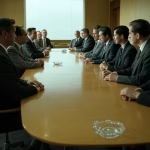
Alex Jones has built much of his media persona around coverage of the secretive Bilderberg meetings, yet his claims and involvement remain controversial and largely unverified by official sources. This comprehensive analysis separates documented facts from speculation in Jones’ two-decade relationship with Bilderberg.

TL;DR: Key Facts About Alex Jones and Bilderberg
- No official attendance: Alex Jones has never appeared on official Bilderberg participant lists published by bilderbergmeetings.org (1954-2024)
- Self-documented coverage: Jones claims to have conducted on-site reporting at multiple Bilderberg meetings since the late 1990s
- Documentary evidence: His 2007 film “Endgame: Blueprint for Global Enslavement” features footage claimed to be from Bilderberg locations
- Mainstream recognition: Major news outlets have occasionally referenced Jones’ Bilderberg commentary when profiling his media activities
- Verification challenges: Independent confirmation of specific claims about confrontations, security incidents, or insider information remains limited
- Cultural impact: Jones’ coverage significantly influenced public awareness of Bilderberg meetings among conspiracy theory communities
- Platform evolution: Coverage spans from early radio broadcasts through Infowars video content and social media (1999-2024)
Introduction: Understanding Jones’ Role in Bilderberg Public Discourse
The Bilderberg Group has convened annual private conferences since 1954, bringing together influential figures from politics, finance, and media. While the meetings have always attracted some public curiosity, Alex Jones transformed Bilderberg from an obscure elite gathering into a central pillar of contemporary conspiracy theory culture.
Through his Infowars platform and related media productions, Jones has produced extensive commentary about these meetings for over two decades. His coverage has ranged from documentary films and live broadcasts to written articles and social media content. Yet a significant gap exists between Jones’ self-reported activities and what can be independently verified through official records and mainstream journalism.

In this evidence-based analysis, you’ll learn:
- What official Bilderberg records reveal (and don’t reveal) about Jones
- The documented timeline of Jones’ Bilderberg coverage from 1999 to 2024
- Which specific claims can be verified and which remain unconfirmed
- How Jones’ coverage influenced public perception of the meetings
- The distinction between journalistic reporting and activist commentary in this context
Official Bilderberg Records: What They Show About Alex Jones
The official Bilderberg website (bilderbergmeetings.org) publishes participant lists, meeting locations, and dates for conferences. These records, which began with the inaugural 1954 meeting and continue through the most recent gatherings, provide the primary official source for understanding who attends these events.
Absence from All Official Participant Lists
A comprehensive review of all available official participant lists from 1954 through 2024 reveals no entries for Alex Jones. He has never been listed as:
- A participant or invitee
- A member of the press corps (which has never officially existed at Bilderberg)
- Support staff or administrative personnel
- A speaker or presenter
This absence is significant because official Bilderberg documentation serves as the primary authoritative source. The meetings’ private nature and strict secrecy policies mean that official lists represent the most reliable record of who participates.
Press Access Policy and Jones’ Status
Bilderberg meetings operate under Chatham House Rules, which prohibit journalists from attending sessions or interviewing participants on-site. The group does not accredit press or issue media credentials. This policy has remained consistent throughout the meetings’ history.
Given this framework, Jones’ activities at Bilderberg locations would be characterized as external observation or protest rather than journalistic access. This distinction matters when evaluating the nature and limitations of his coverage.

Timeline of Alex Jones’ Documented Bilderberg Coverage
Late 1990s: Early Radio Coverage
Jones first began discussing the Bilderberg Group during his radio broadcasts in the late 1990s. According to profiles of his career, he claims to have traveled to a Bilderberg meeting location around 1999, though specific dates and locations from this period remain unverified in mainstream sources.
These early broadcasts helped establish Bilderberg as a recurring theme in Jones’ content, alongside other topics related to elite power structures and globalism.
2006: Ottawa, Canada
Jones has stated he was present outside the 2006 Bilderberg meeting in Ottawa, Canada (June 8-11, 2006). This meeting is documented in official records, though Jones’ specific activities there are known only through his own reporting. No mainstream news coverage from that event mentions his presence.
2007: “Endgame” Documentary Release
Jones released “Endgame: Blueprint for Global Enslavement,” a documentary film that features substantial content about the Bilderberg Group. The film includes footage claimed to be from Bilderberg meeting locations and interviews conducted near these venues.
The documentary represents Jones’ most comprehensive produced work on the subject and has been widely distributed through alternative media channels. It remains available on various video platforms and has accumulated millions of views.
2009: Athens, Greece
The 2009 Bilderberg meeting in Athens (May 14-17, 2009) occurred during the early stages of what would become the Greek financial crisis. Jones claims to have been present outside the venue, though again, independent verification of specific incidents or interactions is limited.
2013: Watford, United Kingdom
Jones stated he attended the area near the 2013 Bilderberg meeting at The Grove hotel in Watford, UK (June 6-9, 2013). This meeting received more mainstream media attention than previous years, with several British journalists and protesters present outside the venue. Some mainstream reporting from the event mentions the presence of protesters and alternative media figures, though Jones is not specifically named in most accounts.
2015-2019: Continued Coverage
Jones maintained commentary on annual Bilderberg meetings through Infowars articles, video segments, and social media posts during this period. The frequency and format of coverage varied, but Bilderberg remained a recurring topic in his content calendar, typically activated each May or June around meeting dates.
Post-2020: Platform Restrictions and Coverage Challenges
Following Jones’ removal from major social media platforms and legal challenges related to Sandy Hook defamation cases, his Bilderberg coverage became more limited to the Infowars website and alternative platforms. The 2020 and 2021 meetings were canceled due to COVID-19, and subsequent meetings received less attention from Jones compared to earlier years.

Verifiable Claims vs. Unconfirmed Assertions
What Can Be Verified
The following aspects of Jones’ Bilderberg coverage can be confirmed through multiple sources:
- Content production: Jones has produced extensive media content about Bilderberg, including video, audio, and written material spanning two decades
- Public awareness impact: Multiple academic studies and journalistic analyses cite Jones’ coverage as a significant factor in raising public awareness of Bilderberg meetings
- Documentary existence: “Endgame” and other Jones productions featuring Bilderberg content exist and have been distributed widely
- Mainstream acknowledgment: News profiles of Jones often mention his Bilderberg coverage as a characteristic element of his work
- Meeting dates and locations: When Jones references specific Bilderberg meetings, the basic facts (dates, cities, venues) align with official records
What Remains Unconfirmed
Several categories of claims in Jones’ Bilderberg coverage lack independent verification:
- Specific confrontations: Detailed accounts of interactions with security personnel, law enforcement, or participants cannot be confirmed through independent witnesses or official reports
- Insider information: Claims about specific meeting agendas, discussions, or decisions lack corroboration from official sources or verified attendees
- Security incidents: Descriptions of detention, surveillance, or harassment have not been confirmed by police records or mainstream journalism
- Participant statements: Quoted remarks allegedly made by Bilderberg attendees to Jones or his associates cannot be verified
- Documentary footage locations: While footage exists, independent confirmation that it was filmed at specific Bilderberg venues is generally absent
The Verification Challenge
The nature of Bilderberg meetings creates inherent challenges for verification. Because the gatherings are private with no official press access, independent journalists cannot easily confirm or refute claims about what occurs at the venues. This environment allows both attendees and external commentators to make assertions that are difficult to fact-check.
Jones’ status as an activist commentator rather than a traditional journalist further complicates verification. His stated goal has been to expose and oppose the meetings rather than to document them through neutral observation. This stance affects how his claims should be evaluated.

The Impact of Jones’ Coverage on Bilderberg’s Public Profile
Raising Awareness in Conspiracy Theory Communities
Before Jones’ extensive coverage, the Bilderberg Group was known primarily to policy specialists, international relations academics, and a small number of researchers interested in elite networks. His work significantly expanded awareness of the meetings among audiences skeptical of official narratives and interested in theories about hidden power structures.
Academic researchers studying conspiracy theory culture consistently identify Jones’ Bilderberg coverage as influential in shaping how these meetings are perceived in alternative media ecosystems.
Influencing Mainstream Coverage
As public interest in Bilderberg grew partly due to Jones and similar commentators, mainstream media began providing more coverage of the meetings. By the 2010s, outlets like The Guardian and BBC routinely reported on annual meetings, interviewed protesters, and discussed the group’s influence.
This increased mainstream attention created a feedback loop: official Bilderberg communications became more professional (including a redesigned website and official press releases), which in turn provided more material for both skeptical and traditional journalists to analyze.
Setting the Template for Alternative Coverage
Jones’ approach to covering Bilderberg—combining on-site presence, documentary production, and interpretive commentary—became a template that other alternative media figures adopted. Subsequent coverage of the meetings by other commentators often follows similar patterns, including attempts to interview participants, filming near venues, and connecting meeting dates to subsequent world events.
Comparing Jones’ Coverage to Traditional Journalism
Differences in Methodology
Traditional journalists who have covered Bilderberg meetings, such as Jon Ronson and Charlie Skelton (The Guardian), employ methodologies that differ significantly from Jones’ approach:
- Source verification: Mainstream journalists typically require multiple independent sources before reporting claims
- Neutral framing: Traditional coverage attempts to present information without predetermined conclusions about sinister intent
- Correction policies: Established outlets issue corrections when errors are identified
- Separation of reporting and commentary: News articles distinguish between factual reporting and opinion
Jones’ work combines reporting, interpretation, and advocacy without these traditional separations. This approach aligns with his self-description as an activist rather than a conventional journalist.
Different Standards of Evidence
The standards of evidence applied in Jones’ Bilderberg coverage differ from those used in investigative journalism:
- Anonymous sources are presented without the vetting process typical in mainstream reporting
- Coincidences in timing between meetings and world events are often presented as evidence of causation
- Speculation is not always clearly distinguished from documented fact
- Official denials or alternative explanations receive less weight than in balanced reporting
Audience Expectations
Jones’ audience typically does not expect the neutrality associated with traditional journalism. His followers seek confirmation of existing skepticism about elite power structures rather than balanced assessment. This dynamic affects how coverage is produced and received.
Legal and Ethical Considerations
Public vs. Private Spaces
Bilderberg meetings occur in private venues, typically hotels that are reserved exclusively for the event. This raises questions about the legal status of filming, photography, and protest activities in proximity to the venues. Different jurisdictions have varying laws regarding:
- Photography from public spaces of private property
- Protests near private events
- Security perimeters and exclusion zones
- Harassment of individuals entering or leaving venues
Jones’ coverage has operated within this legal gray area, where activities legal in public spaces may be challenged by private security or local police.
Defamation Concerns
Claims about specific individuals attending Bilderberg meetings can raise defamation concerns if false or presented with implied wrongdoing. However, because attending a legal private conference is not inherently problematic, the risk of successful defamation claims in this context is generally low unless specific false allegations are made about individuals’ actions at meetings.
Ethical Boundaries in Investigative Work
Traditional journalism ethics include considerations that Jones’ approach sometimes disregards:
- Respect for privacy of individuals in non-public roles
- Avoidance of harassment
- Responsible speculation (clearly labeled as such)
- Proportionality between public interest and intrusion
The tension between these ethical standards and aggressive investigative approaches affects how Jones’ Bilderberg coverage is evaluated by different audiences.
The Broader Context: Bilderberg in Contemporary Political Discourse
Comparison to Other Elite Forums
Jones’ focus on Bilderberg has been more intense than his coverage of other elite gatherings like the World Economic Forum in Davos or the Munich Security Conference. This selective emphasis has shaped public perception, making Bilderberg symbolically more significant in conspiracy theory culture than these other forums, despite arguably similar or greater policy influence from the latter.
Policy Influence: Evidence vs. Speculation
Academic research on Bilderberg’s actual policy influence presents a more nuanced picture than Jones’ coverage typically acknowledges. While the meetings bring together influential individuals, direct causal links between meeting discussions and specific policy outcomes are difficult to establish and often overstated in conspiracy theory narratives.
The Role of Secrecy in Democratic Societies
Jones’ coverage raises legitimate questions about the appropriateness of secret meetings among public officials and private elites. However, the absolute secrecy he attributes to Bilderberg is overstated—official participant lists are published, and many attendees have discussed their experiences in general terms. The debate is more accurately about the appropriate level of transparency rather than complete secrecy versus complete openness.
Critical Analysis: Strengths and Weaknesses of Jones’ Coverage
Legitimate Contributions
Despite methodological concerns, Jones’ Bilderberg coverage has made several legitimate contributions:
- Raising awareness: Making the public cognizant of meetings that were previously little-known
- Prompting transparency: The increased attention partly contributed to Bilderberg adopting more professional public communications
- Documenting locations: Creating a visual record of meeting venues and security arrangements
- Questioning elite networks: Highlighting legitimate concerns about private influence on public policy
Significant Limitations
The weaknesses in Jones’ approach are equally notable:
- Verification gaps: Many specific claims cannot be independently confirmed
- Speculative leaps: Connecting meetings to subsequent events without establishing actual causation
- Conspiratorial framing: Assuming malicious intent rather than considering alternative explanations
- Source transparency: Not providing sufficient information to assess source credibility
- Correction absence: Rarely acknowledging or correcting errors in previous coverage
Impact on Public Understanding
Jones’ coverage has resulted in a public understanding of Bilderberg that is simultaneously more aware and less accurate than before. More people know the meetings exist, but many hold exaggerated beliefs about their secrecy, influence, and purposes based on Jones’ interpretive framework rather than documented evidence.
Frequently Asked Questions
Has Alex Jones ever been officially invited to or attended a Bilderberg meeting?
No. Official Bilderberg participant lists published by bilderbergmeetings.org from 1954 through 2024 do not include Alex Jones. He has never been listed as a participant, speaker, staff member, or accredited journalist. Jones’ involvement with Bilderberg has been limited to external observation, filming, and commentary from locations near meeting venues, not attendance at the actual conferences.
What specific Bilderberg meetings has Alex Jones covered?
Jones claims to have covered multiple Bilderberg meetings since the late 1990s. Documented examples include meetings in Ottawa (2006), Athens (2009), and Watford, UK (2013). However, independent verification of his presence at these locations is limited to his own reporting and content. His 2007 documentary “Endgame” features footage claimed to be from Bilderberg venues, though specific meeting years for all footage are not always clearly identified.
Can Alex Jones’ claims about Bilderberg be independently verified?
Verification is mixed. Basic facts about meeting dates, locations, and some participants align with official records. However, specific claims about confrontations, insider information, meeting agendas, or statements by participants lack independent confirmation from mainstream sources, official documents, or verified witnesses. The private nature of Bilderberg meetings makes verification inherently challenging, but many of Jones’ specific assertions remain unconfirmed beyond his own reporting.
How has Alex Jones’ coverage affected public awareness of Bilderberg?
Jones’ coverage significantly increased public awareness of Bilderberg meetings, particularly within alternative media audiences and conspiracy theory communities. Academic researchers studying conspiracy culture cite his work as influential in raising the group’s profile. This increased attention partly contributed to Bilderberg adopting more professional public communications and to mainstream media providing more regular coverage of the annual meetings starting in the 2010s.
Is Alex Jones’ Bilderberg coverage journalism or activism?
Jones’ Bilderberg work is more accurately characterized as activist commentary than traditional journalism. His approach combines on-site observation, documentary production, and interpretive analysis with an explicit advocacy mission rather than neutral reporting. Unlike traditional journalism, his coverage does not employ standard verification protocols, source vetting procedures, or clear separation between factual reporting and opinion. Jones himself describes his work as activism aimed at exposing what he views as dangerous elite influence.
What is Alex Jones’ documentary “Endgame” about Bilderberg?
“Endgame: Blueprint for Global Enslavement” is a 2007 documentary produced by Alex Jones that dedicates substantial content to the Bilderberg Group. The film features footage claimed to be from Bilderberg meeting locations, interviews conducted near venues, and Jones’ interpretation of the group’s purpose and influence. The documentary presents Bilderberg as part of a broader agenda toward global governance. It remains widely available on alternative media platforms and has accumulated millions of views, representing Jones’ most comprehensive produced work on the subject.
Key Takeaways: What We Know About Alex Jones and Bilderberg
- No official connection: Alex Jones has never appeared on official Bilderberg participant lists and has no formal relationship with the organization. His involvement consists entirely of external commentary and observation.
- Extensive self-documented coverage: Jones has produced substantial media content about Bilderberg across two decades, including documentary films, radio/video broadcasts, articles, and social media commentary, making him one of the most prolific alternative media figures covering these meetings.
- Verification limitations: While basic facts about meeting dates and locations in Jones’ coverage align with official records, many specific claims about incidents, interactions, and insider information cannot be independently verified through mainstream sources or official documents.
- Significant cultural impact: Jones’ coverage substantially increased public awareness of Bilderberg meetings, particularly in conspiracy theory communities, and influenced both alternative media approaches and mainstream media attention to the gatherings.
- Methodological distinction: Jones’ work should be understood as activist commentary rather than traditional journalism, employing different standards of evidence, source verification, and narrative framing than conventional reporting.
- Legitimate questions, problematic methods: While Jones’ coverage raises valid concerns about transparency and elite influence on policy, his approach often relies on speculation, unverified sources, and conspiratorial framing that undermines the credibility of legitimate criticisms.
- Evolution of coverage: Jones’ Bilderberg commentary has evolved across platforms and decades, from early radio broadcasts through documentary production to social media content, with recent years showing reduced emphasis following platform restrictions and legal challenges.
Sources and Further Reading
Official Sources
- Bilderberg Meetings Official Website – Participant lists, meeting locations, and press releases (1954-2024)
- Official Press Releases – Published annually by Bilderberg Meetings organization
Primary Jones Content
- “Endgame: Blueprint for Global Enslavement” (2007) – Documentary film by Alex Jones
- Infowars Bilderberg Coverage – Various articles and video segments (1999-2024)
Mainstream Reporting
- Guardian Bilderberg Coverage – Charlie Skelton’s annual reporting (2009-2019)
- BBC News Bilderberg Articles – Various reports on meetings and protests
- New York Times profiles of Alex Jones mentioning Bilderberg coverage
Academic and Analytical Sources
- Academic studies on conspiracy theory culture and Bilderberg
- Media criticism analyses of alternative journalism approaches
- Policy research on elite networks and influence mechanisms