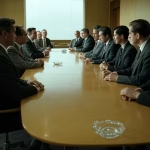
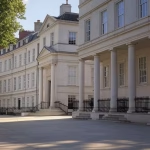
Since 1954, the Bilderberg Meetings have convened global elites annually under strict confidentiality. Despite decades of public curiosity, no official minutes have ever been released—a deliberate policy rooted in the Chatham House Rule that prioritizes candid dialogue over public transparency.

- No official Bilderberg meeting minutes have ever been publicly released by the organizers
- The official Bilderberg website publishes only attendee lists and general topics—never verbatim records
- All meetings operate under the Chatham House Rule, which prohibits attribution of statements
- Historical practice since the 1954 founding meeting shows consistent non-publication of detailed records
- Participant statements remain personal and anecdotal, never constituting official documentation
- No verified archive of complete minutes exists in public libraries, government databases, or journalistic sources
- Leaked documents occasionally circulate but cannot be verified against any official release
Introduction: The Question Behind the Secrecy
The question of whether official minutes exist for Bilderberg meetings strikes at the heart of one of the world’s most scrutinized yet opaque gatherings of power.
Since the first meeting in 1954 at the Hotel de Bilderberg in Oosterbeek, Netherlands, approximately 130 to 150 influential figures from politics, finance, academia, and media have convened annually for closed-door discussions. The deliberate absence of public documentation shapes how information reaches the wider world and fuels ongoing debate about elite accountability.


This matters because in an era of increasing demands for institutional transparency, the Bilderberg Meetings represent a notable exception. Understanding their documentation policy—or lack thereof—requires examining official sources, historical precedent, and the rare public statements from participants.
In this article you’ll learn:
- What the official Bilderberg policy states about meeting records
- The historical context of confidentiality from 1954 to 2024
- What documentation actually exists and where to find it
- How the Chatham House Rule shapes information flow
- The difference between official policy and leaked claims
Official Policy on Meeting Records
The Bilderberg Meetings official website explicitly describes events as private gatherings where participants speak freely under established rules of confidentiality.

No section of the site provides meeting minutes, transcripts, or summaries of decisions. Published materials are strictly limited to:
- Annual meeting dates and locations
- Lists of invited participants (published since the 2000s with increasing consistency)
- General discussion topics (broad themes without details)
The Chatham House Rule Framework
All discussions operate under the Chatham House Rule, established by the Royal Institute of International Affairs. This rule permits participants to use information received but prohibits revealing the identity or affiliation of speakers.
This framework explains why no attributed statements, voting records, or decision documentation appears in any official capacity. The rule’s purpose is to enable frank dialogue free from political or media pressure—a goal that fundamentally conflicts with public minute-taking.

What the Official Source Does Not Contain
Systematic review of bilderbergmeetings.org confirms the absence of:
- Verbatim transcripts of any session from any year
- Detailed agendas showing session structure or speakers
- Summaries of conclusions or consensus positions
- Voting records or policy recommendations
- An archive section for historical documentation
Because the official source contains no record of minutes, any claim that detailed official minutes exist cannot be verified through the primary channel designated by the organizers.
Historical Background: Seven Decades of Consistent Non-Publication
The first Bilderberg meeting occurred in May 1954, convened by Jozef Retinger and Prince Bernhard of the Netherlands to foster dialogue between Europe and North America during the early Cold War.
1954-1970s: Establishing the Precedent
From the inaugural meeting, founders established that discussions would remain confidential. Early participant lists circulated privately among invitees but were not published publicly. Press coverage was minimal and based on external observation rather than official communication.
No archive from this period contains released minutes. Historical accounts reference the meetings but rely on participant memoirs and journalistic investigation rather than official records.
1980s-2000s: Increased Scrutiny, Unchanged Policy
As conspiracy theories gained traction and investigative journalists like Jim Tucker and Daniel Estulin published books about the meetings, public interest intensified. Yet the documentation policy remained identical.
The official response to increased attention was limited to occasional press releases confirming dates and locations—never expanding to include substantive records of discussions.

2010s-2024: Digital Transparency Without Minutes
The launch of the official website brought modest transparency improvements. Participant lists for recent years became publicly accessible, and general discussion topics were announced in advance.
However, this shift toward openness did not extend to documentation of what was actually said. The 2022 Washington meeting published topics including “Geopolitical Realignments” and “Russia-Ukraine,” but no record of positions taken or proposals discussed.
The continuity of this practice over seven decades indicates that the absence of minutes is a deliberate and sustained policy rather than an oversight or temporary measure.
What Documentation Actually Exists
Participant Lists
The most reliable documentation comes from official attendee lists published for meetings from approximately 2010 onward. These lists include:
- Names of invited participants
- Professional titles and affiliations
- Country of origin
Earlier lists exist through journalistic research and occasional leaks but lack official confirmation.
Published Topics
Since the mid-2010s, the official site has published broad discussion themes. For example, the 2022 Washington DC meeting listed topics including:
- Post-Pandemic Health
- Fragmentation of Democratic Societies
- Trade and Deglobalisation
- China
- Russia-Ukraine
These topics provide context but reveal nothing about positions taken, debates conducted, or conclusions reached.
Press Office Statements
The Bilderberg press office occasionally issues brief statements confirming logistical details. These communications never include substantive information about discussions and typically refer journalists to the website for participant lists.
Participant Statements and Secondary Sources
Individuals who have attended meetings sometimes discuss general themes in public forums after events conclude. These comments typically remain at a high level and do not constitute official minutes.
Notable Public Statements
Examples of participant commentary include:
- Denis Healey (British politician, Steering Committee member): Described meetings as useful for informal discussion but declined to provide specifics
- Étienne Davignon (former European Commissioner, Steering Committee member): Acknowledged discussions on European integration in general terms
- Various participants: Have referenced topics like technology, economics, or geopolitics without attributing views to specific individuals

These statements are attributed to individuals rather than to any official secretariat or archive. They provide glimpses of discussion themes but cannot substitute for comprehensive records.
Journalistic Investigation
News organizations including BBC, The Guardian, and The New York Times have covered the meetings extensively. Coverage typically includes:
- Lists of attendees (often compiled independently)
- Analysis of potential influence
- Historical context
- Criticism of secrecy
No major news outlet has published complete meeting minutes because none have been obtained. Investigative journalists like Jon Ronson have documented the external experience of attending the meetings but could not access internal proceedings.
Published Books and Research
Several books about Bilderberg have been published, ranging from academic analysis to conspiracy theory. None contain verified official minutes, though some claim to present leaked documents.
Academic researchers who have studied the meetings base their work on:
- Published participant lists
- Interviews with former attendees
- Analysis of public policy developments that may correlate with meeting timing
- Archival research on founding documents
The Question of Leaked Documents
Periodically, documents purporting to be Bilderberg minutes or internal communications circulate online or in conspiracy-focused publications. These materials warrant careful evaluation.
Known Characteristics of Claimed Leaks
Most purported leaked minutes share common features:
- Lack of verifiable provenance
- No chain of custody linking them to official sources
- Content that often confirms pre-existing conspiracy narratives
- Absence of mundane logistical details typical of actual meeting records
Where claims of leaked minutes circulate, they remain unverified against any primary document released by the meetings themselves.
Distinction from Verified Leaks
Contrast with verified leaks in other contexts (WikiLeaks diplomatic cables, Pentagon Papers, etc.) is instructive. Those leaks involved:
- Documentary authentication by journalists
- Corroboration with known events and officials
- Official acknowledgment or legal action confirming authenticity
No purported Bilderberg minute leak has achieved this level of verification.
Public Availability and Verification
Systematic searches of major repositories confirm the absence of official Bilderberg meeting minutes in public archives.
Government Archives
While some declassified CIA documents reference the Bilderberg Meetings in the context of monitoring European-American relations during the Cold War, these files do not contain meeting minutes. They are intelligence assessments based on external observation.
No government archive or library holds official Bilderberg meeting minutes because none have been deposited by the organizers.
Academic and Research Libraries
Major research institutions including the Library of Congress, British Library, and European University Institute do not hold collections of Bilderberg meeting minutes. Their holdings related to the meetings consist of:
- Books and articles about the meetings
- News coverage
- Occasional correspondence from participants in their personal papers
Freedom of Information Requests
Because the Bilderberg Meetings are organized as a private conference rather than a governmental body, Freedom of Information Act (FOIA) requests do not apply directly to the organizers.
FOIA requests to governments have occasionally yielded correspondence about logistics or security arrangements for hosting meetings, but not discussion records.
Comparison with Other Elite Forums
Understanding the Bilderberg documentation policy benefits from comparison with similar organizations.
World Economic Forum
The World Economic Forum in Davos operates with substantially more transparency:
- Public sessions are livestreamed
- Some panels produce published reports
- Media credentials are granted to hundreds of journalists
- The organization publishes extensive research and white papers
However, WEF also conducts private sessions where no minutes are released, showing that even more open forums maintain confidential discussion spaces.
Council on Foreign Relations
The Council on Foreign Relations publishes its journal Foreign Affairs and makes many events public while maintaining some meetings under the Chatham House Rule. The organization occupies a middle ground between complete transparency and the Bilderberg approach.
Trilateral Commission
The Trilateral Commission, founded in 1973 with overlapping membership to Bilderberg, publishes task force reports and maintains a more extensive public presence. Yet its internal discussions similarly lack published minutes.
Arguments For and Against the Minutes Policy
Arguments Supporting Confidentiality
Defenders of the no-minutes policy argue:
- Candid dialogue: Off-the-record discussions enable participants to explore ideas without political risk
- Reduced posturing: Absence of attribution discourages grandstanding
- Cross-party cooperation: Political rivals can discuss issues without constituency pressure
- Track II diplomacy: Informal channels complement official negotiations
Arguments Calling for Greater Transparency
Critics contend:
- Democratic accountability: Public officials attending should be answerable for their participation
- Elite capture concerns: Secrecy fuels suspicion that policy is shaped away from democratic processes
- Inequality of access: Ordinary citizens cannot know what their leaders discuss
- Conspiracy theory proliferation: Lack of information creates vacuum filled by speculation
What We Can Know Without Minutes
Despite the absence of official minutes, researchers can draw limited conclusions from available evidence.
Correlation Studies
Some analysts have attempted to correlate meeting timing and topics with subsequent policy developments. For example:
- European integration discussions in the 1950s-60s preceded concrete EU development steps
- Technology topics in recent years align with regulatory debates
- Economic discussions sometimes precede coordinated policy responses
However, correlation does not establish causation, and without minutes, determining actual influence remains speculative.
Network Analysis
Examining participant networks reveals connections between attendees and subsequent appointments or policy positions. This approach, used by academic researchers, shows patterns of elite circulation but cannot definitively establish that specific ideas originated at meetings.
Participant Memoirs
Some attendees have discussed their experiences in autobiographies or interviews. These accounts provide limited insight but are selective and reflect individual perspectives rather than comprehensive records.
Frequently Asked Questions
Has anyone ever published verified Bilderberg meeting minutes?
No. No verified official Bilderberg meeting minutes have ever been published by the organizers or confirmed through independent authentication. While documents claiming to be leaked minutes occasionally circulate, none have been verified against official sources or authenticated through journalistic standards comparable to other major document leaks.
Does the Bilderberg organization keep internal minutes that are simply not released?
This cannot be definitively confirmed from public sources. The official website does not address whether internal records exist for organizers’ use only. Some participants have suggested that minimal notes may be taken for planning purposes, but no evidence confirms the existence of detailed verbatim transcripts even for private circulation.
Why don’t governments release records of their officials’ attendance?
Government officials attend in a personal capacity rather than as official representatives. This distinction means their participation is not subject to the same documentation requirements as official diplomatic meetings. Freedom of Information requests have occasionally yielded logistical correspondence but not discussion content.
Could meeting minutes be released decades later, like declassified government documents?
Unlikely, because Bilderberg operates as a private organization rather than a government entity. Declassification processes apply to official state secrets with defined time periods for review. Private organizations have no legal obligation to release historical records unless they choose to do so voluntarily.
What is the most detailed documentation available about what happens at meetings?
The most reliable documentation consists of official participant lists (published from approximately 2010 onward) and broad discussion topics (published for recent years). Beyond this, researchers rely on participant memoirs, journalistic accounts from outside the meetings, and analysis of attendee networks. No source provides session-by-session detail or attributed statements.
Have any whistleblowers from inside the organization come forward?
No verified whistleblowers have emerged with authenticated internal documents. The relatively small organizing staff and reliance on high-profile participants whose reputations depend on discretion may explain the absence of leaks. Unlike large government bureaucracies where whistleblowers have access to extensive document systems, the Bilderberg structure limits access to sensitive information.
Do journalists who attend Bilderberg take notes?
Journalists who attend are bound by the same Chatham House Rule as other participants. While they may take personal notes, they cannot publish attributed information or detailed accounts of specific discussions. Their attendance is intended to inform their general understanding rather than to produce immediate reportage, distinguishing it from normal journalistic practice.
Key Takeaways
- No official minutes exist in the public domain: The Bilderberg Meetings organization has never released meeting minutes, transcripts, or detailed discussion records in its 70-year history.
- Policy is deliberate and consistent: The absence of minutes reflects a sustained policy rooted in the Chatham House Rule rather than a temporary practice or oversight.
- Limited documentation is available: Researchers can access participant lists for recent years and broad discussion topics, but nothing approaching verbatim records.
- Leaked documents remain unverified: Despite occasional circulation of purported minutes, none have achieved authentication standards comparable to verified leaks in other contexts.
- Participant statements are fragmentary: Attendees sometimes discuss general themes publicly but these comments are personal and selective, not official documentation.
- No archival holdings exist: Government archives, research libraries, and public repositories do not contain official Bilderberg meeting minutes because none have been deposited.
- The question reflects broader transparency debates: The minutes issue exemplifies tensions between demands for elite accountability and arguments for confidential dialogue in international affairs.
Conclusion: Transparency Versus Confidentiality
The question “Do Bilderberg meeting minutes exist?” has a clear answer regarding public accessibility: No verified official minutes have ever been released or authenticated through independent sources.
Whether internal records exist for organizers’ private use cannot be definitively confirmed from public evidence. The consistent policy since 1954 suggests that if such records exist, they are minimal and designed solely for logistical rather than substantive purposes.
This documentation gap reflects a fundamental choice by the organizers to prioritize confidential dialogue over public transparency. That choice has remained stable across seven decades despite significant changes in global communication technology, transparency norms, and public expectations for elite accountability.
For researchers, journalists, and citizens seeking to understand these influential gatherings, the absence of minutes means relying on indirect evidence: participant networks, policy correlations, and occasional public statements. This limitation frustrates those who believe democratic accountability requires documentation of elite discussions, while defenders argue it enables valuable informal dialogue impossible in public settings.
The question ultimately extends beyond Bilderberg to broader issues about how transparent governance should be in pluralistic democracies—a debate unlikely to be resolved soon.
Sources
- Official Bilderberg Meetings website: https://www.bilderbergmeetings.org/ (participant lists, meeting locations, general topics)
- Chatham House Rule: https://www.chathamhouse.org/about-us/chatham-house-rule
- BBC coverage of Bilderberg meetings (various articles, 2000s-2020s)
- The Guardian coverage of Bilderberg meetings (various articles, 2000s-2020s)
- Academic research on elite networks and transatlantic relations (various peer-reviewed sources)
- Published books on Bilderberg history (see complete reading guide for comprehensive list)
- Declassified government documents referencing Bilderberg (primarily CIA files from Cold War period)