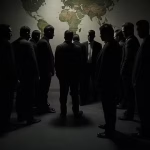
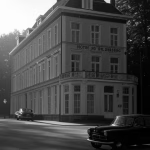
British journalist Jon Ronson’s 2001 investigation into the Bilderberg Group offers a rare, balanced look at how secrecy fuels conspiracy theories. His account of attempting to infiltrate the 1999 Portugal meeting blends humor, skepticism, and verified facts—revealing as much about human nature as about elite gatherings.
- Published 2001: Jon Ronson’s “Them: Adventures with Extremists” includes a landmark chapter on Bilderberg
- 1999 Sintra Meeting: Ronson attempted to observe the June 3-6 conference at Caesar Park Hotel, Portugal
- Jim Tucker Partnership: Collaborated with veteran conspiracy theorist who tracked Bilderberg for decades
- Balanced Approach: Neither endorses nor dismisses conspiracy theories—focuses on verified observations
- Historical Impact: Contributed to mainstream awareness of Bilderberg, influencing later transparency measures
- Journalism Model: Demonstrates fact-based investigation of secretive organizations without sensationalism
- Enduring Relevance: Remains essential reading for understanding elite networks and conspiracy culture dynamics
Introduction: Why Ronson’s Bilderberg Investigation Still Matters
When British journalist Jon Ronson published “Them: Adventures with Extremists” in 2001, few mainstream works had approached the Bilderberg Group with both seriousness and skepticism. His chapter documenting the 1999 Portugal meeting bridged two worlds: legitimate journalism about elite gatherings and the conspiracy culture surrounding them.
This investigation matters because it established a template for evidence-based reporting on secretive organizations. The Bilderberg Group’s secrecy has fueled speculation since its 1954 founding, yet most coverage fell into two extremes—dismissive ridicule or uncritical conspiracy promotion. Ronson’s work occupies the crucial middle ground.
The timing was significant. Published just months before 9/11, the book captured a pre-social media era when conspiracy theories circulated through newsletters and early internet forums. Today, with misinformation proliferating exponentially, Ronson’s methodological approach—verifying claims, interviewing subjects directly, distinguishing observation from speculation—offers lessons for digital-age media literacy.
In this article, you’ll learn:
- Verified details about the 1999 Bilderberg Meeting Ronson investigated
- How Ronson balanced journalistic access with conspiracy culture immersion
- The historical context of Bilderberg’s power structure and transparency evolution
- Key figures like Jim Tucker and their documented connections to Bilderberg tracking
- The chapter’s lasting impact on journalism about secretive elite forums
- How Ronson’s work relates to modern debates about transparency and global governance
The Book: ‘Them: Adventures with Extremists’ in Context
Publication and Critical Reception
“Them: Adventures with Extremists” appeared in March 2001 through Simon & Schuster (US) and Picador (UK). The Guardian’s contemporary review praised Ronson’s “sharp-eyed” approach to fringe groups, while The New York Times called it “entertaining and insightful” in January 2002.
The work originated from Ronson’s Channel 4 documentary series, evolving from television segments into a full narrative exploring various extremist movements. The Bilderberg chapter stood out for tackling conspiracy theories about actual verifiable organizations rather than purely ideological groups.
Ronson’s Journalistic Approach
Ronson’s methodology combined immersive reporting with comedic distance. He embedded himself with subjects—attending their meetings, traveling with them, experiencing their worldviews firsthand—without adopting their beliefs. This empathetic yet critical stance allowed readers to understand why individuals pursue conspiracy theories without validating unfounded claims.

His background in documentary filmmaking informed this approach. Previous work included investigations into unusual subcultures, establishing his reputation for humanizing marginal figures. The Bilderberg chapter applied these techniques to conspiracy culture specifically.
Historical Context of Bilderberg Secrecy (1954-1999)
The Bilderberg Group was founded in May 1954 at the Hotel de Bilderberg in Oosterbeek, Netherlands. According to official Bilderberg documentation, the inaugural meeting aimed to foster dialogue between European and North American leaders during Cold War tensions.
Early participants included Prince Bernhard of the Netherlands (chairman until 1976) and Polish political advisor Jozef Retinger. The first agenda addressed European unification, communism containment, and transatlantic cooperation—topics reflecting 1950s geopolitical priorities.
By 1999, when Ronson investigated, Bilderberg had held 47 annual conferences. Each gathering brought approximately 120-150 participants from politics, business, academia, and media. The Chatham House Rule governed discussions: participants could use information received but could not reveal speakers’ identities or affiliations.
This secrecy policy, intended to encourage frank dialogue, paradoxically fueled conspiracy theories. Without official transparency, speculation filled information voids. Ronson’s chapter captured this dynamic at a transitional moment—before Bilderberg began publishing participant lists in 2002.
The 1999 Sintra Meeting: Ronson’s Investigation
Official Meeting Details
The 47th Bilderberg Meeting occurred June 3-6, 1999, at the Caesar Park Hotel (now Pestana Sintra Golf Resort) in Sintra, Portugal. Official records document discussions on:
- Globalization and its social impacts
- The Kosovo crisis and NATO intervention
- European monetary union and the Euro’s first year
- Transatlantic economic relations
- Security challenges in post-Cold War Europe
Confirmed participants included U.S. Secretary of Defense William Cohen, NATO Secretary-General Javier Solana, and business leaders like Bill Gates. Total attendance reached approximately 111 participants from 24 countries.

Ronson’s Infiltration Attempt with Jim Tucker
Ronson partnered with James P. Tucker Jr., a reporter for the right-wing publication Spotlight (later American Free Press). Tucker had tracked Bilderberg since the mid-1970s, claiming insider sources provided meeting locations and partial agendas.
Their methodology, as Ronson describes, involved:
- Traveling to Sintra under tourist pretenses
- Using binoculars to observe hotel entrances from public areas
- Recording vehicle arrivals and security measures
- Attempting to approach the venue perimeter
- Interviewing other conspiracy theorists and protesters present
Security eventually identified and removed them from hotel vicinity. Ronson presents this confrontation with self-deprecating humor, contrasting his journalistic curiosity with Tucker’s conviction about uncovering world domination plots.
Observations and Verified Details
Ronson’s account includes verifiable elements corroborated by contemporary media coverage. The Observer reported in June 1999 on increased security around the Sintra hotel and small protest gatherings. Portuguese media documented road closures and police presence.
What Ronson observed directly:
- Multiple security checkpoints around hotel grounds
- Vehicles with tinted windows arriving at intervals
- Portuguese police coordinating with private security
- Small groups of protesters and alternative media representatives
- Radio host Alex Jones filming outside the venue
What he could not verify: Tucker’s claims about specific discussion content, alleged conspiratorial agreements, or “New World Order” planning. Ronson carefully distinguishes Tucker’s interpretations from observable facts.
The Alex Jones Connection
Ronson documents encountering Alex Jones, then a relatively unknown radio host, outside the Sintra venue. Jones was filming what would become part of his conspiracy documentary work. This meeting occurred before Jones’s rise to prominence through Infowars.
The encounter illustrates how the 1999 meeting attracted various conspiracy researchers, each with different methodologies. Ronson positions himself as observer of these observers, creating layers of meta-commentary on conspiracy culture itself.

Key Figures in Ronson’s Narrative
Jim Tucker: The Veteran Bilderberg Tracker
James P. Tucker Jr. (1934-2013) became Ronson’s primary guide into Bilderberg conspiracy culture. Tucker’s background included:
- Decades covering Bilderberg for Spotlight newspaper and American Free Press
- Claims of insider sources providing meeting details before public announcements
- Publishing newsletters predicting Bilderberg’s alleged policy outcomes
- Attending or monitoring approximately 30+ meetings between 1975-2013
The Washington Post’s 2013 obituary described Tucker as “a perennial gadfly who pursued the Bilderberg Group with the fervor of Captain Ahab chasing the white whale.” Ronson portrays Tucker with both respect for his dedication and skepticism about his interpretations.
Historical Bilderberg Figures Referenced
Ronson’s chapter references several documented Bilderberg participants to illustrate Tucker’s theories:
David Rockefeller: Attended Bilderberg meetings from the 1950s through 2000s. Tucker positioned Rockefeller as a symbol of global elite power, though official records show his participation was intermittent rather than constant leadership.
Henry Kissinger: First attended in 1957, becoming a frequent participant. His documented presence at multiple meetings made him a focal point for conspiracy theories about U.S. foreign policy coordination through Bilderberg channels.
Prince Bernhard of the Netherlands: Founding chairman (1954-1976) until resignation following the Lockheed bribery scandal. His role established Bilderberg’s European aristocratic connections.
Ronson presents these figures through Tucker’s lens while noting official documentation of their participation. He avoids attributing unverified motives or actions.
Ronson’s Self-Positioning
Ronson portrays himself as skeptical yet curious—neither dismissing Tucker as delusional nor accepting conspiracy claims uncritically. His narrative voice acknowledges the absurdity of hiding in Portuguese bushes while recognizing legitimate questions about elite gathering secrecy.
This positioning allows readers to engage with conspiracy culture’s appeal without endorsing its conclusions. Ronson demonstrates that questioning power structures doesn’t require accepting unfounded theories about secret world government.
Accuracy, Speculation, and Journalistic Ethics
What Ronson Verified
The chapter’s strength lies in clear delineation between confirmed facts and speculation:
Verified elements:
- Meeting dates, location, and approximate participant numbers (from official Bilderberg sources)
- General discussion topics (released in subsequent years’ agendas)
- Security measures and physical observations from public areas
- Tucker’s existence and career tracking Bilderberg
- Historical context of Bilderberg founding and evolution
Unverified claims:
- Tucker’s assertions about specific discussion content
- Allegations of coordinated policy implementation post-meetings
- “New World Order” conspiracy theories
- Claims about Bilderberg “controlling” governments or elections
Ronson labels unverified material as Tucker’s beliefs or conspiracy theorist claims, never presenting them as established fact. This ethical approach distinguishes his work from both uncritical conspiracy promotion and dismissive mainstream coverage.

The Transparency Paradox
Ronson’s investigation highlights a genuine issue: how organizational secrecy breeds suspicion regardless of actual activities. Bilderberg’s Chatham House Rule, designed to facilitate open discussion, creates information vacuums that speculation fills.
The group’s gradual transparency evolution—publishing participant lists starting 2002, releasing agenda topics, acknowledging meetings publicly—partly responded to media attention Ronson’s work exemplified.
Comparison to Academic Analysis
Ronson’s journalism complements academic research on elite networks. Political scientists studying informal governance mechanisms recognize Bilderberg as one forum among many—alongside the World Economic Forum, Council on Foreign Relations, and Trilateral Commission—where influential figures exchange ideas.
These analyses, available through university research, confirm Bilderberg’s existence and elite composition while finding no evidence of the conspiratorial coordination Tucker alleged. Ronson’s approach aligns with this evidence-based perspective while making it accessible to general readers.
Cultural Impact and Legacy
Mainstream Awareness Expansion
Before Ronson’s book, Bilderberg existed primarily in conspiracy subcultures and specialized political research. “Them” brought the group into popular consciousness through major publishers and mainstream reviews. The BBC adapted the book into a 2001 documentary series, further expanding reach.
This visibility contributed to increased mainstream media coverage. The Guardian, BBC, and other outlets began occasional Bilderberg reporting, particularly around annual meetings. While coverage remained limited compared to events like the World Economic Forum, the complete media blackout ended.
Influence on Subsequent Reporting
Ronson’s methodology influenced later Bilderberg journalism:
- Charlie Skelton’s Guardian blog series (2009-2014) covering multiple meetings
- Documentary investigations balancing access attempts with factual research
- Academic papers examining Bilderberg as a case study in elite networks
- Investigative pieces distinguishing legitimate transparency questions from conspiracy theories
His work demonstrated that serious journalists could investigate secretive organizations without either dismissing concerns or promoting unfounded theories.
Conspiracy Culture Documentation
Beyond Bilderberg specifics, the chapter contributed to understanding conspiracy theory psychology. Ronson showed how intelligent, dedicated individuals like Tucker could pursue theories with genuine conviction, driven by legitimate distrust of power rather than simple delusion.
This humanizing approach anticipated later research on conspiracy belief formation. Academic studies now recognize that conspiracy theories often stem from real grievances about transparency and accountability, even when specific claims lack evidence.
Digital Age Relevance
Published before social media’s rise, Ronson’s work gains retrospective significance. The pre-internet conspiracy networks he documented—newsletters, shortwave radio, early websites—seem quaint compared to today’s viral misinformation. Yet his analytical framework remains applicable.
Modern discussions about elite influence, whether concerning tech billionaires, Davos attendance, or political donor networks, echo Bilderberg conspiracy themes. Comparing Bilderberg to Davos reveals similar transparency debates around elite gatherings.
Ronson’s lesson—distinguish verified facts from speculation, take transparency concerns seriously while demanding evidence for conspiratorial claims—offers guidance for navigating contemporary information ecosystems.
The Broader Context: Bilderberg Then and Now
From 1999 to 2024: Evolution of Transparency
The Bilderberg Group Ronson investigated in 1999 differs from today’s more documented version:
1999 practices:
- No official participant list publication
- Meeting locations often unconfirmed until last minute
- No agenda topics released
- Minimal public acknowledgment of meetings
- Complete media exclusion
Current practices (2020s):
- Participant lists published on bilderbergmeetings.org
- General discussion topics released
- Official website with historical information
- Acknowledgment in participants’ biographies
- Occasional official statements
This evolution partly responds to attention from Ronson and others. While Chatham House Rule secrecy remains, basic transparency increased significantly.
Comparison to Other Elite Forums
Understanding Bilderberg requires context within similar gatherings:
World Economic Forum (Davos): More public, with extensive media coverage, public sessions, and livestreaming. Contrasts sharply with Bilderberg’s closed-door approach.
Council on Foreign Relations: U.S.-based organization with published membership and research. More transparent than Bilderberg but still criticized for elite influence.
Trilateral Commission: Founded 1973 by David Rockefeller, focusing on trilateral cooperation among North America, Europe, and Japan. Similar secrecy concerns.
Ronson’s work helps contextualize these networks without demonizing them. Elite coordination forums exist; the question is accountability, not existence.
Legitimate Questions vs. Conspiracy Theories
Ronson’s chapter implicitly distinguishes valid concerns from unfounded theories:
Legitimate questions:
- Should influential figures’ private policy discussions be public knowledge?
- How do informal networks influence formal governance?
- What accountability mechanisms exist for elite coordination?
- Does secrecy undermine democratic transparency principles?
Unfounded conspiracy claims:
- Bilderberg controls world governments
- Meetings involve sinister “New World Order” plotting
- Participants receive orders to implement specific policies
- The group represents unified elite with single agenda
This distinction—which Ronson navigates skillfully—remains crucial for productive discourse about elite power structures.
Frequently Asked Questions
What is Jon Ronson’s “Them: Adventures with Extremists” about?
“Them: Adventures with Extremists” is a 2001 non-fiction book by British journalist Jon Ronson exploring various extremist groups and conspiracy theorists through immersive reporting. The Bilderberg chapter documents Ronson’s attempt to investigate the 1999 meeting in Portugal alongside veteran conspiracy researcher Jim Tucker. The book balances empathy for subjects with skeptical analysis, neither endorsing nor completely dismissing the conspiracy theories it explores.
Did Jon Ronson actually infiltrate a Bilderberg meeting?
No, Ronson did not infiltrate the 1999 Bilderberg Meeting. He and Jim Tucker observed from public areas outside the Caesar Park Hotel in Sintra, Portugal, using binoculars to watch arrivals and security measures. Security personnel eventually identified and removed them from the hotel vicinity. The chapter’s value lies in documenting the conspiracy research process and surrounding culture rather than accessing actual meeting content.
Who was Jim Tucker and what was his connection to Bilderberg?
James P. Tucker Jr. (1934-2013) was a journalist for Spotlight newspaper and American Free Press who tracked Bilderberg meetings for nearly 40 years. He claimed insider sources provided advance meeting details and claimed the group coordinated global policy. While Tucker’s dedication was genuine, his conspiracy interpretations about “New World Order” planning remain unverified. The Washington Post’s obituary described him as Bilderberg’s “perennial gadfly,” and he served as Ronson’s guide into conspiracy research culture.
What actually happened at the 1999 Bilderberg Meeting in Portugal?
The 47th Bilderberg Meeting occurred June 3-6, 1999, at the Caesar Park Hotel in Sintra, Portugal, with approximately 111 participants from 24 countries. Official records indicate discussions covered globalization, the Kosovo crisis, European monetary union, and transatlantic relations. Confirmed participants included U.S. Defense Secretary William Cohen, NATO Secretary-General Javier Solana, and business leaders like Bill Gates. Specific discussion details remain protected under Chatham House Rule, but no evidence supports conspiratorial claims about world domination planning.
How has Bilderberg’s transparency changed since Ronson’s 1999 investigation?
Bilderberg has become significantly more transparent since 1999. The group now publishes participant lists and general discussion topics on its official website, bilderbergmeetings.org, starting from 2002. Meeting locations are announced in advance, and the organization acknowledges its existence publicly. However, the Chatham House Rule still governs discussions—participants can share information but cannot attribute statements to specific individuals. This evolution partly responds to increased media attention that investigations like Ronson’s generated.
Is Jon Ronson’s book about Bilderberg credible?
Yes, Ronson’s chapter is considered credible within its scope. He carefully distinguishes verified facts (meeting dates, locations, confirmed participants) from unverified conspiracy claims (alleged secret planning, “New World Order” theories). Major publications like The Guardian and The New York Times praised the book’s balanced approach. Ronson doesn’t claim to reveal secret Bilderberg activities but rather documents the conspiracy culture surrounding the group while presenting factual context from official sources. His methodology—skeptical inquiry without dismissiveness—makes the work valuable for understanding both Bilderberg and conspiracy theory dynamics.
Key Takeaways
- Evidence-Based Methodology: Ronson’s 2001 chapter established a template for investigating secretive organizations—distinguishing verified facts from speculation, taking transparency concerns seriously while demanding evidence for conspiratorial claims.
- The 1999 Portugal Meeting: Ronson documented the June 3-6 Bilderberg conference in Sintra through external observation, verifying basic facts (location, security, participant types) while honestly acknowledging inability to access actual discussions.
- Jim Tucker’s Legacy: The veteran Bilderberg tracker represented dedicated conspiracy researchers driven by genuine distrust of elite secrecy, illustrating how legitimate transparency concerns can evolve into unverified theories.
- Transparency Evolution: The book captured Bilderberg at a transitional moment before increased openness—participant list publication starting 2002, official website creation, and agenda topic releases—partly responding to media attention Ronson exemplified.
- Cultural Impact: “Them” brought Bilderberg into mainstream consciousness, influencing subsequent journalism, documentary investigations, and academic research on elite networks while maintaining factual rigor.
- Conspiracy Psychology: Ronson humanized conspiracy theorists without validating unfounded claims, showing how intelligent individuals pursue theories based on real grievances about power and accountability.
- Digital Age Relevance: Published pre-social media, the book’s analytical framework—separating legitimate elite influence questions from conspiratorial speculation—remains essential for navigating modern misinformation ecosystems.
Sources
Primary Sources
- Ronson, Jon: “Them: Adventures with Extremists” (Simon & Schuster, 2001) – Original text and chapter content
Contemporary Reviews and Analysis
- The Guardian: Book review (March 17, 2001) – Contemporary critical reception
- The New York Times: Review (January 20, 2002) – U.S. critical response
- NPR: Interview with Jon Ronson (January 24, 2002) – Author discussion of methodology
Jim Tucker Documentation
- The Washington Post: Obituary (April 29, 2013) – Tucker’s career and Bilderberg tracking history
- Reason Magazine: Profile article (2001) – Contemporary analysis of Tucker’s work
Historical Context
- The Observer: Coverage of 1999 Sintra meeting (June 1999) – Contemporary reporting on security and protests
- BBC Archives: Documentation of Ronson’s television adaptation (2001-2002)
Related Bilderberg Research
- Bilderberg.club: CIA declassified documents analysis – Intelligence community perspectives on Bilderberg
- Academic sources: Political science research on elite networks and informal governance mechanisms